Memories of the conversations with my cat – 54

As some may be aware, but many not, Chester, my faithful writing assistant, mice catcher, and general pain in the neck, passed away some months ago.

Recently I was running a series based on his adventures, under the title of Past Conversations with my cat.

For those who have not had the chance to read about all of his exploits I will run the series again from Episode 1

These are the memories of our time together…

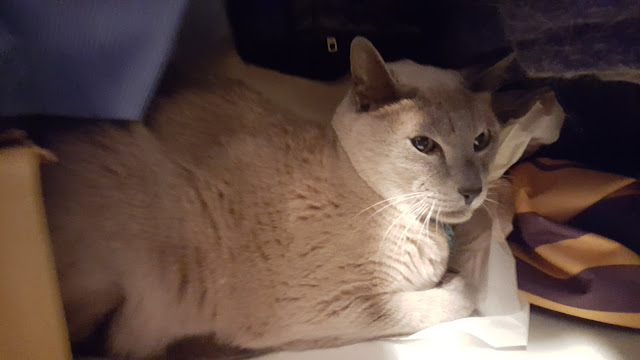
20160903_163858

This is Chester.  Did someone use the word ‘vet’ out loud?

It is odd how some animals can recognise some words and remember what activity is attached to it.

Chester knows the word vet, and his memory attaches a great deal of seemingly horrible experience, not the worst of which is being transported in a pet basket.

Yes, we have just tried carrying him, but there is a sixth sense in every cat that tells them when they’re nearing a vet.  Within 50 metres of the front door, the hair stands up, the cat starts hissing as he would face off against a formidable opponent.

We only carried him once, never again.

But the histrionics start in the house where we have to mound a search party to find hi,  There are innumerable hiding places, and we have to be organised.

Invariably, each time something like this happens, he finds somewhere new to hide.  We keep forgetting he can use his paws to open sliding doors, and close them again, a talent he had learned.

We’ve also learned to start looking a half-hour earlier than we used to.  The vet is only three minutes away, and we used to leave it to the last minute, but being late for the appointment happens only once.

Vets are worse than doctors when you miss appointments.  PErhaps Chester knows this and tries to use it to his advantage.  It no longer works.

Then, once we find him, the next exercise is to get him into the basket.  I’ve never seen so many tricks on how not to let the humans put him in it.

But, over time, we’ve learned, and sometimes it’s easy, others, I have the scars to prove it.

Then, once we get to the vet, it’ss a completely different cat, not Chester, but some other cat disguised as him.  Chester has never given the vet an ounce of trouble.

Perhaps we should become vets.

Chester is fine, just a little off-colour perhaps from something he ate.  Not all pet food is agreeable, and we’ve been trying to get his to have something different.  I even specially cook fish for him, and maybe that was the problem.

What is off-putting is the ease in which he goes back into the basket for the vet.

But all is well, and he will be glad to get out…

An excerpt from “Strangers We’ve Become” – Coming Soon

I wandered back to my villa.

It was in darkness.  I was sure I had left several lights on, especially over the door so I could see to unlock it.

I looked up and saw the globe was broken.

Instant alert.

I went to the first hiding spot for the gun, and it wasn’t there.  I went to the backup and it wasn’t there either.  Someone had found my carefully hidden stash of weapons and removed them.

Who?

There were four hiding spots and all were empty.  Someone had removed the weapons.  That could only mean one possibility.

I had a visitor, not necessarily here for a social call.

But, of course, being the well-trained agent I’d once been and not one to be caught unawares, I crossed over to my neighbor and relieved him of a weapon that, if found, would require a lot of explaining.

Suitably armed, it was time to return the surprise.

There were three entrances to the villa, the front door, the back door, and a rather strange escape hatch.  One of the more interesting attractions of the villa I’d rented was its heritage.  It was built in the late 1700s, by a man who was, by all accounts, a thief.  It had a hidden underground room which had been in the past a vault but was now a wine cellar, and it had an escape hatch by which the man could come and go undetected, particularly if there was a mob outside the door baying for his blood.

It now gave me the means to enter the villa without my visitors being alerted, unless, of course, they were near the vicinity of the doorway inside the villa, but that possibility was unlikely.  It was not where anyone could anticipate or expect a doorway to be.

The secret entrance was at the rear of the villa behind a large copse, two camouflaged wooden doors built into the ground.  I move aside some of the branches that covered them and lifted one side.  After I’d discovered the doors and rusty hinges, I’d oiled and cleaned them, and cleared the passageway of cobwebs and fallen rocks.  It had a mildew smell, but nothing would get rid of that.  I’d left torches at either end so I could see.

I closed the door after me, and went quietly down the steps, enveloped in darkness till I switched on the torch.  I traversed the short passage which turned ninety degrees about halfway to the door at the other end.  I carried the key to this door on the keyring, found it and opened the door.  It too had been oiled and swung open soundlessly.

I stepped in the darkness and closed the door.

I was on the lower level under the kitchen, now the wine cellar, the ‘door’ doubling as a set of shelves which had very little on them, less to fall and alert anyone in the villa.

Silence, an eerie silence.

I took the steps up to the kitchen, stopping when my head was level with the floor, checking to see if anyone was waiting.  There wasn’t.  It seemed to me to be an unlikely spot for an ambush.

I’d already considered the possibility of someone coming after me, especially because it had been Bespalov I’d killed, and I was sure he had friends, all equally as mad as he was.  Equally, I’d also considered it nigh on impossible for anyone to find out it was me who killed him because the only people who knew that were Prendergast, Alisha, a few others in the Department, and Susan.

That raised the question of who told them where I was.

If I was the man I used to be, my first suspect would be Susan.  The departure this morning, and now this was too coincidental.  But I was not that man.

Or was I?

I reached the start of the passageway that led from the kitchen to the front door and peered into the semi-darkness.  My eyes had got used to the dark, and it was no longer an inky void.  Fragments of light leaked in around the door from outside and through the edge of the window curtains where they didn’t fit properly.  A bone of contention upstairs in the morning, when first light shone and invariably woke me up hours before I wanted to.

Still nothing.

I took a moment to consider how I would approach the visitor’s job.  I would get a plan of the villa in my head, all entrances, where a target could be led to or attacked where there would be no escape.

Coming in the front door.  If I was not expecting anything, I’d just open the door and walk-in.  One shot would be all that was required.

Contract complete.

I sidled quietly up the passage staying close to the wall, edging closer to the front door.  There was an alcove where the shooter could be waiting.  It was an ideal spot to wait.

Crunch.

I stepped on some nutshells.

Not my nutshells.

I felt it before I heard it.  The bullet with my name on it.

And how the shooter missed, from point-blank range, and hit me in the arm, I had no idea.  I fired off two shots before a second shot from the shooter went wide and hit the door with a loud thwack.

I saw a red dot wavering as it honed in on me and I fell to the floor, stretching out, looking up where the origin of the light was coming and pulled the trigger three times, evenly spaced, and a second later I heard the sound of a body falling down the stairs and stopping at the bottom, not very far from me.

Two assassins.

I’d not expected that.

The assassin by the door was dead, a lucky shot on my part.  The second was still breathing.

I checked the body for any weapons and found a second gun and two knives.  Armed to the teeth!

I pulled off the balaclava; a man, early thirties, definitely Italian.  I was expecting a Russian.

I slapped his face, waking him up.  Blood was leaking from several slashes on his face when his head had hit the stairs on the way down.  The awkward angle of his arms and legs told me there were broken bones, probably a lot worse internally.  He was not long for this earth.

“Who employed you?”

He looked at me with dead eyes, a pursed mouth, perhaps a smile.  “Not today my friend.  You have made a very bad enemy.”  He coughed and blood poured out of his mouth.  “There will be more …”

Friends of Bespalov, no doubt.

I would have to leave.  Two unexplainable bodies, I’d have a hard time explaining my way out of this mess.  I dragged the two bodies into the lounge, clearing the passageway just in case someone had heard anything.

Just in case anyone was outside at the time, I sat in the dark, at the foot of the stairs, and tried to breathe normally.  I was trying not to connect dots that led back to Susan, but the coincidence was worrying me.


A half-hour passed and I hadn’t moved.  Deep in thought, I’d forgotten about being shot, unaware that blood was running down my arm and dripping onto the floor.

Until I heard a knock on my front door.

Two thoughts, it was either the police, alerted by the neighbors, or it was the second wave, though why would they be knocking on the door?

I stood, and immediately felt a stabbing pain in my arm.  I took out a handkerchief and turned it into a makeshift tourniquet, then wrapped a kitchen towel around the wound.

If it was the police, this was going to be a difficult situation.  Holding the gun behind my back, I opened the door a fraction and looked out.

No police, just Maria.  I hoped she was not part of the next ‘wave’.

“You left your phone behind on the table.  I thought you might be looking for it.”  She held it out in front of her.

When I didn’t open the door any further, she looked at me quizzically, and then asked, “Is anything wrong?”

I was going to thank her for returning the phone, but I heard her breathe in sharply, and add, breathlessly, “You’re bleeding.”

I looked at my arm and realized it was visible through the door, and not only that, the towel was soaked in blood.

“You need to go away now.”

Should I tell her the truth?  It was probably too late, and if she was any sort of law-abiding citizen she would go straight to the police.

She showed no signs of leaving, just an unnerving curiosity.  “What happened?”

I ran through several explanations, but none seemed plausible.  I went with the truth.  “My past caught up with me.”

“You need someone to fix that before you pass out from blood loss.  It doesn’t look good.”

“I can fix it.  You need to leave.  It is not safe to be here with me.”

The pain in my arm was not getting any better, and the blood was starting to run down my arm again as the tourniquet loosened.  She was right, I needed it fixed sooner rather than later.

I opened the door and let her in.  It was a mistake, a huge mistake, and I would have to deal with the consequences.  Once inside, she turned on the light and saw the pool of blood just inside the door and the trail leading to the lounge.  She followed the trail and turned into the lounge, turned on the light, and no doubt saw the two dead men.

I expected her to scream.  She didn’t.

She gave me a good hard look, perhaps trying to see if I was dangerous.  Killing people wasn’t something you looked the other way about.  She would have to go to the police.

“What happened here?”

“I came home from the cafe and two men were waiting for me.  I used to work for the Government, but no longer.  I suspect these men were here to repay a debt.  I was lucky.”

“Not so much, looking at your arm.”

She came closer and inspected it.

“Sit down.”

She found another towel and wrapped it around the wound, retightening the tourniquet to stem the bleeding.

“Do you have medical supplies?”

I nodded.  “Upstairs.”  I had a medical kit, and on the road, I usually made my own running repairs.  Another old habit I hadn’t quite shaken off yet.

She went upstairs, rummaged, and then came back.  I wondered briefly what she would think of the unmade bed though I was not sure why it might interest her.

She helped me remove my shirt, and then cleaned the wound.  Fortunately, she didn’t have to remove a bullet.  It was a clean wound but it would require stitches.

When she’d finished she said, “Your friend said one day this might happen.”

No prizes for guessing who that friend was, and it didn’t please me that she had involved Maria.

“Alisha?”

“She didn’t tell me her name, but I think she cares a lot about you.  She said trouble has a way of finding you, gave me a phone and said to call her if something like this happened.”

“That was wrong of her to do that.”

“Perhaps, perhaps not.  Will you call her?”

“Yes.  I can’t stay here now.  You should go now.  Hopefully, by the time I leave in the morning, no one will ever know what happened here, especially you.”

She smiled.  “As you say, I was never here.”


© Charles Heath 2018-2020
Searching for locations: The Longjing Pearl Factory, Beijing, China

The Longjing Pearl Factory is located at:
No.2 Zuoan Gate Inner Street, ChongWen District, Beijing 100061 China.

This Pearl Center specializes in both freshwater and seawater pearls, with a reputation backed by the government of China, with a big selection and of the highest quality.  There were all kinds of jewelry made of pearls in different colors, shapes, and sizes.

They also had, as an interesting sideline, famous Chinese traditional cosmetics such as pearl cream and pearl powder, reputed to make your skin smoother, tenderer, and most importantly, younger.

We were advised of all of this well before we arrived at the factory, and of course, one suspected the glowing review, with emphasis on the fact it was a government operation and therefore trustworthy, suggested we should buy, meant the tour guide would receive a commission on each sale.

This is nothing new, it’s the same the world over, so it’s up to the visitor to buy or not to buy.

As soon as you get in the door you are taken to the group’s guide for the tour (and afterward, available for help on making purchases). who gives you a rundown on the different types and colors of pearls.  This briefly is,

Pearls come in two main categories: freshwater cultured pearls and saltwater cultured pearls. Various types of pearls are the result of the environment in which they live, and different cultivation techniques used by the pearl farmers. 

Freshwater cultured pearls are grown in lakes and rivers, whereas saltwater cultured pearls are grown in bodies of saltwater such as bays.  The most commonly used pearls are Freshwater pearls. 

Freshwater Pearls come in various pastel shades of white, pink, peach, lavender, plum, purple, and tangerine.  
South Sea cultured pearls come in shades of lustrous white, often with silver or rose overtones. 

Black pearls are known as Tahitian pearls and come most often in shades of black and gray. While a Tahitian pearl has a black body color, it will vary in its overtones, which most often will be green or pink.

Then there’s a demonstration, where one of the tour group is selected to pick an oyster out of the tank, and then there’s the guessing game as to how many pearls are in the shell, with the winner getting a pearl.

Guesses ranged from 1 to 23 and the answer was 26.  Nearest wins, and one for the person who picked the oyster out of the tank.  After this demonstration, we move on to the ways we can tell the difference between real and fake pearls.

It seems strange that they would, but we were guaranteed by both the tour guide and the lady delivering the lecture that the pearls we were about to buy were real, so how could we suspect there was anything dodgy about them?  Besides, now we could tell real from fake!

We then move onto the showroom floor where there are casements of pearl products, in the form of necklaces, earrings, and any number of variations and uses.  And, just to let you know, the prices are very, very expensive, even if they say they have a special.

Perhaps the best products, and those that found favor with many of the women on the tour, was the pearl cremes and powders.  These were not expensive, and, as we discovered later, actually worked as described.

Skeletons in the closet, and doppelgangers

A story called “Mistaken Identity”

How many of us have skeletons in the closet that we know nothing about? The skeletons we know about generally stay there, but those we do not, well, they have a habit of coming out of left field when we least expect it.

In this case, when you see your photo on a TV screen with the accompanying text that says you are wanted by every law enforcement agency in Europe, you’re in a state of shock, only to be compounded by those same police, armed and menacing, kicking the door down.

I’d been thinking about this premise for a while after I discovered my mother had a boyfriend before she married my father, a boyfriend who was, by all accounts, the man who was the love of her life.

Then, in terms of coming up with an idea for a story, what if she had a child by him that we didn’t know about, which might mean I had a half brother or sister I knew nothing about. It’s not an uncommon occurrence from what I’ve been researching.

There are many ways of putting a spin on this story.

Then, in the back of my mind, I remembered a story an acquaintance at work was once telling us over morning tea, that a friend of a friend had a mother who had a twin sister and that each of the sisters had a son by the same father, without each knowing of the father’s actions, both growing up without the other having any knowledge of their half brother, only to meet by accident on the other side of the world.

It was an encounter that in the scheme of things might never have happened, and each would have remained oblivious of the other.

For one sister, the relationship was over before she discovered she was pregnant, and therefore had not told the man he was a father. It was no surprise the relationship foundered when she discovered he was also having a relationship with her sister, a discovery that caused her to cut all ties with both of them and never speak to either from that day.

It’s a story with more twists and turns than a country lane!

And a great idea for a story.

That story is called ‘Mistaken Identity’.

Read an extract tomorrow.

An unfortunate side-effect of a pandemic

As writers, we put ourselves in the shoes of many different people.

We have extraordinary lives, sometimes more than one, but never more than the regulatory nine.

We get shot at, manage to run into cars and miraculously bounce off with only a few scratches, fall off three-story balconies, and sometimes get in the way of stray, and almost perfectly aimed bullets.

Near-death, almost dead, mostly dead, but always, somehow, we come back to life.

But, in reality, this rarely happens.  You get shot; you often die.  You get hit by a car, or, worse, a bus, you quite often die.

You certainly do not get back up again, leap out of hospital beds, and chase after bad guys.

So, what does any or all of these things feel like in reality?

In my case, I have no idea, other than what I have read, and what I’ve been told by experts it might be like.

But what if…

…you are facing what might be certain death?

It’s not a realistic statement, is it?  You can’t possibly know when and how you’re going to die.

So, let’s factor in a possibility, and let’s call it Covid-19.

What do we know about it?  It is a killer if you have respiratory problems, heart problems, in fact, any sort of problem with organs, and, if you have a weakened immune system.

And, it is far more dangerous if you have any of these conditions and are over the age of 60.

I’m 68.

I have psoriatic arthritis and use methotrexate which is an immunosuppressive medicine

It means, in not so many words, I have a compromised immune system.  That’s the doctor’s polite way of saying I’m in deep trouble if I get Covid-19.

So…

I now have to face what is most like man’s worst fear: death.

I fit into a category where I have a 40% chance of survival.

There is no cure, there are vaccines but they might also kill me even though the odds are very slim, so really it is simply a matter of the body fighting off the virus itself, and, more or less, wait and see.

To say I’m scared of what might happen is an understatement.

In this country, up till now, we have managed to avoid a disaster, but with the new variant, everyone is all but saying that in a short time that will change … for the worse.

I hope not.

I do not want to have a first-hand experience of what it like to die.

An excerpt from “If Only” – a work in progress

Investigation of crimes don’t always go according to plan, nor does the perpetrator get either found or punished.

That was particularly true in my case.  The murderer was very careful in not leaving any evidence behind, to the extent that the police could not rules out whether it was a male or a  female.

At one stage the police thought I had murdered my own wife though how I could be on a train at the time of the murder was beyond me.  I had witnesses and a cast-iron alibi.

The officer in charge was Detective Inspector Gabrielle Walters.  She came to me on the day after the murder seeking answers to the usual questions when was the last time you saw your wife, did you argue, the neighbors reckon there were heated discussions the day before.

Routine was the word she used.

Her Sargeant was a surly piece of work whose intention was to get answers or, more likely, a confession by any or all means possible.  I could sense the raging violence within him.  Fortunately, common sense prevailed.

Over the course of the next few weeks, once I’d been cleared of committing the crime, Gabrielle made a point of keeping me informed of the progress.

After three months the updates were more sporadic, and when, for lack of progress, it became a cold case, communication ceased.

But it was not the last I saw of Gabrielle.

The shock of finding Vanessa was more devastating than the fact she was now gone, and those images lived on in the same nightmare that came to visit me every night when I closed my eyes.

For months I was barely functioning, to the extent I had all but lost my job, and quite a few friends, particularly those who were more attached to Vanessa rather than me.

They didn’t understand how it could affect me so much, and since it had not happened to them, my tart replies of ‘you wouldn’t understand’ were met with equally short retorts.  Some questioned my sanity, even, for a time, so did I.

No one, it seemed, could understand what it was like, no one except Gabrielle.

She was by her own admission, damaged goods, having been the victim of a similar incident, a boyfriend who turned out to be a very bad boy.  Her story varied only in she had been made to witness his execution.  Her nightmare, in reliving that moment in time, was how she was still alive and, to this day, had no idea why she’d been spared.

It was a story she told me one night, some months after the investigation had been scaled down.  I was still looking for the bottom of a bottle and an emotional mess.  Perhaps it struck a resonance with her; she’d been there and managed to come out the other side.

What happened become our secret, a once-only night together that meant a great deal to me, and by mutual agreement, it was not spoken of again.  It was as if she knew exactly what was required to set me on the path to recovery.

And it had.

Since then we saw each about once a month in a cafe.   I had been surprised to hear from her again shortly after that eventful night when she called to set it up, ostensibly for her to provide me with any updates on the case, but perhaps we had, after that unspoken night, formed a closer bond than either of us wanted to admit.

We generally talked for hours over wine, then dinner and coffee.  It took a while for me to realize that all she had was her work, personal relationships were nigh on impossible in a job that left little or no spare time for anything else.

She’d always said that if I had any questions or problems about the case, or if there was anything that might come to me that might be relevant, even after all this time, all I had to do was call her.

I wondered if this text message was in that category.  I was certain it would interest the police and I had no doubt they could trace the message’s origin, but there was that tiny degree of doubt, whether or not I could trust her to tell me what the message meant.

I reached for the phone then put it back down again.  I’d think about it and decide tomorrow.

© Charles Heath 2018-2021

Was it just another surveillance job – Episode 47

I’m back home and this story has been sitting on the back burner for a few months, waiting for some more to be written.

The trouble is, there are also other stories to write, and I’m not very good at prioritizing.

But, here we are, a few minutes opened up and it didn’t take long to get back into the groove.

Chasing leads, maybe


When the room was empty and only Richards and I remained, he cut the ties that bound my hands and legs.

“Bad business,” he said.

I sat again, and flexed the muscles that had begun to stiffen up whilst tightly bound.

“I’m assuming you know a woman by the name of Jan?” I said. “She told me she was working for MI6 so I’m assuming you’re her handler.”

“When she chooses to be handled, yes.  Jan is just one of her names.  She’s currently missing, and I think we now know why?”

“Her work,” I nodded towards the body.

“God no.  She’s charged with chasing down leads and then calling the cavalry.  We had a tracker on this chap, found him, and had him in a safe facility awaiting interrogation, what we thought was safe at any rate, and Jan and another agent watching over him until the interrogation team arrived.  When the interrogation team got there everyone was gone, but with enough blood on the floor to paint a pretty clear picture.  Maury had been interrogated and killed there, dumped here, with no indication of the whereabouts of our agents.  She told me this guy and another trained you, and others, in rather strange circumstances.  A bogus operation. To what end?”

“From what I could tell, a single surveillance operation.  Me and a dozen others.  Cut loose after it failed, those of us that survived, that is.”

“A lot of effort to achieve nothing.”

“Pity we can’t ask him what it was about?”  I looked over at the body.  Maury was hardly recognizable.  Whoever carried out the interrogation had been either in a hurry or in a bad mood.

“Indeed.  She told me this chap called O’Connell was involved.  Now so?”

Another rule that popped into my head from the training: never share information with other agencies unless you absolutely had to.  I had no doubt if Dobbin was here\, he would agree, but he wasn’t.

I wondered if I should tell him she had allegiance to another branch of the secret services, or mention Dobbin.

“He was the surveillance target.  We were charged with observing him, but not what he was suspected of.  I followed him as far as the exploding shop, got temporarily disorientated after the blast,, but managed to reacquire the target, following him to an alley where I spoke briefly to him before Maury and Severin arrived, and he was shot, apparently killed.”

“Either he was or he wasn’t.”

“The body disappeared.  My view is he is still alive, somewhere.”

“That explosion was supposed to be caused by a gas leak.”

“Standard operational doubletalk.  A journalist was killed, apparently in the shop waiting for the target.  It went up after the target passed, I’m assuming his tradecraft was to check first then go back.  Never got a chance.  I think now given the circumstances, the journalist was going to hand something off.  I’ve been asked a number of times by various people about a USB drive.  You know anything about it?”

“This is the first I’m hearing about anything about a USB drive.  You know what was on it?”

“Above my pay grade, I was told.”

“OK.  What about this Severin character?:

“All I have is a phone number, and that, I think we can both agree, will be a burner.”

“Agreed, but it might be useful.”

I gave it to him and he put it on his phone.

A new team of men in white suits arrived at the door, no doubt MI5 forensic specialists, and two more agents, bigger and tougher, what I would call the muscle.

“I’m afraid you’re going to have to come back to the office to answer a few more questions.  It’s not custody, but mandatory co-operation.”

“And if I refuse?”

“It might make their day if you know what I mean.”

I shrugged.  One I might be able to take, but not the both of them.  And they both looked like they would be happy to teach me the error of my ways if I tried to escape/

“That won’t be necessary.  I’m taking him with me.”

“Dobbin just came to the door, flashing an MI6 warrant card.

“I’ve been charged with cleaning this mess up.”

“And so you shall, but not including this agent.  Orders from above, reasons why, as they say, are above your pay grade.

I suspect the warrant card said Dobbin outranked him.  Did our people have fake MI6 IDs?

“This is highly irregular.”

“Call your boss, if you don’t like it.  I can wait.”

I could see the reluctance in his face.

He glared at me.  “Go, but don’t go too far.  I still might get clearance to have another chat.”

© Charles Heath 2020-2022

The story behind the story – Echoes from the Past

The novel ‘Echoes from the past’ started out as a short story I wrote about 30 years ago, titled ‘The birthday’.

My idea was to take a normal person out of their comfort zone and led on a short but very frightening journey to a place where a surprise birthday party had been arranged.

Thus the very large man with a scar and a red tie was created.

So was the friend with the limousine who worked as a pilot.

So were the two women, Wendy and Angelina, who were Flight Attendants that the pilot friend asked to join the conspiracy.

I was going to rework the short story, then about ten pages long, into something a little more.

And like all re-writes, especially those I have anything to do with, it turned into a novel.

There was motivation.  I had told some colleagues at the place where I worked at the time that I liked writing, and they wanted a sample.  I was going to give them the re-worked short story.  Instead, I gave them ‘Echoes from the past’

Originally it was not set anywhere in particular.

But when considering a location, I had, at the time, recently been to New York in December, and visited Brooklyn and Queens, as well as a lot of New York itself.  We were there for New Years, and it was an experience I’ll never forget.

One evening we were out late, and finished up in Brooklyn Heights, near the waterfront, and there was rain and snow, it was cold and wet, and there were apartment buildings shimmering in the street light, and I thought, this is the place where my main character will live.

It had a very spooky atmosphere, the sort where ghosts would not be unexpected.  I felt more than one shiver go up and down my spine in the few minutes I was there.

I had taken notes, as I always do, of everywhere we went so I had a ready supply of locations I could use, changing the names in some cases.

Fifth Avenue near the Rockefeller center is amazing at first light, and late at night with the Seasonal decorations and lights.

The original main character was a shy and man of few friends, hence not expecting the surprise party.  I enhanced that shyness into purposely lonely because of an issue from his past that leaves him always looking over his shoulder and ready to move on at the slightest hint of trouble.  No friends, no relationships, just a very low profile.

Then I thought, what if he breaks the cardinal rule, and begins a relationship?

But it is also as much an exploration of a damaged soul, as it is the search for a normal life, without having any idea what normal was, and how the understanding of one person can sometimes make all the difference in what we may think or feel.

And, of course, I wanted a happy ending.

Except for the bad guys.


Get it here:  https://amzn.to/2CYKxu4

newechocover5rs


In a word: Leg

Aside from the fact it is one of those necessary items to walk with, and the fact we can have two or four for most humans and animals, there are a few other uses for the word ‘leg’.

Like…

‘You haven’t got a leg to stand on’, doesn’t necessarily mean you have no legs, but that you are in a precarious position.

“the table had ornate legs’, yes, even non-living objects can have legs, like tables and chairs.

“It was the fifth leg of the race’, meaning it can be a stage of a race.

“He was legless’, meaning that he was too drunk to stand up.  Some might think being legless is a badge of honour, but I suspect those people have been drinking a long time and the alcohol has destroyed most of their brain cells.

“leg it!’, meaning get the hell out of here before you’re caught.

Then, finally, ‘he’s on his last legs’, meaning that he’s exhausted, or about to die.

I’m sure there’s more but that’ll do for now.

I have to use my legs to get some exercise, of which the first leg is to the tripod to check if its legs are stable, and the second leg is to come back to the table and replace one of the legs which is broken.  Then I’ll leg it to the pub where hopefully I won’t become legless.

Hmm…

The cinema of my dreams – Was it just another surveillance job – Episode 30

I’m back home and this story has been sitting on a back burner for a few months, waiting for some more to be written.

The trouble is, there are also other stories to write, and I’m not very good at prioritizing.

But, here we are, a few minutes opened up and it didn’t take long to get back into the groove.

Chasing leads, maybe


Collecting the car was easy because it was not kept near my flat.  I could not afford to park nearby, and couldn’t get a permit to park on the street.  I had cursed my bad luck at the time, but now it was very useful.

I spend a few hours resting in the car, stopping along the way at a park, and then, well past nightfall, I drove to the block in Oakwood Avenue, easily recognizable from the exterior photo also provided by the realtor.

Twice around the block, I stopped around the corner, past the block, and noted that I could walk back and then take cover from the trees and shrubs growing in front of, and around the building.  To reach the right flat, I would have to pass down the inner side towards the rear where, hopefully, there might be a door.

Otherwise, it would have to be the hard way.

At 00:45, I left the car, and walked back to the block, keeping an eye out form people walking, or looking out their windows on either side of the street.  Then, satisfied I hadn’t been seen, I ducked through the trees and quickly walked the distance from the front to the side where I stopped and waited.  After a few minutes, and nothing had stirred, I started down the side of the building.

Several flats had lights on, but the curtains were drawn.  Being the ground floor, I doubted whether those curtains would be open at night.  It didn’t take long to be alongside the flat in question.

It was in total darkness, and the curtains had been drawn.

First problem.  There was no back door.  The traditional entry point would be the front door, and no doubt there was a communal back door as well.  Next, I checked the windows, and those that I could see were complete glass and non-opening.  Worse still they had a metal grilled across them to deter thieves.

Near the corner, leading to the rear of the building was a window, higher up and ajar.  By its location, I guessed this was the bathroom or the toilet.  I was hoping for the former.

It took a few minutes to unlatch the window and several more to scramble up the wall, and it through the window opening, which wasn’t much wider than me.  I had to be careful not to drop any of the bottles on the inner ledge.

Once down of the other side, inside the room, it was a narrow bathroom, without a bath, and almost impossible to see.  I fixed the window and put everything back on the ledge, just in case someone did a circuit of the building at a security measure.

Once inside, and after one in the morning, little stirred.

I could just faintly hear the flat owners above, hardly enough noise to be concerned about, and bringing a thought; shouldn’t they be asleep like everyone else.

It was certainly a quiet neighborhood.

I brought a small torch from the car with me and sparingly used it to find my way around.  When my eyes got used to the semi-darkness, I found that the flow from small lights of appliances adequately lit the rooms.

It had two bedrooms, one empty and being used as a storeroom, a lounge room, a dining area, and the bathroom, and kitchen area.  It was big enough for a couple, or even a couple with one child.

Inside what I assumed was the front door, I found several letters shoved under the door.  They were addressed to Mr. Adam Quinley.

I hoped that I’d not made a mistake and broken into a flat belonging to another person.  O’Connell didn’t see to me to be a Quinley, because it was an unusual name.

The dates on the letters went back a week and told me whoever the flat belonged to, they hadn’t visited it for a while.  I went back to the lounge room and over to a desk.  There were the familiar cords leading to no computer, but there was a printer.  It meant he had a laptop he carried with him.

A laptop that no one had found.  It suggested to me that he had it somewhere near him, perhaps in a car, which may be still parked in a garage, or parking station somewhere.

I searched through the neat pile of documents on the desk, and in a folder marked ‘Accounts’ and found one for the car registration, in the name of Quigley.  I noted the registration and type of car, and just in case I forgot it, folded the piece of paper and put it in my pocket.  It would be the subject of my next search if nothing showed up.

The next half hour I made a thorough search of the flat and found nothing of use.  I checked for all the spots he might have hidden the USB, but it was not there.  He had kept it somewhere else.

Done, I left the flat by the front door, and for good measure, checked his mailbox, outside, and found a number of letters.  I took them and would look at them back in the car.  Just as I made the tree line to walk back, a car stopped outside the building.

The door opened and I watched the driver get out of the car, stop and look up and down the street, then walk towards the front door,

By chance, the occupant of the flat above the door switched on a light in the room which, uncurtained, spilled out to shed light on the person now at the front entrance.

I recognized her immediately, just before the light was switched off and darkness took over.

It was Jan.


© Charles Heath 2020