The cinema of my dreams – It’s a treasure hunt – Episode 20

Here’s the thing…

Every time I close my eyes, I see something different.

I’d like to think the cinema of my dreams is playing a double feature but it’s a bit like a comedy cartoon night on Fox.

But these dreams are nothing to laugh about.

Once again there’s a new instalment of an old feature, and we’re back on the treasure hunt.


As we all stood either on or off the boat, two things were clear to me.  The first, Rico’s genuine surprise at finding the body on his boat, and the second, how quickly the authorities had circled in for the kill.

I know calling 911 was supposed to get a rapid response to dire situations, but to get from the police station to the pier would take at least five minutes longer than it had, and that was breaking all the speed limits.

I might be jumping to conclusions, but someone wanted Rico to be found with an unexplainable body.  His recently departed friend’s maybe?

Johnson waited until the officer off the boat had finished his call, and asked, “What are we doing here?”

It was now obvious the men on the boat was either state police, the coast guard, or some Federal branch-like FBI or, if Rico was suspected of dealing or trafficking drugs, the DEA.

“Take him into custody.  Some of our people will be along to sit in on the questioning.  This is an FBI crime scene and we’ll take it from here.”

“These two?”  Johnson nodded in our direction.

“They’ve just found themselves in the wrong place at the wrong time.  Cut them loose, they have nothing to do with this, other than to contaminate our crime scene.”

And that was it, more men, this time in white overalls, came up from below the deck of the newly arrived boat and came over.  Crime scene investigators.

Johnson grabbed both of us by the scruff of the neck and shoved us in the direction of the shore.  “Get out of here before I find something to charge you with.”

Neither of us waited to be told a second time.  We were lucky, very lucky.

And Johnson was not happy his investigation had been pulled from under him.  He needed a case like this to enhance his prospects for the upcoming election for the new Sherriff.

On dry land again I stopped and turned to look back at the boat, and Rico, now handcuffed and guarded.

In the background something else caught my attention, slowly cruising past the unfolding scene aboard Rico’s boat.  A large ocean-going yacht, one that was owned by the Benderby’s.  With Alex standing at the back of the bridge looking at Rico’s boat, and two others at the stern, dressed in what looked like diving suits, putting equipment away.

Even from this far away I could see the smug expression on his face.

No prizes then, for guessing how the police got an early warning.

Equally so for guessing who it was most likely to dump a body on a boat and have someone else take the rap for it.  I had no doubt that a quantity of drugs would be found in some hidey-hole on Rico’s boat where he usually stashed the drugs he picked up from out in the sea lanes.  A win-win, for law enforcement on many levels, and Benderby.

The question then I needed an answer to was, who was the dead man, and what was his relationship with the Benderby’s.  I think I was now certain Rico had no idea who the man was, or why he was found on his boat, dead.


© Charles Heath 2019

The cinema of my dreams – It’s a treasure hunt – Episode 21

Here’s the thing…

Every time I close my eyes, I see something different.

I’d like to think the cinema of my dreams is playing a double feature but it’s a bit like a comedy cartoon night on Fox.

But these dreams are nothing to laugh about.

Once again there’s a new instalment of an old feature, and we’re back on the treasure hunt.


“Why are we still here,” Boggs asked.

A small crowd had gathered to watch the police, some vocal about them finally doing what they should have some time ago.  Very few people liked Rico and rumours were rife about his alleged participation in trafficking drugs.

The fact the current Sherriff hadn’t arrested him before now was said to be because he was corrupt, but nobody would say so out loud.  I felt sorry for the Sherriff because my mother said he had made it quite clear he was not working for anyone but the city that employed him, and that no one was above the law.

But I’d only heard one person question why he was not here, using the event as part of his campaign for re-election.

“Curiosity,” I said.

“About what.  I thought the situation explained itself.  Rico’s finally been caught red-handed.”

“I’m not so sure/it was him.  Were you watching the boat the whole time when you were waiting for me?”

“What do you mean?”

“If you were, you would have seen him on the boat, join the others and leave.  Did it look like they were killing a man below deck?”

How the hell should I know?  As you said, it was below deck.”

“But the boat would have been moving, well, the mast really.”

“With the wash coming towards it from the fools who drive their boats too fast.  Good luck with that.  Do you want Rico to get off, and then come terrorize us.  That’s what’s going to happen if they let him go.”

“I don’t think so.”

Despite his protestations, Boggs was as interested in what was unfolding as I was.  Only I suspect he wanted to see Rico locked up, if possible, forever.  Quite a few people would, and none more than the Benderby’s.

Boggs might not realise it, but his quest for the treasure was at the heart of this.  Had Rico tried to double-cross the Benderby’s?  He was trying to get Nadia to steal the map from Rico, and perhaps Rico had discovered Benderby was trying to cut him out of the deal.

Had Rico threatened them, and was this how they rep[aid disloyalty?

Or was it my original thought, that the Benderby’s were looking for an easy target?

“I’m going.  Coming?”  Boggs had lost interest.

“No.  Not yet.  I want to see what Alex is going to do.”

“Alex Benderby?  What’s he doing here?”

“He just conveniently arrived on his father’s boat, which means he wasn’t very far away.”

“Of course not.  They’ve been having engine troubles for the last month.  They were probably out testing the repairs.”

“How do you know that?”

“Rico.  He thinks it’s hilarious they spent so much money on that boat and haven’t got a full day of sailing out of it.  More money than sense, that lot.”

I looked in the direction of Alex’s boat and he was coming ashore.  So were the divers, now out of their suits and dressed casually, and for the sake of looking normal, with three women, one of whom looked like Nadia.

“Anyway, I’ve decided,” he said, “we’re doing this treasure hunt on our own.  I don’t trust anyone but you.  It was a mistake thinking Alex would help.  Call me tomorrow when you’re free.  We have to start planning.”

“OK.”

I didn’t see him leave.  I was too busy watching the group with Alex.  It was Nadia, and she was looking very cosy next to him.


© Charles Heath 2019

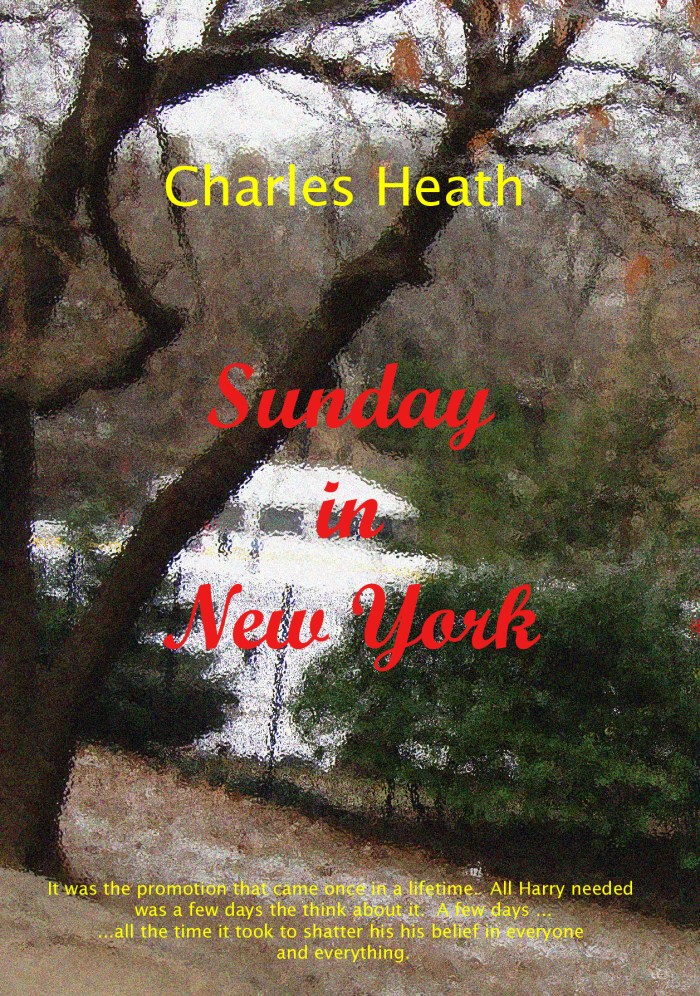
“Sunday in New York”, a romantic adventure that’s not a walk in the park!

“Sunday in New York” is ultimately a story about trust, and what happens when a marriage is stretched to its limits.

When Harry Steele attends a lunch with his manager, Barclay, to discuss a promotion that any junior executive would accept in a heartbeat, it is the fact his wife, Alison, who previously professed her reservations about Barclay, also agreed to attend, that casts a small element of doubt in his mind.

From that moment, his life, in the company, in deciding what to do, his marriage, his very life, spirals out of control.

There is no one big factor that can prove Harry’s worst fears, that his marriage is over, just a number of small, interconnecting events, when piled on top of each other, points to a cataclysmic end to everything he had believed in.

Trust is lost firstly in his best friend and mentor, Andy, who only hints of impending disaster, Sasha, a woman whom he saved, and who appears to have motives of her own, and then in his wife, Alison, as he discovered piece by piece damning evidence she is about to leave him for another man.

Can we trust what we see with our eyes or trust what we hear?

Haven’t we all jumped to conclusions at least once in our lives?

Can Alison, a woman whose self-belief and confidence is about to be put to the ultimate test, find a way of proving their relationship is as strong as it has ever been?

As they say in the classics, read on!

Purchase:

http://tinyurl.com/Amazon-SundayInNewYork

In a word: Choice

We are often told that it’s the choices we make that shape our lives.

It’s true.

What distinguishes the basis of those choices is the circumstances of the individual.

What a lot of people don’t realize is the diversity of backgrounds of everyone, and that in a minority of cases, the few that really have no choices at all.

Yes, there are those who have no control over their circumstances, and therefore no choice whatsoever.

Inevitably, the people who are first to criticize those who apparently made the wrong choice, are those that have never found themselves in similar circumstances.

And probably never will.

This perhaps is the biggest problem with governments who are staffed with advisors who do not understand the plight of the common man.

I never had the same opportunities as those who could afford a university education.  My family were working class and were relatively poor.  Had I not hot a scholarship who knows what sort of education I would have got, if any.

Certainly, my father never got an opportunity to get a good education, but, at the time, during the great depression, his choices were limited, whereas those with any sort of wealth it was a different story.

And his lack of choices reflected on us, and that lack of opportunity haunted all of us as time passed.

It was always a case of the haves and the have not’s.

Yes, we all have choices, but sometimes it really is the lesser of two evils, and not whether we will have the fillet or the rib eye steak.

Motive, means, and opportunity – Motive

I’m working on a novella which may boringly be called “Motive, Means and Opportunity” where I will present a chunk of information from which you if you want to, can become the armchair detective.

Here’s the first part, the so-called Motive


So, here’s the thing…

I said it.  Not once, in the heat of the moment, but more than once, to several different people.  I wanted James Burgman dead.

Why?

Because I knew he was the man sleeping with my wife, Wendy.

I’d long suspected she was having an affair, you know the signs, not where you expect her to be, making excuses where none were necessary if she was doing what she said she was, and disappearing for hours without an explanation.

And I knew James Burgman was an old boyfriend, a discovery that was made quite by accident.  In fact, I followed her one night, not because I was suspicious, but worried for her safety.

That was where I saw her meet him with more than just a friendly handshake.

I had to say it made me feel gutted.

But would I kill him?

It was not worth the problems it would cause me to do so, and, when push came to shove, neither of them were worth it.  I knew, even if he was out of the way, she would not stay with me. 

That train had left the station about a year ago when our only son had been killed in a senseless road accident.


© Charles Heath 2019-2020

I always wanted to see the planets – Episode 10

Now, that was unexpected…

Like everyone who was in that artificially silent environment that was the flight deck of a shuttle, unexpected sounds caused unexpected results.

The Engineer cursed.

The Pilot, Myrtle, hesitated for a moment, as if not quite sure what to do, highlighting the fact she had not been in such a situation before, but quickly recovered, and brought up the incoming object on screen.

Note to self: amend the training program to allow for random objects to come out of nowhere.

We all looked at the object. Myrtle should have been taking us into the freighter, but had got overawed by the not easily identifiable ship approaching.

“Our ship will take care of the problem,” I said. “Take us into the freighter.”

As if surprised that she should be asked to do so, she realised it was not her job to be staring at the screen, and muttered, “Oh, yes,” before resuming our passage.

Another note to self: Proper command structures and language should be used at all times.

A minute or so later we were in the cargo bay and the cargo doors were closing. Once closed and the atmosphere adjusted, the deck would become a hive of activity.

There was still a static picture of the craft on the screen, and it was one I’d seen before, an old vessel that dated back over a hundred years. I’d seen it in a space museum on the moon.

I was tempted to ask the Captain what was happening, but knew that to interrupt would not be worth the reprimand.

The engineer had seen one before too. “You don’t see those craft very often, if at all. Or this far out in space. They only had a limited trave distance, didn’t they?”

“Unless someone had been tinkering.” Several had been built as exploration ships, but the majority were freighters, used to build the outer colonies on the nearest planets.

A new drive would enable it to travel to the outer rim of our galaxy, but not much further if there were no readily available fuel supplies. Those that were available were tightly regulated by space command.

Cargo doors closed, deck pressurised, suddenly the whole deck was alive with people and machinery, our people meeting with the freighter crew and arranging for the cargo for Venus to be loaded. Myrtle was to stay with the shuttle, monitoring the loading.

I went down the ramp and was greeted by the first officer of the freighter, a chap I’d once served with, Jacko Miles. Jacko loved being in space, but no longer interested in the machinations of Space Command. The simple life of a freighter first officer was all he desired.

Except his face, right now, had the visual lines of worry.

“What happened?” We were past the usual introductions, and general bonhomie.

“Stopped, boarded, and a crate removed.”

“What was in the crate?”

“No one is saying, but whatever it was, it must have been important to attack us for it.”

My private communicator vibrated in my pocket. The captain was calling, and didn’t want anyone else listening in.

“Just give me a moment,” I said taking the communicator out of my pocket and answering the call. “Yes sir?”

“We have a problem.”

And in that moment, I had to agree with him. Jacko now had his hands in the air, and behind him were two people with handheld weapons trained on him, and me.

© Charles Heath 2021

My disdain for some reporters, and reporting these days

It is sometimes quite trashy and that’s saying something!

Having been a journalist in a previous lifetime, and one that always believed that the truth mattered, it didn’t take long to realize that journalists should never let the truth get in the way of a good story.

Newspapers, and all other forms of media, will only write what they believe will sell, or what they think the public wants to read. The truth, sadly, is not the first thing on the reader’s mind, only that someone is to blame for something they have no control over, and it doesn’t matter who.

And the more outlandish the situation, the more the public will buy into it.

This, I guess, is why we like reading about celebrities and royalty, not for the good they might do, but the fact they stumble and make mistakes, and that somehow makes us feel better about ourselves.

Similarly, if the media can beat up a subject, like the corona-virus, and make it worse than it is, then people will lap up the continuing saga, as it relates to them, and will take one of two stances, that they believe the horror of it, and do as they’re asked, or disbelieve it because nothing can be that bad, and ignore it and the consequences of disobedience. knowing the government will not press too hard against the non-compliers simply because of democracy issues it will stir up.

That is, then the media will get a hold of this angle and push it, and people will start to think disobedience is a good thing, not a bad one.

So, our problems of trying to get a fair and balanced look at what the coronavirus is all about is nigh on impossible. We are continuously bombarded with both right and wrong information, and the trouble is, both sides are very plausibly supported by facts.

And that’s the next problem we have in reporting. We can get facts to prove anything we want. It’s called the use and abuse of statistics and was an interesting part of the journalism degree I studied for. We were told all about statistics, good and bad, and using them to prove the veracity of our piece.

I remember writing a piece for the tutor extolling the virtues of a particular person who was probably the worst human since Vlad the Impaler, using only the facts that suited my narrative. I also remember the bollocking he gave me for doing so but had to acknowledge that sometimes that would happen.

The integrity of reporting only went as far as the editor, and if the editor hated something, you had to hate it too. This is infamously covered in various texts where newspaper publishers pick sides and can influence elections, and governments. It still happens.

So, the bottom line is, when I’m reading an article in the media, I always take it with a grain of salt, and do my own fact-checking, remembering, of course, not just to fact check to prove the bias one way of the other, but then get a sense of balance.

We have state elections coming up where I live, but it does not sink to the personal sniping level as it does in the US, we haven’t sunk that low yet, but we haven’t got past the sniping about all the wrongs and failed promises of the government of the day, or the endless tirade against the opposition and how bad a job they did when they were previously in government.

You can see, no one is talking about what they’re going to do for us, no one is telling us what their policies are. It’s simply schoolyard tit for tat garbage speak. What happened to the town hall meeting, a long and winding speech encompassing the policies, what the government plans to do for its people in the next three years, and then genuinely answering questions?

Perhaps we should ban campaigning, and just get each party to write a book about what they intend to do, and keep them away from the papers, the TV, and any other form of media, in other words, don’t let them speak!

And don’t get me started about the drivel they speak in the parliament. Five-year-olds could do a better job.

OK, rant over.

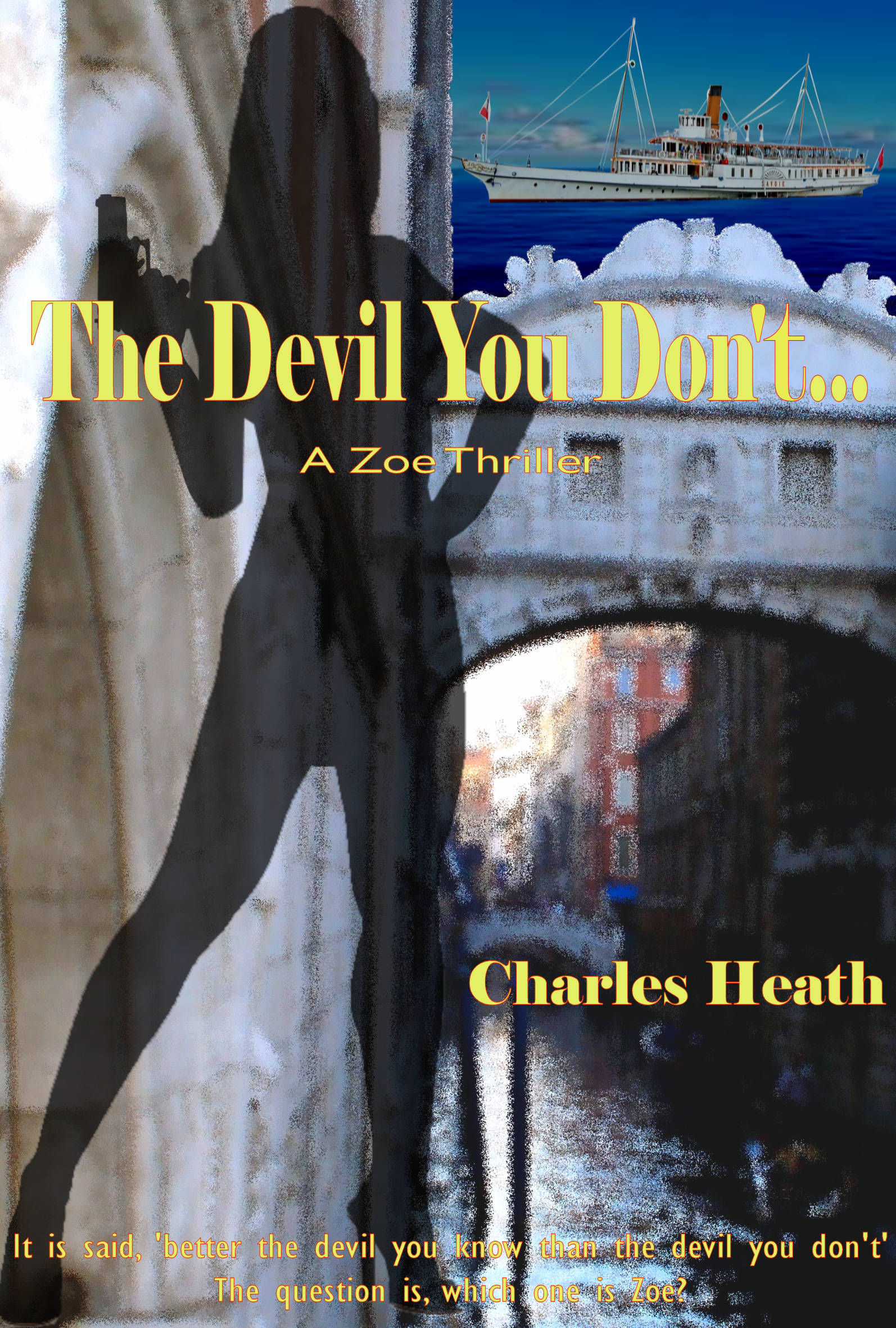
‘The Devil You Don’t’ – A beta reader’s view

It could be said that of all the women one could meet, whether contrived or by sheer luck, what are the odds it would turn out to be the woman who was being paid a very large sum to kill you.

John Pennington is a man who may be lucky in business, but not so lucky in love. He has just broken up with Phillipa Sternhaven, the woman he thought was the one, but relatives and circumstances, and perhaps because she was a ‘princess’, may also have contributed to the end result.

So, what do you do when you are heartbroken?

That is a story that slowly unfolds, from the first meeting with his nemesis on Lake Geneva, all the way to a hotel room in Sorrento, where he learns the shattering truth.

What should have been solace after disappointment, turns out to be something else entirely, and from that point, everything goes to hell in a handbasket.

He suddenly realizes his so-called friend Sebastian has not exactly told him the truth about a small job he asked him to do, the woman he is falling in love with is not quite who she says she is, and he is caught in the middle of a war between two men who consider people becoming collateral damage as part of their business.

The story paints the characters cleverly displaying all their flaws and weaknesses. The locations add to the story at times taking me back down memory lane, especially to Venice where, in those back streets I confess it’s not all that hard to get lost.

All in all a thoroughly entertaining story with, for once, a satisfying end.

Available on Amazon here: https://amzn.to/2Xyh1ow

Searching for locations: The apartments at Greve in Chianti, Tuscany, Italy

When we first planned to stay in Tuscany for a few days, we wanted to be in a central area.  We had thought of staying in Florence and making daily treks, but the tour operator we selected told us it would be better if we stayed closer to Arezzo.

We picked Greve in Chianti, and a place called Antico Pastificio, we booked a standard apartment with two bedrooms, and it was about as authentic Italian you could get.  The building we stayed in was the yellow pasta factory, and the apartment named ‘Iris’.

It was only steps away from the main square, shops, restaurants, and at the opposite end, the quaint ringing of church bells at various times during the day.

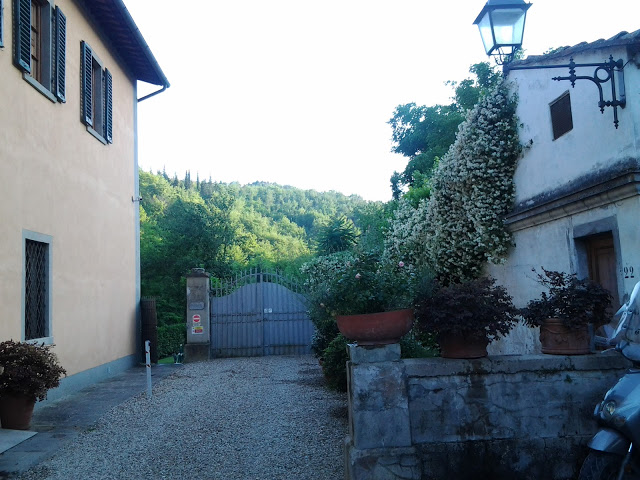
Gaining access was through a very narrow arch which required some deft driving and then up the road.  There were villas and two large apartment blocks.

You can just see the archway at the end of the road. 
This was the entrance to our room,

 along a passage and up the stairs, turning left at the top.

 Going straight ahead through the gate to the car park, 

and access to the grounds behind the buildings.

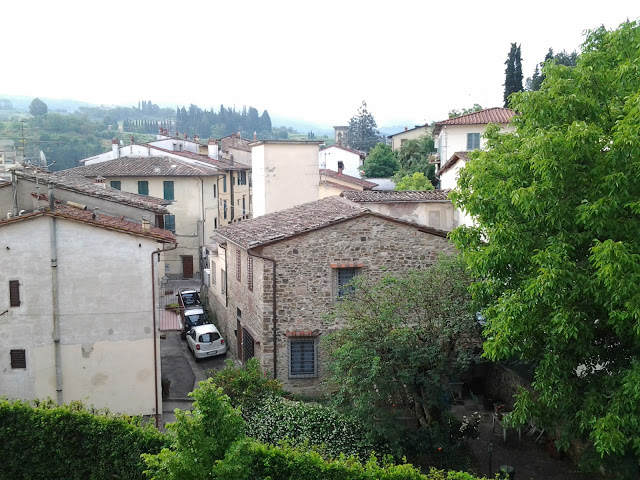
This was the view from the lounge/living room.  The days were hot, and on several evenings it rained, breaking the heat and making the evenings sitting by the window cool and refreshing.

 And the last view is looking towards the town piazza and the church

An excerpt from “The Things We Do For Love”; In love, Henry was all at sea!

In the distance he could hear the dinner bell ringing and roused himself.  Feeling the dampness of the pillow, and fearing the ravages of pent up emotion, he considered not going down but thought it best not to upset Mrs. Mac, especially after he said he would be dining.

In the event, he wished he had reneged, especially when he discovered he was not the only guest staying at the hotel.

Whilst he’d been reminiscing, another guest, a young lady, had arrived.  He’d heard her and Mrs. Mac coming up the stairs, and then shown to a room on the same floor, perhaps at the other end of the passage.

Henry caught his first glimpse of her when she appeared at the door to the dining room, waiting for Mrs. Mac to show her to a table.

She was about mid-twenties, slim, long brown hair, and the grace and elegance of a woman associated with countless fashion magazines.  She was, he thought, stunningly beautiful with not a hair out of place, and make-up flawlessly applied.  Her clothes were black, simple, elegant, and expensive, the sort an heiress or wife of a millionaire might condescend to wear to a lesser occasion than dinner.

Then there was her expression; cold, forbidding, almost frightening in its intensity.  And her eyes, piercingly blue and yet laced with pain.  Dracula’s daughter was his immediate description of her.

All in all, he considered, the only thing they had in common was, like him, she seemed totally out of place.

Mrs. Mac came out of the kitchen, wiping her hands on her apron.  She was, she informed him earlier, chef, waitress, hotelier, barmaid, and cleaner all rolled into one.  Coming up to the new arrival she said, “Ah, Miss Andrews, I’m glad you decided to have dinner.  Would you like to sit with Mr. Henshaw, or would you like to have a table of your own?”

Henry could feel her icy stare as she sized up his appeal as a dining companion, making the hair on the back on his neck stand up.  He purposely didn’t look back.  In his estimation, his appeal rating was minus six.  Out of a thousand!

“If Mr. Henshaw doesn’t mind….”  She looked at him, leaving the query in mid-air.

He didn’t mind and said so.  Perhaps he’d underestimated his rating.

“Good.”  Mrs. Mac promptly ushered her over.  Henry stood, made sure she was seated properly and sat.

“Thank you.  You are most kind.”  The way she said it suggested snobbish overtones.

“I try to be when I can.”  It was supposed to nullify her sarcastic tone but made him sound a little silly, and when she gave him another of her icy glares, he regretted it.

Mrs. Mac quickly intervened, asking, “Would you care for the soup?”

They did, and, after writing the order on her pad, she gave them each a look, imperceptibly shook her head, and returned to the kitchen.

Before Michelle spoke to him again, she had another quick look at him, trying to fathom who and what he might be.  There was something about him.

His eyes, they mirrored the same sadness she felt, and, yes, there was something else, that it looked like he had been crying?  There was a tinge of redness.

Perhaps, she thought, he was here for the same reason she was.

No.  That wasn’t possible.

Then she said, without thinking, “Do you have any particular reason for coming here?”  Seconds later she realized she’s spoken it out loud, had hadn’t meant to actually ask, it just came out.

It took him by surprise, obviously not the first question he was expecting her to ask of him.

“No, other than it is as far from civilization, and home, as I could get.”

At least we agree on that, she thought.

It was obvious he was running away from something as well.

Given the isolation of the village and lack of geographic hospitality, it was, from her point of view, ideal.  All she had to do was avoid him, and that wouldn’t be difficult.

After getting through this evening first.

“Yes,” she agreed.  “It is that.”

A few seconds passed, and she thought she could feel his eyes on her and wasn’t going to look up.

Until he asked, “What’s your reason?”

Slight abrupt in manner, perhaps as a result of her question, and the manner in which she asked it.

She looked up.  “Rest.  And have some time to myself.”

She hoped he would notice the emphasis she had placed on the word ‘herself’ and take due note.  No doubt, she thought,  she had completely different ideas of what constituted a holiday than he, not that she had actually said she was here for a holiday.

Mrs. Mac arrived at a fortuitous moment to save them from further conversation.


Over the entree, she wondered if she had made a mistake coming to the hotel.  Of course, there had been no possible way she could know than anyone else might have booked the same hotel, but realized it was foolish to think she might end up in it by herself.

Was that what she was expecting?

Not a mistake then, but an unfortunate set of circumstances, which could be overcome by being sensible.

Yet, there he was, and it made her curious, not that he was a man, by himself, in the middle of nowhere, hiding like she was, but for very different reasons.

On discreet observance whilst they ate, she gained the impression his air of light-heartedness was forced and he had no sense of humor.

This feeling was engendered by his looks, unruly dark hair, and permanent frown.  And then there was his abysmal taste in clothes on a tall, lanky frame.  They were quality but totally unsuited to the wearer.

Rebellion was written all over him.

The only other thought crossing her mind, and rather incongruously, was he could do with a decent feed.  In that respect, she knew now from the mountain of food in front of her, he had come to the right place.

“Mr. Henshaw?”

He looked up.  “Henshaw is too formal.  Henry sounds much better,” he said, with a slight hint of gruffness.

“Then my name is Michelle.”

Mrs. Mac came in to take their order for the only main course, gather up the entree dishes, then return to the kitchen.

“Staying long?” she asked.

“About three weeks.  Yourself?”

“About the same.”

The conversation dried up.

Neither looked at the other, rather at the walls, out the window, towards the kitchen, anywhere.  It was, she thought, almost unbearably awkward.


Mrs. Mac returned with a large tray with dishes on it, setting it down on the table next to theirs.

“Not as good as the usual cook,” she said, serving up the dinner expertly, “but it comes a good second, even if I do say so myself.  Care for some wine?”

Henry looked at Michelle.  “What do you think?”

“I’m used to my dining companions making the decision.”

You would, he thought.  He couldn’t help but notice the cutting edge of her tone.  Then, to Mrs. Mac, he named a particular White Burgundy he liked and she bustled off.

“I hope you like it,” he said, acknowledging her previous comment with a smile that had nothing to do with humor.

“Yes, so do I.”

Both made a start on the main course, a concoction of chicken and vegetables that were delicious, Henry thought, when compared to the bland food he received at home and sometimes aboard my ship.

It was five minutes before Mrs. Mac returned with the bottle and two glasses.  After opening it and pouring the drinks, she left them alone again.

Henry resumed the conversation.  “How did you arrive?  I came by train.”

“By car.”

“Did you drive yourself?”

And he thought, a few seconds later, that was a silly question, otherwise she would not be alone, and certainly not sitting at this table. With him.

“After a fashion.”

He could see that she was formulating a retort in her mind, then changed it, instead, smiling for the first time, and it served to lighten the atmosphere.

And in doing so, it showed him she had another more pleasant side despite the fact she was trying not to look happy.

“My father reckons I’m just another of ‘those’ women drivers,” she added.

“Whatever for?”

“The first and only time he came with me I had an accident.  I ran up the back of another car.  Of course, it didn’t matter to him the other driver was driving like a startled rabbit.”

“It doesn’t help,” he agreed.

“Do you drive?”

“Mostly people up the wall.”  His attempt at humor failed.  “Actually,” he added quickly, “I’ve got a very old Morris that manages to get me where I’m going.”

The apple pie and cream for dessert came and went and the rapport between them improved as the wine disappeared and the coffee came.  Both had found, after getting to know each other better, their first impressions were not necessarily correct.

“Enjoy the food?” Mrs. Mac asked, suddenly reappearing.

“Beautifully cooked and delicious to eat,” Michelle said, and Henry endorsed her remarks.

“Ah, it does my heart good to hear such genuine compliments,” she said, smiling.  She collected the last of the dishes and disappeared yet again.

“What do you do for a living,” Michelle asked in an off-hand manner.

He had a feeling she was not particularly interested and it was just making conversation.

“I’m a purser.”

“A what?”

“A purser.  I work on a ship doing the paperwork, that sort of thing.”

“I see.”

“And you?”

“I was a model.”

“Was?”

“Until I had an accident, a rather bad one.”

“Oh, I’m sorry.”

So that explained the odd feeling he had about her.

As the evening had worn on, he began to think there might be something wrong, seriously wrong with her because she didn’t look too well.  Even the carefully applied makeup, from close up, didn’t hide the very pale, and tired look, or the sunken, dark ringed eyes.

“I try not to think about it, but it doesn’t necessarily work.  I’ve come here for peace and quiet, away from doctors and parents.”

“Then you will not have to worry about me annoying you.  I’m one of those fall-asleep-reading-a-book types.”

Perhaps it would be like ships passing in the night and then smiled to himself about the analogy.

Dinner now over, they separated.

Henry went back to the lounge to read a few pages of his book before going to bed, and Michelle went up to her room to retire for the night.

But try as he might, he was unable to read, his mind dwelling on the unusual, yet the compellingly mysterious person he would be sharing the hotel with.

Overlaying that original blurred image of her standing in the doorway was another of her haunting expressions that had, he finally conceded, taken his breath away, and a look that had sent more than one tingle down his spine.

She may not have thought much of him, but she had certainly made an impression on him.


© Charles Heath 2015-2020

lovecoverfinal1