In a word: High or is it hie

When the boss says jump, the question is usually ‘how high’.

Not that it’s possible for many of us with a challenging centre of gravity to get much elevation.

High generally means height, how far something rises above ground level, is above our heads.

That plane flies very high in the sky.

Then there’s another meaning, increased intensity, such as a high temperature, a high fever, but my favourite is, a high dudgeon.

I’m still to get a definition on what a dudgeon is.

We have secondary schools here that we call high schools. Make of that what you will

And in the idiomatic world, flying high means we are very happy, and when were left high and dry then not so much. Unless it related to a ship, in which case a lot of people would be unhappy.

We can use high just about everywhere, high hopes, high ceilings, feelings that run high, a high chair for toddlers of course, high speed which may cause s crash and land you in a high security prison.

This is not to be confused with just plain hi which is a universal greeting.

But there is another, hie, which has a more obscure meaning, to hasten or go quickly.

I always wanted to see the planets – Episode 16

Space command, one of our captains is missing

Before I called, I had one question for the second officer; where were we heading. The answer was not surprising, Uranus.

The next question was why the alien pirate had told us. The first answer that came to mind, we would never get there in time, that is, he had a much faster ship than us.

Us humans were going to have to get a lot more savvy in a hurry.

I had a special channel to call in space command if anything went wrong. As the Admiral had said, he didn’t want our mistakes to be front page news.

This was not a mistake, but it was news that might start riots. A lot of people had been against going out into the universe to explore.

My first attempt to raise him failed. It was when I realised it would be around 3am where he was, and hardly at his console waiting for me to call him.

But, 10 minutes later, he was calling me.

‘I take it this is about Vanderhoven and Myers.”

Again, it took a moment to remember that the ground crew could monitor everyone on the ship, a precaution because we were heading where no human had been before.

“We were boarded by an alien who transported onto and off the ship the same was transport inanimate objects. He purported to be chasing after the pirates who stole the plutonium fuel rods bound for Venus, and was asking for our help in chasing down the purportrators. It was a ruse to keep us occupied while his men were looking for Myers.”

“They stole plutonium?”

Again, not my first question. “I think the first revelation might be the more significant, that there are other life forms out there.”

“And hostile?”

“I don’t think they plan to attack earth sir, because according to this alien, they have had people on our planet since before the second world war.”

“And you believe him?”

“Do we know of any rogue earth based people who could secretly put together a ship vastly superior to this one, which is supposedly the best we’ve ever had?”

His silence told me there wasn’t, not the he’d probably tell me if there was, but his expression spoke volumes. He also looked deep in thought.

Then, “in the absence of the captain, you’re it. I’ll confirm it within the next few hours. Do you know where they’ve gone?”

“I believe so. One of Uranus’s moons, Coronis.”

“That’s nothing but ice.”

“Maybe. Well know more when we get there.”

OK. I want a more detailed report of the incident in two hours. Something you should be aware of, your ship is capable of a SSPD factor of 10, not 4. We were not going to tell anyone until after the shakedown. I’ll talk to the Engineer, and he’ll get back to you when it can be implemented. Keep me informed.”

The screen went dead.

As number one I was responsible for making the Captain look good. As captain, I was now responsible for a priceless ship and all 2,223 souls aboard.

Too much, too soon.

But before I had time to consider it, the scene officer was back.

“Sir, we have a problem.”

© Charles Heath 2021

“Do you believe in g..g..ghosts…?”, a short story

Inside the old building, it was very quiet and almost cold.

Strange, perhaps, because outside the temperature was bordering on the record hottest day ever, nearly 45 degrees centigrade.

The people who’d built this building nearly a hundred years before must have known how to keep that heat at bay, using sandstone.

Back then, the sandstone would have looked very impressive, but now after many years of being closed off and left abandoned, the outside was stained by modern-day pollutants giving it a black streaky look, and inside layers of dust, easily stirred up as we walked slowly into the main foyer.

It was huge, the roof, ornate, with four huge chandelier lights hanging down, and wood paneling, giving way to a long counter with brass serving cages highlighting its former use; a bank.

In its day it would have conveyed the power and wealth so that its customers could trust the money to. Of course, that was before the global economy, online banking, and a raft of the new and different institutions all vying for that same money.

Then it was a simple choice of a few, now it was a few thousand.

“How many years had this been closed up?” I asked.

“Close to twenty, maybe twenty-five. It was supposed to be pulled down, but someone got it on the heritage list, and that put an end to it. “

Phil was the history nut. He’s spent a month looking into the building, finding construction plans, and correspondence dating back to before and during the construction.

Building methods, he said, that didn’t exist today and were far in advance of anything of its type for the period. It was the reason we were standing in the foyer now.

We were budding civil engineers, and the university had managed to organize a visit, at our own risk. The owner of the building had made sure we’d signed a health and safety waiver before granting access.

And the caretaker only took us as far as the front door. He gave us his cell number to call when we were finished. When we asked him why he didn’t want to come in with us, he didn’t say but it was clear to me he was afraid of something.

But neither of us believed in ghosts.

“You can see aspects of cathedrals in the design,” Phil said. ” You could quite easily turn this space into a church.”

“Or a very large wine cellar.” I brought a thermometer with me, and inside where we were standing it was the ideal temperature to store wine.

Behind the teller cages were four large iron doors to the vaults. They were huge, and once contained a large amount of cash, gold, and whatever else was deemed valuable.

They were all empty now, the shelves and floor had scattered pieces of bank stationery, and in a corner, several cardboard boxes, covered in even more dust.

Behind the vaults were offices, half-height with glass dividers, the desks and chairs still in place, and some with wooden filing cabinets drawers half-open.

Others had benches, and one, set in the corner, very large, and looked like the manager’s office. Unlike the other office which had linoleum tiles, this one had carpet. In a corner was a large mirror backed cabinet, with several half-empty bottles on it.

“Adds a whole new meaning to aged whiskey, don’t you think.” Phil looked at it but didn’t pick it up.

“I wonder why they left it,” I muttered. The place had the feel of having been left in a hurry, not taking everything with them.

I shivered, but it was not from the cold.

We went back to the foyer and the elevator lobby. They were fine examples of the sort of caged elevators that belonged in that time, and which there were very few working examples these days.

The elevators would have a driver, he would pull back an inner and outer door when the car arrived on a floor, and close both again when everyone was aboard.

Both cars were on the ground floor, with the shutter doors closed, and when I tried to open one, I found it had been welded shut. The other car was not sitting level with the floor and the reason for that, the cable that raised and lowered it was broken.

Restoring them would be a huge job and would not be in their original condition due to occupational health and safety issues.

The staircase wound around the elevator cage, going up to the mezzanine floor or down to the basement.

“Up or down?” He asked.

“Where do you want to go first?”

“Down. There’s supposed to be a large vault, probably where the safety deposit boxes are.”

And the restrooms I thought. Not that I was thinking of going.

As we descended the stairs it was like going down into a mine shaft, getting darker, and the rising odor of damp, and mustiness. I suspect it would have been the same back when it was first built being so close to the shoreline of the bay, not more than half a mile away.

The land this building and a number of others in a similar style, was built on was originally a swamp, and it was thought that the seawater still found its way this far inshore. But the foundations were incredibly strong and extensive which was why there’d been no shifting or cracking anywhere in the ten-story structure.

At the bottom, there was a huge arch, with built-in brass caging with two huge gates, both open. It was like the entrance to a mythical Aladdin’s cave.

There was also an indefinable aura coming from the depths of that room. That, and a movement of cold air. Curiously, the air down there was not musty but had a tinge of saltiness to it.

Was there a natural air freshener effect coming from somewhere within that vault.

“Are we going in?”

I checked my torch beam, still very bright. I pointed it into the blackness and after a minute checking, I said, “We’re here, so why not.”

We had to walk down a dozen steps then pass under through the open gates into the room. There was a second set of gates, the same as the first, about thirty feet from the first, and, in between, a number of cubicles where customers collected their boxes.

Beyond the second set of gates was a large circular reinforced safe door high enough for us to walk through.

This cavernous space stretched back quite a distance, and along the walls, rows, and rows of safety deposit boxes, some half hanging out of their housing, and a lot more stacked haphazardly on the floor.

I checked a few but they were all empty.

I shivered again. It felt like there was a presence in the room. I turned to ask Phil, but he wasn’t there. I hadn’t heard him walk away, and there were only two sets of footprints on the floor, his and mine, and both ended where I was standing.

It was as if he had disappeared into thin air.

I called out his name, and it echoed off the walls in the confined space. No answer from him.

I went further into the room, thinking he might have ventured towards the end while my back was turned, but he hadn’t. Nor had he left because there were only footprints coming in, not going out.

I turned to retrace my steps and stopped suddenly. An old man, in clothes that didn’t belong to this era, was standing where Phil had last been.

He was looking at me, but not inclined to talk.

“Hello. I didn’t see you come down.”

Seconds later the figure dissolved in front of me and there was no one but me standing in the room.

“Joe.”

Phil, from behind me. I turned and there he was large as life.

“Where were you?”

“I’ve been here all the time. Who were you just talking to?”

“There was an old man, standing just over there,” I said pointing to somewhere between Phil and the entrance.

“I didn’t see anyone. Are you sure you’re not having me on?”

“No. He’s right behind you.” The old man had reappeared.

Phil shook his head, believing I was trying to fool him.

That changed when the man touched his shoulder, and Phil shrieked.

And almost ran out of the room. It took a few minutes for him to catch his breath and steady the palpitating heart.

“Are you real?” I asked, not quite sure what to say.

“To me, I am. To anyone else, let’s just say you are the first not got faint, or run away.”

“Are you a ghost?” Phil wasn’t exactly sure what he was saying.

“Apparently I am and will be until you find out who killed me “

Ok, so what was it called, stuck in the afterlife or limbo until closure?

“When?”

“25 years ago, just before the bank closed. It’s the reason why it’s empty now.”

“And you’re saying we find the killer and you get to leave?”

“Exactly. Now shoo. Go and find him.”

We looked at each other in surprise, or more like shock, then back to the man. Only he was no longer there.

“What the…” Phil sail. “It’s time to go.”

“What about the man and finding his killer?”

“What man? We saw nothing. We’re done here.”

I shrugged. Phil turned to leave, but only managed to take three steps before the gates at the entrance closed with a loud clang.

When he crossed the room to stand in front, he tried pulling them open.

“Locked,” he said. Flat, and without panic, he added, “I guess it looks like we have a murder to solve.”

© Charles Heath 2019-2020

Memories of the conversations with my cat – 6

As some may be aware, but many not, Chester, my faithful writing assistant, mice catcher, and general pain in the neck, passed away some months ago.

Recently I was running a series based on his adventures, under the title of Past Conversations with my cat.

For those who have not had the chance to read about all of his exploits I will run the series again from Episode 1

These are the memories of our time together…

20160907_135509

This is Chester.  He is giving me the ‘Come back when you’ve rewritten the start’ look.

Yet another ‘disagreement’ over such a small matter!

Here’s the thing.

Like many authors with cats, I like to use Chester as my audience of one, my sounding board.  It is better to be reading to him, rather than reading out loud by yourself.

Reading what you have written often points out tongue tangling or ‘drippy’ dialog, and  unfortunate mix ups in words.  Proof reading sometimes misses these.

Hitherto, Chester has been patient, lying on the floor, or sitting on the couch.

I guess a few pats doesn’t go astray in the process.

But, this morning, reading him the new start to ‘First Dig Two Graves’ the sequel to ‘The Devil You Don’t’, he just gave me one of his angry ‘meow’s’ and left.

Obviously he didn’t like it.

Of course, after I re-read it again, I could see the problem, so the days writing is not over yet.

An excerpt from “What Sets Us Apart”, a mystery with a twist

See excerpt from the story below, just a taste of what’s in store…

http://amzn.to/2Eryfth

whatsetscover

McCallister was old school, a man who would most likely fit in perfectly campaigning on the battlefields of Europe during the Second World War. He’d been like a fish out of water in the army, post-Falklands, and while he retired a hero, he still felt he’d more to give.

He’d applied and was accepted as head of a SWAT team, and, watching him now as he and his men disembarked from the truck in almost military precision, a look passed between Annette, the police liaison officer, and I that said she’d seen it all before. I know I had.

There was a one in four chance his team would be selected for this operation, and she had been hoping it would be one of the other three. While waiting for them to arrive she filled me in on the various teams. His was the least co-operative, and the more likely to make ad-hoc decisions rather than adhere to the plan, or any orders that may come from the officer in charge.

This, she said quite bluntly, was going to end badly.

I still had no idea why Prendergast instructed me to attend the scene of what looked to be a normal domestic operation, but as the nominated expert in the field in these types of situations, it was fairly clear he wasn’t taking any chances. It was always a matter of opinion between us, and generally I lost.

In this case, it was an anonymous report identifying what the authorities believed were explosives in one of the dockside sheds where explosives were not supposed to be.

The only reason why the report was given any credence was the man, while not identifying himself by name, said he’d been an explosive expert once and recognized the boxes. That could mean anything, but the Chief Constable was a cautious man.

With his men settled and preparing their weapons, McCallister came over to the command post, not much more than the SUV my liaison and I arrived in, with weapons, bulletproof vests, and rolls of tape to cordon off the area afterward. We both had coffee, steaming in the cold early morning air. Dawn was slowly approaching and although rain had been forecast it had yet to arrive.

A man by the name of Benson was in charge. He too had groaned when he saw McCallister.

“A fine morning for it.” McCallister was the only enthusiastic one here.

He didn’t say what ‘it’ was, but I thought it might eventually be mayhem.

“Let’s hope the rain stays away. It’s going to be difficult enough without it,” Benson said, rubbing his hands together. We had been waiting for the SWAT team to arrive, and another team to take up their position under the wharf, and who was in the final stages of securing their position.

While we were waiting we drew up the plan. I’d go in first to check on what we were dealing with, and what type of explosives. The SWAT team, in the meantime, were to ensure all the exits to the shed were covered. When I gave the signal, they were to enter and secure the building. We were not expecting anyone inside or out, and no movement had been detected in the last hour since our arrival and deployment.

“What’s the current situation?”

“I’ve got eyes on the building, and a team coming in from the waterside, underneath. Its slow progress, but they’re nearly there. Once they’re in place, we’re sending McKenzie in.”

He looked in my direction.

“With due respect sir, shouldn’t it be one of us?” McCallister glared at me with the contempt that only a decorated military officer could.

“No. I have orders from above, much higher than I care to argue with, so, McCallister, no gung-ho heroics for the moment. Just be ready to move on my command, and make sure you have three teams at the exit points, ready to secure the building.”

McCallister opened his mouth, no doubt to question those orders, but instead closed it again. “Yes sir,” he muttered and turned away heading back to his men.

“You’re not going to have much time before he storms the battlements,” Benson quietly said to me, a hint of exasperation in his tone. “I’m dreading the paperwork.”

It was exactly what my liaison officer said when she saw McCallister arriving.

The water team sent their ‘in position’ signal, and we were ready to go.

In the hour or so we’d been on site nothing had stirred, no arrivals, no departures, and no sign anyone was inside, but that didn’t mean we were alone. Nor did it mean I was going to walk in and see immediately what was going on. If it was a cache of explosives then it was possible the building was booby-trapped in any number of ways, there could be sentries or guards, and they had eyes on us, or it might be a false alarm.

I was hoping for the latter.

I put on the bulletproof vest, thinking it was a poor substitute for full battle armor against an exploding bomb, but we were still treating this as a ‘suspected’ case. I noticed my liaison officer was pulling on her bulletproof vest too.

“You don’t have to go. This is my party, not yours,” I said.

“The Chief Constable told me to stick to you like glue, sir.”

I looked at Benson. “Talk some sense into her please, this is not a kindergarten outing.”

He shrugged. Seeing McCallister had taken all the fight out of him. “Orders are orders. If that’s what the Chief Constable requested …”

Madness. I glared at her, and she gave me a wan smile. “Stay behind me then, and don’t do anything stupid.”

“Believe me, I won’t be.” She pulled out and checked her weapon, chambering the first round. It made a reassuring sound.

Suited up, weapons readied, a last sip of the coffee in a stomach that was already churning from nerves and tension, I looked at the target, one hundred yards distant and thought it was going to be the longest hundred yards I’d ever traversed. At least for this week.

A swirling mist rolled in and caused a slight change in plans.

Because the front of the buildings was constantly illuminated by large overhead arc lamps, my intention had been to approach the building from the rear where there was less light and more cover. Despite the lack of movement, if there were explosives in that building, there’d be ‘enemy’ surveillance somewhere, and, after making that assumption, I believed it was going to be easier and less noticeable to use the darkness as a cover.

It was a result of the consultation, and studying the plans of the warehouse, plans that showed three entrances, the main front hangar type doors, a side entrance for truck entry and exit and a small door in the rear, at the end of an internal passage leading to several offices. I also assumed it was the exit used when smokers needed a break. Our entry would be by the rear door or failing that, the side entrance where a door was built into the larger sliding doors. In both cases, the locks would not present a problem.

The change in the weather made the approach shorter, and given the density of the mist now turning into a fog, we were able to approach by the front, hugging the walls, and moving quickly while there was cover. I could feel the dampness of the mist and shivered more than once.

It was nerves more than the cold.

I could also feel rather than see the presence of Annette behind me, and once felt her breath on my neck when we stopped for a quick reconnaissance.

It was the same for McCallister’s men. I could feel them following us, quickly and quietly, and expected, if I turned around, to see him breathing down my neck too.

It added to the tension.

My plan was still to enter by the back door.

We slipped up the alley between the two sheds to the rear corner and stopped. I heard a noise coming from the rear of the building, and the light tap on the shoulder told me Annette had heard it too. I put my hand up to signal her to wait, and as a swirl of mist rolled in, I slipped around the corner heading towards where I’d last seen the glow of a cigarette.

The mist cleared, and we saw each other at the same time. He was a bearded man in battle fatigues, not the average dockside security guard.

He was quick, but my slight element of surprise was his undoing, and he was down and unconscious in less than a few seconds with barely a sound beyond the body hitting the ground. Zip ties secured his hands and legs, and tape his mouth. Annette joined me a minute after securing him.

A glance at the body then me, “I can see why they, whoever they are, sent you.”

She’d asked who I worked for, and I didn’t answer. It was best she didn’t know.

“Stay behind me,” I said, more urgency in my tone. If there was one, there’d be another.

Luck was with us so far. A man outside smoking meant no booby traps on the back door, and quite possibly there’d be none inside. But it indicated there were more men inside, and if so, it appeared they were very well trained. If that were the case, they would be formidable opponents.

The fear factor increased exponentially.

I slowly opened the door and looked in. A pale light shone from within the warehouse itself, one that was not bright enough to be detected from outside. None of the offices had lights on, so it was possible they were vacant. I realized then they had blacked out the windows. Why hadn’t someone checked this?

Once inside, the door closed behind us, progress was slow and careful. She remained directly behind me, gun ready to shoot anything that moved. I had a momentary thought for McCallister and his men, securing the perimeter.

At the end of the corridor, the extent of the warehouse stretched before us. The pale lighting made it seem like a vast empty cavern, except for a long trestle table along one side, and, behind it, stacks of wooden crates, some opened. It looked like a production line.

To get to the table from where we were was a ten-yard walk in the open. There was no cover. If we stuck to the walls, there was equally no cover and a longer walk.

We needed a distraction.

As if on cue, the two main entrances disintegrated into flying shrapnel accompanied by a deafening explosion that momentarily disoriented both Annette and I. Through the smoke and dust kicked up I saw three men appear from behind the wooden crates, each with what looked like machine guns, spraying bullets in the direction of the incoming SWAT members.

They never had a chance, cut down before they made ten steps into the building.

By the time I’d recovered, my head heavy, eyes watering and ears still ringing, I took several steps towards them, managing to take down two of the gunmen but not the third.

I heard a voice, Annette’s I think, yell out, “Oh, God, he’s got a trigger,” just before another explosion, though all I remember in that split second was a bright flash, the intense heat, something very heavy smashing into my chest knocking the wind out of me, and then the sensation of flying, just before I hit the wall.

I spent four weeks in an induced coma, three months being stitched back together and another six learning to do all those basic actions everyone took for granted. It was twelve months almost to the day when I was released from the hospital, physically, except for a few alterations required after being hit by shrapnel, looking the same as I always had.

But mentally? The document I’d signed on release said it all, ‘not fit for active duty; discharged’.

It was in the name of David Cheney. For all intents and purposes, Alistair McKenzie was killed in that warehouse, and for the first time ever, an agent left the Department, the first to retire alive.

I was not sure I liked the idea of making history.


© Charles Heath 2016-2020

Searching for locations: Auckland, New Zealand, a rare day for the port

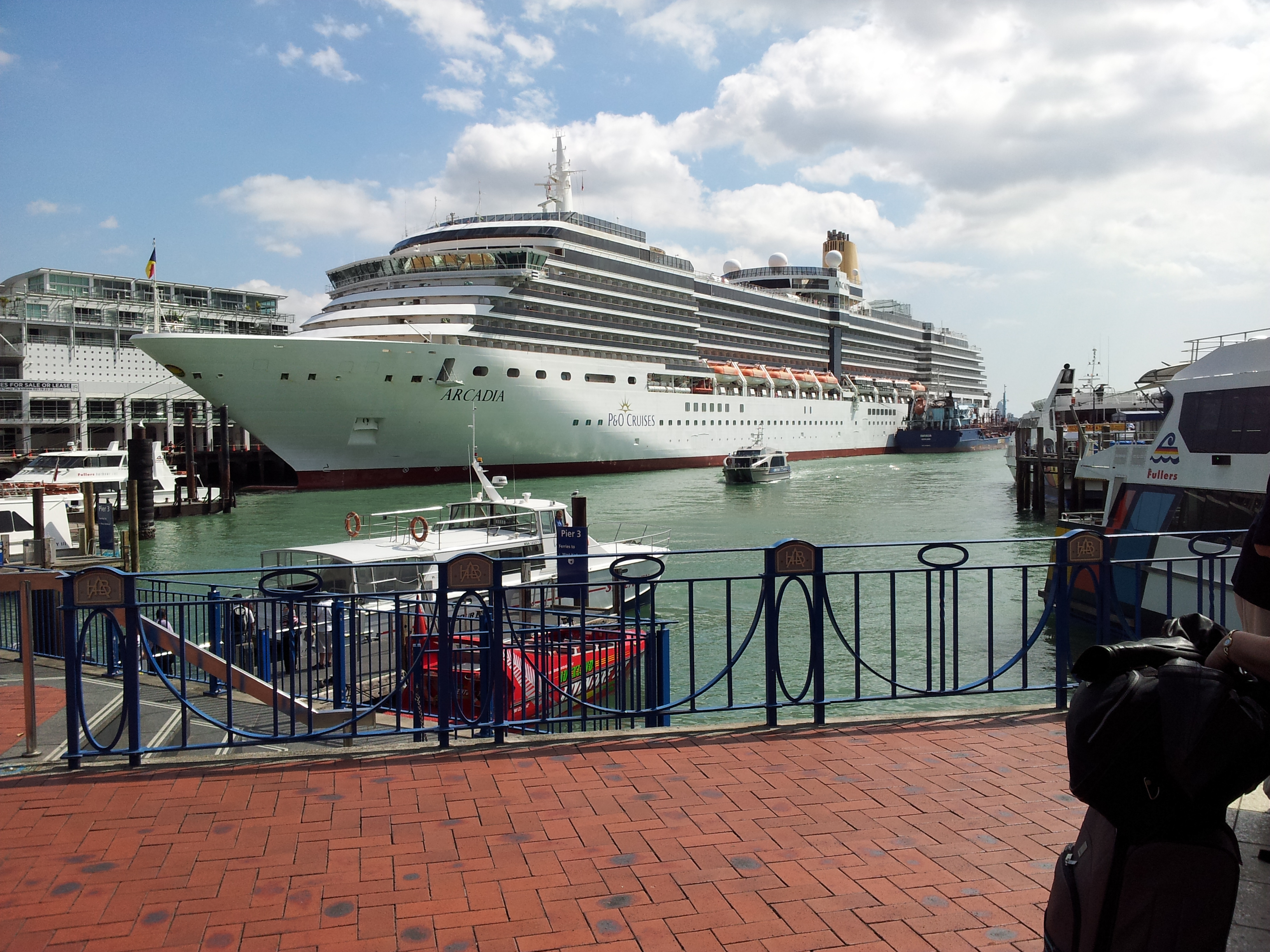
We were staying at the Hilton and advised there would be a large cruise liner berthing next to the hotel.  There was the Arcadia.

2013-03-08 11.51.48

This is the view from the other side of the hotel.  Where our room was, we could almost walk onto the aft end of the ship.

We were also told this was a rather extraordinary day because there were two cruise ships in the port. particularly because it was near the end of the cruising season.

The other ship was two berths along, the Sun Princess.

2013-03-08 11.56.17

Not as big as the Arcadia, up close it was still very impressive.

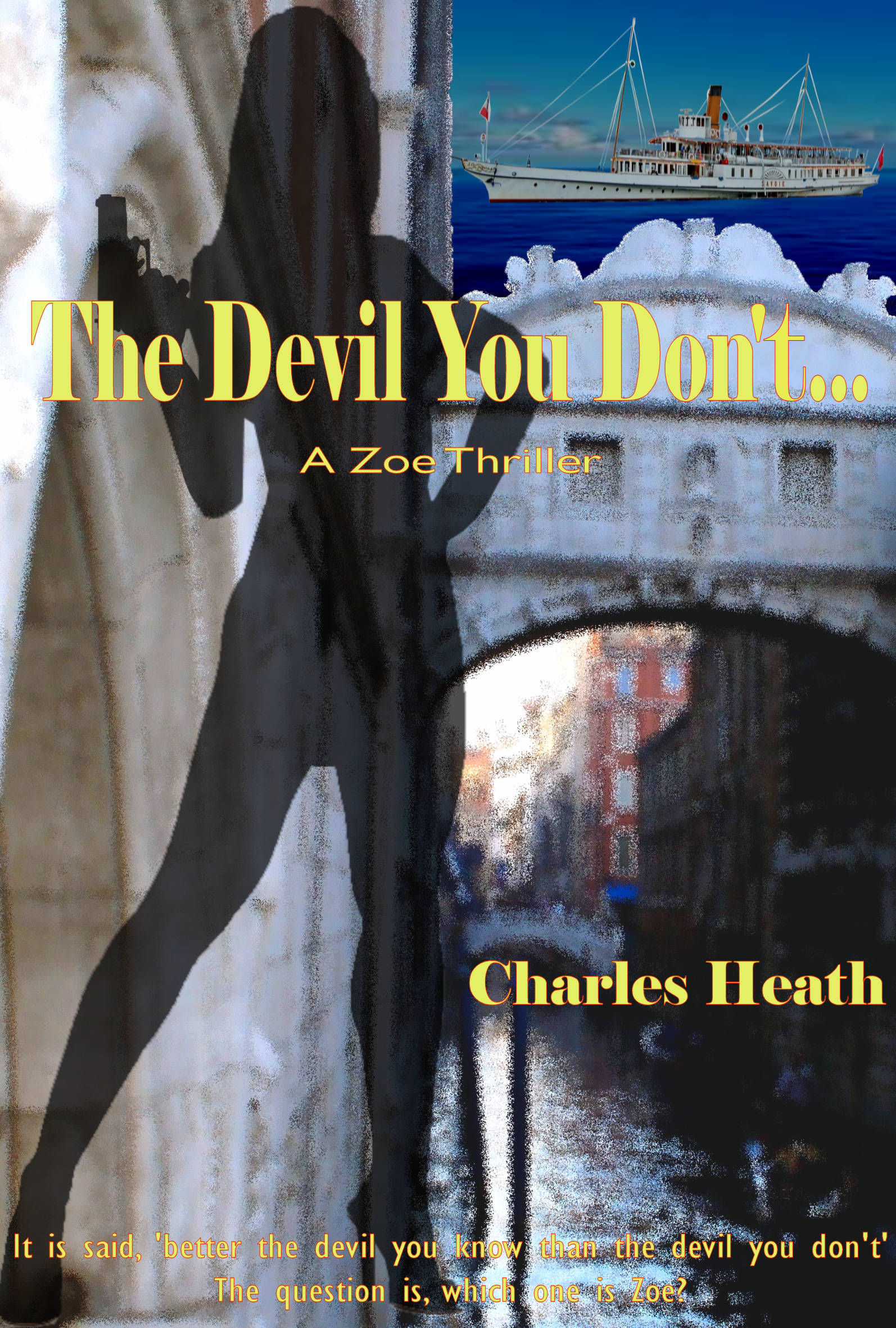
‘The Devil You Don’t’ – A beta reader’s view

It could be said that of all the women one could meet, whether contrived or by sheer luck, what are the odds it would turn out to be the woman who was being paid a very large sum to kill you.

John Pennington is a man who may be lucky in business, but not so lucky in love. He has just broken up with Phillipa Sternhaven, the woman he thought was the one, but relatives and circumstances, and perhaps because she was a ‘princess’, may also have contributed to the end result.

So, what do you do when you are heartbroken?

That is a story that slowly unfolds, from the first meeting with his nemesis on Lake Geneva, all the way to a hotel room in Sorrento, where he learns the shattering truth.

What should have been solace after disappointment, turns out to be something else entirely, and from that point, everything goes to hell in a handbasket.

He suddenly realizes his so-called friend Sebastian has not exactly told him the truth about a small job he asked him to do, the woman he is falling in love with is not quite who she says she is, and he is caught in the middle of a war between two men who consider people becoming collateral damage as part of their business.

The story paints the characters cleverly displaying all their flaws and weaknesses. The locations add to the story at times taking me back down memory lane, especially to Venice where, in those back streets I confess it’s not all that hard to get lost.

All in all a thoroughly entertaining story with, for once, a satisfying end.

Available on Amazon here: https://amzn.to/2Xyh1ow

We have this sport called Australian Rules Football

In Melbourne, it’s an institution even a religion.  Traditionally it is played on a Saturday afternoon and luckily for us, we were attending such a game.

Of course, this was before last year.  Last year, with the COVID 19 virus everything, including football has been called off.

Now, we’re subject to the off outbreak that sees games transferred to other states, and sometimes without crowds. We just stick to watching it on TV these days.

Except now we have ‘flattened the curve’ football can start again, sometimes with sometimes without the spectators.  Social distancing means we can’t pack the stadium, or rarely even go to a game.  For a while, it was just to be from our lounge rooms, watching it on the TV.

But, as some of the states began to get on top of the virus, football teams moved from Victoria, and played in Sydney, Adelaide, Perth, and the Northern Territory.

And as the Victorian situation got worse, the decision was made to move the grand final, which had never left the MCG in Victoria, to Brisbane. It was like America never losing the Americas Cup, until they did.

But, below, is the atmosphere that we have been missing, and has returned in a limited sense as coronavirus restrictions eased (but not completely), a game we attended last year:

The stadium is the MSG, one of the biggest and best in Australia.  Shortly after the start, I’d estimate there are about 40,000, but eventually, we were told there was 53,000, spectators here for a clash between the two Melbourne based teams.  It is not unheard of to have in closer to 90,000 spectators, and the atmosphere is at times electric.

For the die-hards like me who can remember the days when there were only Victorian-based teams,  in the modern-day form of the game, to have two such teams is something of a rarity.

However, it’s not so much about the antics on the field as it is the spectators.  They are divided into three groups, the members, the private boxes, and the general public.

But in the end, there is no distinction between any of them because they all know the rules, well, their version of them, and it doesn’t matter who you are, If there is something that goes against your team, it is brings a huge roar of disapproval.

Then there are ebbs and flows in the crowd noise and reactions to events like holding the ball attracting a unified shout ‘ball, or a large collective groan when a free kick should have been paid or by the opposite team’s followers if it should have been.

It is this crowd reaction which makes going to a live game so much better than watching it televised live.  The times when players take marks, get the ball out of congestion, and when goals are scored when your team is behind and when one is needed to get in front.

This is particularly so when one of the stars goes near the ball and pulls off a miracle 1 percent movement of the ball.  These are what we come to see, the high flying marks, the handball threaded through a needle, a kick that reaches one of our players that looked like it would never get there, an intercept mark or steal that throws momentum the opposite way.

This game is not supposed to be a game of inches but fast yards, a kick, a mark, a handball, a run, and bounce.  You need to get the ball to your goal as quickly as possible.

That’s the objective.

But in this modern game, much to the dismay of spectators and commentators alike, there is this thing called flooding where all 36 players are basically in a clump around the ball and it moves basically in inches, not yards.

It is slow and it is ugly.

It is not the game envisioned by those who created it and there is a debate right now about fixing it.

Here, it is an example of the worst sort.  This game is played in four quarters and for the first two, it is ugly scrappy play with little skill on display.  The third shows improvement and it seems the respective coaches had told their players to open it up

They have and it becomes better to look at.

But this is the point where one team usually gets away with a handy lead, a third-quarter effort that almost puts the game out of reach.  The fourth quarter is where the losing team stages a comeback, and sometimes it works sometimes it does not.

The opposition gives it a red hot try but is unsuccessful.  Three goals in a row, it gave their fans a sniff of hope but as the commentators call it, a kick against the flow and my team prevails.

It is the moment to stay for when they play the winning teams song over the stadium’s loudspeaker system, and at least half the spectators sing along.  It is one of that hair raising on the back of your neck moments which for some can be far too few in a season

We have great hopes for our team this year, and it was worth the trek from Brisbane to Melbourne to see it live rather than on the TV

Leaving the ground with thousands of others heading towards the train station for the journey home there is a mixture of feelings, some lamenting their teams, and others jubilant their team won.  There is no rancor, everyone shuffles in an orderly manner, bearing the slow entry to the station, and the long lines to get on the train.

Others who perhaps came by car, or who have decided to wait for a later train or other transport, let their children kick the football around on the leaf-covered parkland surrounding the stadium.

It is an integral part of this game that children experience the football effect.  Kicking a ball with your father, brothers, and sisters, or friends on that late autumn afternoon is a memory that will be cherished for a long long time.

It’s where you pretend you are your favorite player and are every bit as good.  I know that’s what I used to do with my father, and that is what I did with my sons.

But no matter what the state of the game, it is the weekend the football fans look forward to and who turn out in their hundreds of thousands.  It is a game that ignites passions, it brings highs and it brings incredible lows.

And, through thick and thin, we never stop supporting them.

An excerpt from “The Things We Do For Love”; In love, Henry was all at sea!

In the distance he could hear the dinner bell ringing and roused himself.  Feeling the dampness of the pillow, and fearing the ravages of pent up emotion, he considered not going down but thought it best not to upset Mrs. Mac, especially after he said he would be dining.

In the event, he wished he had reneged, especially when he discovered he was not the only guest staying at the hotel.

Whilst he’d been reminiscing, another guest, a young lady, had arrived.  He’d heard her and Mrs. Mac coming up the stairs, and then shown to a room on the same floor, perhaps at the other end of the passage.

Henry caught his first glimpse of her when she appeared at the door to the dining room, waiting for Mrs. Mac to show her to a table.

She was about mid-twenties, slim, long brown hair, and the grace and elegance of a woman associated with countless fashion magazines.  She was, he thought, stunningly beautiful with not a hair out of place, and make-up flawlessly applied.  Her clothes were black, simple, elegant, and expensive, the sort an heiress or wife of a millionaire might condescend to wear to a lesser occasion than dinner.

Then there was her expression; cold, forbidding, almost frightening in its intensity.  And her eyes, piercingly blue and yet laced with pain.  Dracula’s daughter was his immediate description of her.

All in all, he considered, the only thing they had in common was, like him, she seemed totally out of place.

Mrs. Mac came out of the kitchen, wiping her hands on her apron.  She was, she informed him earlier, chef, waitress, hotelier, barmaid, and cleaner all rolled into one.  Coming up to the new arrival she said, “Ah, Miss Andrews, I’m glad you decided to have dinner.  Would you like to sit with Mr. Henshaw, or would you like to have a table of your own?”

Henry could feel her icy stare as she sized up his appeal as a dining companion, making the hair on the back on his neck stand up.  He purposely didn’t look back.  In his estimation, his appeal rating was minus six.  Out of a thousand!

“If Mr. Henshaw doesn’t mind….”  She looked at him, leaving the query in mid-air.

He didn’t mind and said so.  Perhaps he’d underestimated his rating.

“Good.”  Mrs. Mac promptly ushered her over.  Henry stood, made sure she was seated properly and sat.

“Thank you.  You are most kind.”  The way she said it suggested snobbish overtones.

“I try to be when I can.”  It was supposed to nullify her sarcastic tone but made him sound a little silly, and when she gave him another of her icy glares, he regretted it.

Mrs. Mac quickly intervened, asking, “Would you care for the soup?”

They did, and, after writing the order on her pad, she gave them each a look, imperceptibly shook her head, and returned to the kitchen.

Before Michelle spoke to him again, she had another quick look at him, trying to fathom who and what he might be.  There was something about him.

His eyes, they mirrored the same sadness she felt, and, yes, there was something else, that it looked like he had been crying?  There was a tinge of redness.

Perhaps, she thought, he was here for the same reason she was.

No.  That wasn’t possible.

Then she said, without thinking, “Do you have any particular reason for coming here?”  Seconds later she realized she’s spoken it out loud, had hadn’t meant to actually ask, it just came out.

It took him by surprise, obviously not the first question he was expecting her to ask of him.

“No, other than it is as far from civilization, and home, as I could get.”

At least we agree on that, she thought.

It was obvious he was running away from something as well.

Given the isolation of the village and lack of geographic hospitality, it was, from her point of view, ideal.  All she had to do was avoid him, and that wouldn’t be difficult.

After getting through this evening first.

“Yes,” she agreed.  “It is that.”

A few seconds passed, and she thought she could feel his eyes on her and wasn’t going to look up.

Until he asked, “What’s your reason?”

Slight abrupt in manner, perhaps as a result of her question, and the manner in which she asked it.

She looked up.  “Rest.  And have some time to myself.”

She hoped he would notice the emphasis she had placed on the word ‘herself’ and take due note.  No doubt, she thought,  she had completely different ideas of what constituted a holiday than he, not that she had actually said she was here for a holiday.

Mrs. Mac arrived at a fortuitous moment to save them from further conversation.


Over the entree, she wondered if she had made a mistake coming to the hotel.  Of course, there had been no possible way she could know than anyone else might have booked the same hotel, but realized it was foolish to think she might end up in it by herself.

Was that what she was expecting?

Not a mistake then, but an unfortunate set of circumstances, which could be overcome by being sensible.

Yet, there he was, and it made her curious, not that he was a man, by himself, in the middle of nowhere, hiding like she was, but for very different reasons.

On discreet observance whilst they ate, she gained the impression his air of light-heartedness was forced and he had no sense of humor.

This feeling was engendered by his looks, unruly dark hair, and permanent frown.  And then there was his abysmal taste in clothes on a tall, lanky frame.  They were quality but totally unsuited to the wearer.

Rebellion was written all over him.

The only other thought crossing her mind, and rather incongruously, was he could do with a decent feed.  In that respect, she knew now from the mountain of food in front of her, he had come to the right place.

“Mr. Henshaw?”

He looked up.  “Henshaw is too formal.  Henry sounds much better,” he said, with a slight hint of gruffness.

“Then my name is Michelle.”

Mrs. Mac came in to take their order for the only main course, gather up the entree dishes, then return to the kitchen.

“Staying long?” she asked.

“About three weeks.  Yourself?”

“About the same.”

The conversation dried up.

Neither looked at the other, rather at the walls, out the window, towards the kitchen, anywhere.  It was, she thought, almost unbearably awkward.


Mrs. Mac returned with a large tray with dishes on it, setting it down on the table next to theirs.

“Not as good as the usual cook,” she said, serving up the dinner expertly, “but it comes a good second, even if I do say so myself.  Care for some wine?”

Henry looked at Michelle.  “What do you think?”

“I’m used to my dining companions making the decision.”

You would, he thought.  He couldn’t help but notice the cutting edge of her tone.  Then, to Mrs. Mac, he named a particular White Burgundy he liked and she bustled off.

“I hope you like it,” he said, acknowledging her previous comment with a smile that had nothing to do with humor.

“Yes, so do I.”

Both made a start on the main course, a concoction of chicken and vegetables that were delicious, Henry thought, when compared to the bland food he received at home and sometimes aboard my ship.

It was five minutes before Mrs. Mac returned with the bottle and two glasses.  After opening it and pouring the drinks, she left them alone again.

Henry resumed the conversation.  “How did you arrive?  I came by train.”

“By car.”

“Did you drive yourself?”

And he thought, a few seconds later, that was a silly question, otherwise she would not be alone, and certainly not sitting at this table. With him.

“After a fashion.”

He could see that she was formulating a retort in her mind, then changed it, instead, smiling for the first time, and it served to lighten the atmosphere.

And in doing so, it showed him she had another more pleasant side despite the fact she was trying not to look happy.

“My father reckons I’m just another of ‘those’ women drivers,” she added.

“Whatever for?”

“The first and only time he came with me I had an accident.  I ran up the back of another car.  Of course, it didn’t matter to him the other driver was driving like a startled rabbit.”

“It doesn’t help,” he agreed.

“Do you drive?”

“Mostly people up the wall.”  His attempt at humor failed.  “Actually,” he added quickly, “I’ve got a very old Morris that manages to get me where I’m going.”

The apple pie and cream for dessert came and went and the rapport between them improved as the wine disappeared and the coffee came.  Both had found, after getting to know each other better, their first impressions were not necessarily correct.

“Enjoy the food?” Mrs. Mac asked, suddenly reappearing.

“Beautifully cooked and delicious to eat,” Michelle said, and Henry endorsed her remarks.

“Ah, it does my heart good to hear such genuine compliments,” she said, smiling.  She collected the last of the dishes and disappeared yet again.

“What do you do for a living,” Michelle asked in an off-hand manner.

He had a feeling she was not particularly interested and it was just making conversation.

“I’m a purser.”

“A what?”

“A purser.  I work on a ship doing the paperwork, that sort of thing.”

“I see.”

“And you?”

“I was a model.”

“Was?”

“Until I had an accident, a rather bad one.”

“Oh, I’m sorry.”

So that explained the odd feeling he had about her.

As the evening had worn on, he began to think there might be something wrong, seriously wrong with her because she didn’t look too well.  Even the carefully applied makeup, from close up, didn’t hide the very pale, and tired look, or the sunken, dark ringed eyes.

“I try not to think about it, but it doesn’t necessarily work.  I’ve come here for peace and quiet, away from doctors and parents.”

“Then you will not have to worry about me annoying you.  I’m one of those fall-asleep-reading-a-book types.”

Perhaps it would be like ships passing in the night and then smiled to himself about the analogy.

Dinner now over, they separated.

Henry went back to the lounge to read a few pages of his book before going to bed, and Michelle went up to her room to retire for the night.

But try as he might, he was unable to read, his mind dwelling on the unusual, yet the compellingly mysterious person he would be sharing the hotel with.

Overlaying that original blurred image of her standing in the doorway was another of her haunting expressions that had, he finally conceded, taken his breath away, and a look that had sent more than one tingle down his spine.

She may not have thought much of him, but she had certainly made an impression on him.


© Charles Heath 2015-2020

lovecoverfinal1

I’ve always wanted to go on a Treasure Hunt – Part 25

Here’s the thing…

Every time I close my eyes, I see something different.

I’d like to think the cinema of my dreams is playing a double feature but it’s a bit like a comedy cartoon night on Fox.

But these dreams are nothing to laugh about.

Once again there’s a new instalment of an old feature, and we’re back on the treasure hunt.


I was in the middle of a large building, sitting on a chair, a single light on above me creating a weird shadow in a circle of light.  Beyond that circle was darkness.

But I was grateful there was no blindfold or gag.

It had to be one of the buildings on Benderby’s factory site.  There were a number of older warehouses on the perimeter of the site, boarded up and in disrepair.  I had heard rumours they were going to be refurbished or demolished, no one seemed to be able to decide what to do with them.

It was deathly quiet, but if I strained hard, I thought I could hear the sound of a generator not far away.  Benderby’s had their own mini power station in case the main power grid went down, and I remembered that it was round the time for the six-monthly testing of the generators.  I was definitely inside the Benderby complex.

So, did that make my captor one of Benderby’s men?  Or was it Alex himself, trying to make a bold statement.  I didn’t think he had that sort of aggressive behaviour in him, but he was a Benderby, and they all had violent streaks somewhere in their makeup.

“Good.  You’re awake.”  The distorted voice could be either male or female.  I’d know more when I saw my assailant, but it came from beside me and I tried to look in that direction.  It was difficult because whoever tied me up did a good job.

There was also an echo, brought on by the emptiness of the building.

“What do you want?  I’m not much good to you if you’re trying to break into the main building.  I don’t have night access.”

“I’m not interested in the main building.”

“What are you interested in?”

“You.”

I had expected to hear the word treasure, not me.

“Sadly, I’m not that interesting.”

“So you say.  But maybe it might have something to do with that friend of yours, Boggs.”

“Then it’s the treasure you’re after.”

“Me, personally, no.  The people I work for, I guess.  The word is that Boggs has a treasure map that his father left him.”

This person had to be acquainted with Rico, because only he could possibly know about that particular map, that is, if Boggs had told him, or told his mother, and Rico had overheard him.

Or Boggs had told this person, under duress, that I had the map, holding it for safekeeping.  My mind started conjuring up all sorts of terrifying scenarios, all of which ended badly.

“If Rico told you that, then he was only trying to save his own skin.  He’s been trying to barter a copy of something to the Benderby’s, a map he didn’t have and hadn’t been able to get off Boggs.  If there is such a map, then Boggs has it.”

“I’m sure he told you about it, didn’t he?”

“What are best friends for, but whether I believed him is a different matter.  He told me about a map he said his father had in his possession, and I know he’s been hunting high and low for it, but if he’s found it, then he hasn’t told me about it yet.”

I was trying to sound sincere, but fear has a way of making you sound, well, afraid.

My captor took a step forward into the fringe of the light.  Dressed in black, with a mask, the body shape looked more like a woman than a man, a figure that could be disguised by the bulky outer clothing.

“Who are you?”

“That’s irrelevant.  What I will do to you if you do not tell me the truth, is.  Boggs told me you had the map.  I believe he was telling the truth.”

So, this person had interrogated Boggs.  It would not have taken much.  Boggs was not the bravest soul I knew.  At school, Boggs had always been the first to capitulate in any confrontation.

I wondered if they had searched him.  Of course, they had, and he didn’t have the map on him, which made it easier to deflect the onus to me.

But I didn’t have the map on me either.  I took the precaution of hiding it away in a place no one would find except me.  Now it was a matter of withstanding whatever this person decided was needed to extract ‘the truth’.

The problem was, I didn’t handle confrontation any better than Boggs had.

“And I’m telling you the truth when I tell you I haven’t got the map.  But I do have one of those being peddled at Osborne’s bar.  You can have that one if you like.”

I saw my captor shake their head.  Disdain, or disappointment?

Two steps further into the circle of light, and the two slaps, either side of my face, very hard.  The paid was instant and stinging, bringing tears to my eyes.  It should have brought acquiescence, but deep down defiance was building.  It surprised me.

My captor took a step back and looked down on me.  “Don’t make me have to hurt you.  All I want is the map.”

“I can’t give you what I don’t have.”

Closed fist this time, and aside from the teeth jarring, possible jaw-breaking, nose bleeding effect, I was starting to consider how long I could withstand this sort of beating.

“The map?”  Patience was running thin, anger was building.

“I can’t…”

Several punches to the ribs and stomach, taking my breath away and making it very difficult to breathe.  Pains where I’d never had pain before.  I’d had beatings at school but never like this.

Once more a step back, I could now only see the black figure through blurry eyes.

Time to plead to deaf ears, “You can beat me to within an inch of my life, but I can’t give you what I don’t have.  It’s as simple as that.”

And then I waited for the next round of punches.

A minute.  Two.

Then a new voice, out in the void, said, “He doesn’t have it.  This is a nothing but an elaborate hoax.”

Not a recognisable voice though.

A final blow rendered me unconscious.


© Charles Heath 2019