Memories of the conversations with my cat – 17

As some may be aware, but many not, Chester, my faithful writing assistant, mice catcher, and general pain in the neck, passed away some months ago.

Recently I was running a series based on his adventures, under the title of Past Conversations with my cat.

For those who have not had the chance to read about all of his exploits I will run the series again from Episode 1

These are the memories of our time together…

Am I seriously reading my work to a cat, as an aid to correcting errors and grammar

20160907_135509

This is Chester, he helps with the proofreading.

It’s not his favorite job, and truth be told he’d rather be outside being chased by a dog.  But that’s why he’s not allowed outside.

He mistakenly wanders into my writing room ready to take up a spot on the seat near the window.

I watch him, and he’s pretending not to care if I’m watching him.  A wide yawn, and a dour look in my direction.  Yes, I can hear him now, “do your worst.”

For a moment while I read, trying to add the right amount of inflection and accent into the voices of the various characters, I realize that some of the conversational pieces seem a little awkward.

I think, judging from the expression on Chester’s face he agrees

Stilted, forced, or ‘mate, you’ve got a bloody awful accent, that sounded nothing like an Italian using English as a second language’.

OK, so I can’t write accents very well.  Note to self, find an Italian and spend some time talking to them.

So, the conversation needs a little rework, let’s move on.

The next part is a little descriptive, just to set the scene.

‘Flowery’ is the word Chester uses.  Flowery?  It isn’t describing a garden.  Oh, overly descriptive with too many comparisons.

What’s wrong with the sky is as blue as the ocean?

Have you seen the ocean?

Yes.

I doubt it.  The ocean is green.

How do you know, you’ve never seen an ocean?  This cat is starting to annoy me.

A gentle shrug, he gets up off the floor and heads towards the door.  A condescending look over his shoulder and he’s gone.

What’s the definition of madness?  Doing the same thing over and over and expecting a different result.

It’s official.  I’m mad!


An excerpt from “Strangers We’ve Become” – Coming Soon

I wandered back to my villa.

It was in darkness.  I was sure I had left several lights on, especially over the door so I could see to unlock it.

I looked up and saw the globe was broken.

Instant alert.

I went to the first hiding spot for the gun, and it wasn’t there.  I went to the backup and it wasn’t there either.  Someone had found my carefully hidden stash of weapons and removed them.

Who?

There were four hiding spots and all were empty.  Someone had removed the weapons.  That could only mean one possibility.

I had a visitor, not necessarily here for a social call.

But, of course, being the well-trained agent I’d once been and not one to be caught unawares, I crossed over to my neighbor and relieved him of a weapon that, if found, would require a lot of explaining.

Suitably armed, it was time to return the surprise.

There were three entrances to the villa, the front door, the back door, and a rather strange escape hatch.  One of the more interesting attractions of the villa I’d rented was its heritage.  It was built in the late 1700s, by a man who was, by all accounts, a thief.  It had a hidden underground room which had been in the past a vault but was now a wine cellar, and it had an escape hatch by which the man could come and go undetected, particularly if there was a mob outside the door baying for his blood.

It now gave me the means to enter the villa without my visitors being alerted, unless, of course, they were near the vicinity of the doorway inside the villa, but that possibility was unlikely.  It was not where anyone could anticipate or expect a doorway to be.

The secret entrance was at the rear of the villa behind a large copse, two camouflaged wooden doors built into the ground.  I move aside some of the branches that covered them and lifted one side.  After I’d discovered the doors and rusty hinges, I’d oiled and cleaned them, and cleared the passageway of cobwebs and fallen rocks.  It had a mildew smell, but nothing would get rid of that.  I’d left torches at either end so I could see.

I closed the door after me, and went quietly down the steps, enveloped in darkness till I switched on the torch.  I traversed the short passage which turned ninety degrees about halfway to the door at the other end.  I carried the key to this door on the keyring, found it and opened the door.  It too had been oiled and swung open soundlessly.

I stepped in the darkness and closed the door.

I was on the lower level under the kitchen, now the wine cellar, the ‘door’ doubling as a set of shelves which had very little on them, less to fall and alert anyone in the villa.

Silence, an eerie silence.

I took the steps up to the kitchen, stopping when my head was level with the floor, checking to see if anyone was waiting.  There wasn’t.  It seemed to me to be an unlikely spot for an ambush.

I’d already considered the possibility of someone coming after me, especially because it had been Bespalov I’d killed, and I was sure he had friends, all equally as mad as he was.  Equally, I’d also considered it nigh on impossible for anyone to find out it was me who killed him because the only people who knew that were Prendergast, Alisha, a few others in the Department, and Susan.

That raised the question of who told them where I was.

If I was the man I used to be, my first suspect would be Susan.  The departure this morning, and now this was too coincidental.  But I was not that man.

Or was I?

I reached the start of the passageway that led from the kitchen to the front door and peered into the semi-darkness.  My eyes had got used to the dark, and it was no longer an inky void.  Fragments of light leaked in around the door from outside and through the edge of the window curtains where they didn’t fit properly.  A bone of contention upstairs in the morning, when first light shone and invariably woke me up hours before I wanted to.

Still nothing.

I took a moment to consider how I would approach the visitor’s job.  I would get a plan of the villa in my head, all entrances, where a target could be led to or attacked where there would be no escape.

Coming in the front door.  If I was not expecting anything, I’d just open the door and walk-in.  One shot would be all that was required.

Contract complete.

I sidled quietly up the passage staying close to the wall, edging closer to the front door.  There was an alcove where the shooter could be waiting.  It was an ideal spot to wait.

Crunch.

I stepped on some nutshells.

Not my nutshells.

I felt it before I heard it.  The bullet with my name on it.

And how the shooter missed, from point-blank range, and hit me in the arm, I had no idea.  I fired off two shots before a second shot from the shooter went wide and hit the door with a loud thwack.

I saw a red dot wavering as it honed in on me and I fell to the floor, stretching out, looking up where the origin of the light was coming and pulled the trigger three times, evenly spaced, and a second later I heard the sound of a body falling down the stairs and stopping at the bottom, not very far from me.

Two assassins.

I’d not expected that.

The assassin by the door was dead, a lucky shot on my part.  The second was still breathing.

I checked the body for any weapons and found a second gun and two knives.  Armed to the teeth!

I pulled off the balaclava; a man, early thirties, definitely Italian.  I was expecting a Russian.

I slapped his face, waking him up.  Blood was leaking from several slashes on his face when his head had hit the stairs on the way down.  The awkward angle of his arms and legs told me there were broken bones, probably a lot worse internally.  He was not long for this earth.

“Who employed you?”

He looked at me with dead eyes, a pursed mouth, perhaps a smile.  “Not today my friend.  You have made a very bad enemy.”  He coughed and blood poured out of his mouth.  “There will be more …”

Friends of Bespalov, no doubt.

I would have to leave.  Two unexplainable bodies, I’d have a hard time explaining my way out of this mess.  I dragged the two bodies into the lounge, clearing the passageway just in case someone had heard anything.

Just in case anyone was outside at the time, I sat in the dark, at the foot of the stairs, and tried to breathe normally.  I was trying not to connect dots that led back to Susan, but the coincidence was worrying me.


A half-hour passed and I hadn’t moved.  Deep in thought, I’d forgotten about being shot, unaware that blood was running down my arm and dripping onto the floor.

Until I heard a knock on my front door.

Two thoughts, it was either the police, alerted by the neighbors, or it was the second wave, though why would they be knocking on the door?

I stood, and immediately felt a stabbing pain in my arm.  I took out a handkerchief and turned it into a makeshift tourniquet, then wrapped a kitchen towel around the wound.

If it was the police, this was going to be a difficult situation.  Holding the gun behind my back, I opened the door a fraction and looked out.

No police, just Maria.  I hoped she was not part of the next ‘wave’.

“You left your phone behind on the table.  I thought you might be looking for it.”  She held it out in front of her.

When I didn’t open the door any further, she looked at me quizzically, and then asked, “Is anything wrong?”

I was going to thank her for returning the phone, but I heard her breathe in sharply, and add, breathlessly, “You’re bleeding.”

I looked at my arm and realized it was visible through the door, and not only that, the towel was soaked in blood.

“You need to go away now.”

Should I tell her the truth?  It was probably too late, and if she was any sort of law-abiding citizen she would go straight to the police.

She showed no signs of leaving, just an unnerving curiosity.  “What happened?”

I ran through several explanations, but none seemed plausible.  I went with the truth.  “My past caught up with me.”

“You need someone to fix that before you pass out from blood loss.  It doesn’t look good.”

“I can fix it.  You need to leave.  It is not safe to be here with me.”

The pain in my arm was not getting any better, and the blood was starting to run down my arm again as the tourniquet loosened.  She was right, I needed it fixed sooner rather than later.

I opened the door and let her in.  It was a mistake, a huge mistake, and I would have to deal with the consequences.  Once inside, she turned on the light and saw the pool of blood just inside the door and the trail leading to the lounge.  She followed the trail and turned into the lounge, turned on the light, and no doubt saw the two dead men.

I expected her to scream.  She didn’t.

She gave me a good hard look, perhaps trying to see if I was dangerous.  Killing people wasn’t something you looked the other way about.  She would have to go to the police.

“What happened here?”

“I came home from the cafe and two men were waiting for me.  I used to work for the Government, but no longer.  I suspect these men were here to repay a debt.  I was lucky.”

“Not so much, looking at your arm.”

She came closer and inspected it.

“Sit down.”

She found another towel and wrapped it around the wound, retightening the tourniquet to stem the bleeding.

“Do you have medical supplies?”

I nodded.  “Upstairs.”  I had a medical kit, and on the road, I usually made my own running repairs.  Another old habit I hadn’t quite shaken off yet.

She went upstairs, rummaged, and then came back.  I wondered briefly what she would think of the unmade bed though I was not sure why it might interest her.

She helped me remove my shirt, and then cleaned the wound.  Fortunately, she didn’t have to remove a bullet.  It was a clean wound but it would require stitches.

When she’d finished she said, “Your friend said one day this might happen.”

No prizes for guessing who that friend was, and it didn’t please me that she had involved Maria.

“Alisha?”

“She didn’t tell me her name, but I think she cares a lot about you.  She said trouble has a way of finding you, gave me a phone and said to call her if something like this happened.”

“That was wrong of her to do that.”

“Perhaps, perhaps not.  Will you call her?”

“Yes.  I can’t stay here now.  You should go now.  Hopefully, by the time I leave in the morning, no one will ever know what happened here, especially you.”

She smiled.  “As you say, I was never here.”


© Charles Heath 2018-2020

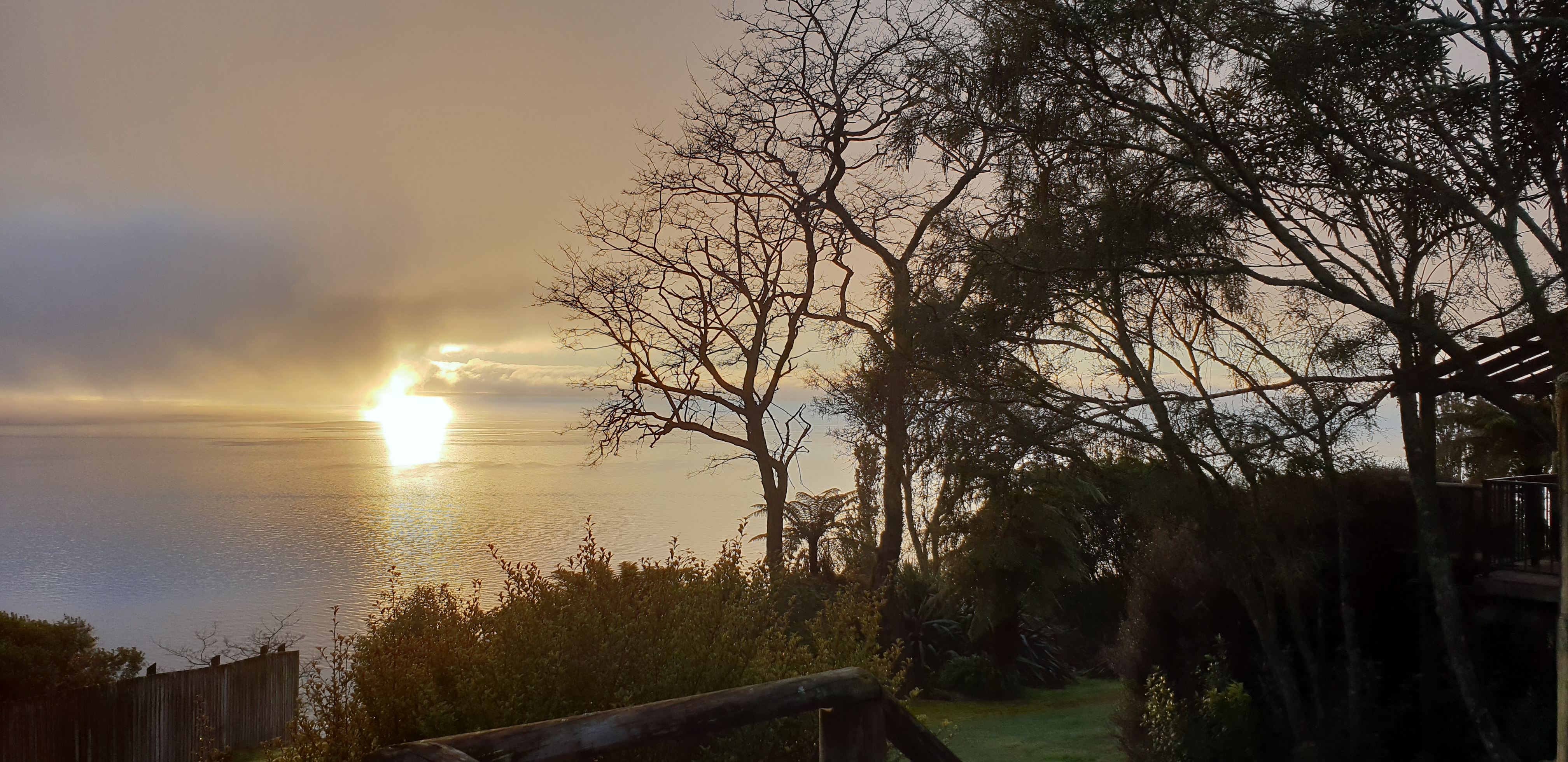
Searching for locations: Oreti Village – No two sunrises are the same – 2

Oreti Village, Pukawa Bay, North Island, New Zeland

On the southern tip of Lake Taupo

Our first morning there, a Saturday.  Winter.  Cold.  And a beautiful sunrise.

20180812_073230

This was taken from the balcony, overlooking the lake.

The sun is just creeping up over the horizon

20180812_073241

It gradually gets lighter, and then the sun breaks free of the low cloud

It lights up the balcony

20180811_074651

And the trees just beyond, a cascade of colorful ferns.

20180811_074622

It looks like it’s going to be a fine day, our first for this trip, and we will be heading to the mountains to see snow, for the first time for two of our granddaughters.

Skeletons in the closet, and doppelgangers

A story called “Mistaken Identity”

How many of us have skeletons in the closet that we know nothing about? The skeletons we know about generally stay there, but those we do not, well, they have a habit of coming out of left field when we least expect it.

In this case, when you see your photo on a TV screen with the accompanying text that says you are wanted by every law enforcement agency in Europe, you’re in a state of shock, only to be compounded by those same police, armed and menacing, kicking the door down.

I’d been thinking about this premise for a while after I discovered my mother had a boyfriend before she married my father, a boyfriend who was, by all accounts, the man who was the love of her life.

Then, in terms of coming up with an idea for a story, what if she had a child by him that we didn’t know about, which might mean I had a half brother or sister I knew nothing about. It’s not an uncommon occurrence from what I’ve been researching.

There are many ways of putting a spin on this story.

Then, in the back of my mind, I remembered a story an acquaintance at work was once telling us over morning tea, that a friend of a friend had a mother who had a twin sister and that each of the sisters had a son by the same father, without each knowing of the father’s actions, both growing up without the other having any knowledge of their half brother, only to meet by accident on the other side of the world.

It was an encounter that in the scheme of things might never have happened, and each would have remained oblivious of the other.

For one sister, the relationship was over before she discovered she was pregnant, and therefore had not told the man he was a father. It was no surprise the relationship foundered when she discovered he was also having a relationship with her sister, a discovery that caused her to cut all ties with both of them and never speak to either from that day.

It’s a story with more twists and turns than a country lane!

And a great idea for a story.

That story is called ‘Mistaken Identity’.

Read an extract tomorrow.

I’ve been reading a lot

And at times wish I hadn’t.

Having been a journalist in a previous lifetime, and one that always believed that the truth mattered, it didn’t take long to realise that journalists should never let the truth get in the way of a good story.

Newspapers, and all other forms of media, will only write what they believe will sell, or what they think the public wants to read. The truth, sadly, is not the first thing on the readers mind, only that someone is to blame for something they have no control over, and it doesn’t matter who.

And the more outlandish the situation, the more the public will buy into it.

This, I guess, is why we like reading about celebrities and royalty, not for the good they might do, but the fact they stumble and make mistakes, and that somehow makes us feel better about ourselves.

Similarly, if the media can beat up a subject, like the corona-virus, and make it worse that it is, then people will lap up the continuing saga, as it relates to them, and will take one of two stances, that they believe the horror of it, and do as they’re asked, or disbelieve it because nothing can be that bad, and ignore it and the consequences of disobedience. knowing the government will not press too hard against the non compliers simply because of domocracy issues it will stir up.

That is, then the media will get a hold of this angle and push it, and people will start to think disobedience is a good thing not a bad.

So, our problems of trying to get a fair and balanced look at what the coronavirus is all about is nigh on impossible. We are continuously bombarded with both right and wrong information, and the trouble is, both sides are very plausibly supported by facts.

And that’s the next problem we have in reporting. We can get facts to prove anything we want. It;s called the use and abuse of statistics, and was an interest part of the journalism degree I studied for. We were told all about statistics, good and bad, and using them to prove the veracity of our piece.

I remember writing a piece for the tutor extolling the virtues of a particular person who was probably the worst human since Vlad the Impaler, using only the facts that suited my narrative. I also remember the bollocking he gave me for doing so, but had to acknowledge that sometimes that would happen.

Integrity of reporting only went as far as the editor, and if the editor hated something, you had to hate it too. This is infamously covered in various texts where newspaper publishers pick sides, and can influence elections, and governments. It still happens.

So, the bottom line is, when I;m reading an article in the media, I always take it with a grain of salt, and do my own fact checking, remembering, of course, not just to fact check to prove the bias one way of the other, but the get a sense of balance.

You can see at the moment when elections don’t matter, no one is talking about what they’re going to do for us, no one is telling us what their policies are. It’s simply schoolyard tit for tat garbage speak. What happened to the town hall meeting, a long and winding speech encompassing what the government plans to do for its people now, and then genuinely answer questions?

Perhaps we should ban campaigning, and just get each party to write a book about what they intend to do, and keep them away from the papers, the TV, and any other form of media, in other words, don’t let them speak!

And don’t get me started about the drivel they speak in the parliament. Five year olds could do a better job.

OK, rant over.

An excerpt from “If Only” – a work in progress

Investigation of crimes don’t always go according to plan, nor does the perpetrator get either found or punished.

That was particularly true in my case.  The murderer was very careful in not leaving any evidence behind, to the extent that the police could not rules out whether it was a male or a  female.

At one stage the police thought I had murdered my own wife though how I could be on a train at the time of the murder was beyond me.  I had witnesses and a cast-iron alibi.

The officer in charge was Detective Inspector Gabrielle Walters.  She came to me on the day after the murder seeking answers to the usual questions when was the last time you saw your wife, did you argue, the neighbors reckon there were heated discussions the day before.

Routine was the word she used.

Her Sargeant was a surly piece of work whose intention was to get answers or, more likely, a confession by any or all means possible.  I could sense the raging violence within him.  Fortunately, common sense prevailed.

Over the course of the next few weeks, once I’d been cleared of committing the crime, Gabrielle made a point of keeping me informed of the progress.

After three months the updates were more sporadic, and when, for lack of progress, it became a cold case, communication ceased.

But it was not the last I saw of Gabrielle.

The shock of finding Vanessa was more devastating than the fact she was now gone, and those images lived on in the same nightmare that came to visit me every night when I closed my eyes.

For months I was barely functioning, to the extent I had all but lost my job, and quite a few friends, particularly those who were more attached to Vanessa rather than me.

They didn’t understand how it could affect me so much, and since it had not happened to them, my tart replies of ‘you wouldn’t understand’ were met with equally short retorts.  Some questioned my sanity, even, for a time, so did I.

No one, it seemed, could understand what it was like, no one except Gabrielle.

She was by her own admission, damaged goods, having been the victim of a similar incident, a boyfriend who turned out to be a very bad boy.  Her story varied only in she had been made to witness his execution.  Her nightmare, in reliving that moment in time, was how she was still alive and, to this day, had no idea why she’d been spared.

It was a story she told me one night, some months after the investigation had been scaled down.  I was still looking for the bottom of a bottle and an emotional mess.  Perhaps it struck a resonance with her; she’d been there and managed to come out the other side.

What happened become our secret, a once-only night together that meant a great deal to me, and by mutual agreement, it was not spoken of again.  It was as if she knew exactly what was required to set me on the path to recovery.

And it had.

Since then we saw each about once a month in a cafe.   I had been surprised to hear from her again shortly after that eventful night when she called to set it up, ostensibly for her to provide me with any updates on the case, but perhaps we had, after that unspoken night, formed a closer bond than either of us wanted to admit.

We generally talked for hours over wine, then dinner and coffee.  It took a while for me to realize that all she had was her work, personal relationships were nigh on impossible in a job that left little or no spare time for anything else.

She’d always said that if I had any questions or problems about the case, or if there was anything that might come to me that might be relevant, even after all this time, all I had to do was call her.

I wondered if this text message was in that category.  I was certain it would interest the police and I had no doubt they could trace the message’s origin, but there was that tiny degree of doubt, whether or not I could trust her to tell me what the message meant.

I reached for the phone then put it back down again.  I’d think about it and decide tomorrow.

© Charles Heath 2018-2021

The cinema of my dreams – It’s a treasure hunt – Episode 35

Here’s the thing…

Every time I close my eyes, I see something different.

I’d like to think the cinema of my dreams is playing a double feature but it’s a bit like a comedy cartoon night on Fox.

But these dreams are nothing to laugh about.

Once again there’s a new installment of an old feature, and we’re back on the treasure hunt.


It was an understatement to say I was dreading going to Boggs’ place.

In fact, in the hour it took to get through the morning chores I had time to consider how and why I was in this position.  Boggs was a friend.  We were friends at school and as best we could we had each other’s back when the bullies came out to play.

At times that didn’t amount to much because as everyone knows, bullies hunt in packs.  Six against two wasn’t much of an equation.  And it those days, the teachers spent more time hiding from the students than being in front of them.

It was simply a case of what doesn’t kill you makes you stronger.

It didn’t feel like that, not for a very long time.

But, in the end, misfortune can make strange bedfellows, and in a town that depended on a single industry, it soon became apparent that there were more people against the Benderby’s and the Cossatino’s than for, and in small-town politics, that was more than an evening up.  Out of school and separated from their acolytes, both Alex and Vince found that whatever influence they had once, was now gone, and all that was left was a grunt, and we were basically left alone.

Boggs was the dreamer.

He had idolized his father and when he went missing it broke him.

This map thing was the first signs of Boggs finally coming back to life, but the problem was, it was all pinned on false hopes.  The Sherriff was right.  Boggs was in over his head, playing with the two most vicious families from around here, and it was bad enough that his father had fallen foul of them, the Sherriff was not about to see his son go the same way.  I was going to try and talk Boggs out of it.

Yet, on the other hand, it was people like us who needed a win, just to show there was still hope in this place.  With threats every day that the factory might have to close, there were dark clouds hanging over everyone’s head.

If the factory closed, there was going to be a very large hole in the local economy and a lot of people in financial trouble.  I’m not sure how finding the treasure might solve all of that, but I suspect Boggs’ had something up his sleeve.

I knocked on the door and his mother answered.  She looked harried.  She was a nurse and looked as though she just got home from the night shift at the hospital.  

“Boggs is in his room.”

“How are you this morning?”

“Tired.  And an afternoon shift, which I might not get to if I don’t get some sleep.  You know where he is.  Try not to make any noise.”

“Will do.”

I came in and closed the door, watching her dash off down the passage to the other end of the house.

She could not work endless double shifts for much longer, but like all of us, it was not out of desire but necessity.  She had implored Boggs to get a job and help, but he seemed oblivious to the problem.  I’d tried to speak to him, but he had that insufferable way of just not listening.

Boggs was in his room, sitting on the bed and staring at the ceiling.

I looed up too, but there was nothing there.

“Don’t tell me,” I said, “but you’ve suddenly discovered you’ve got X-Ray vision.”

“If only.  I could use it right now to find something that’s missing>”

“Your cell phone?”  Boggs was always misplacing something, of forgetting it.  I’d lost count how many times he’d misplaced his phone.

“No.  An underground river.”

OK.  That was out of left field.  I had no idea any rivers were missing, or, in fact, they could actually go missing.

Apparently, they could.

“There’s two,” he said.  300 years ago five or take this part of the coastline had several rivers that ran down from the mountain range.  What we now call the hills on the edge of the coastal plain.  There was also a lake, not very large, but it used to have several streams flow into it all year round and had an aqua flow that came out along the coastline.”

“And you figured all of this out from what?  A copy of the treasure map.”

The moment he started quoting rivers, streams, and lakes, I remembered each of those geographical features appeared on several of the map versions.  I had suggested, rather comically, that it would be funny if the treasure was buried in the lake.

It wasn’t all that funny.  It was also possible.

“Imagine this.  Drop anchor out to sea, in other words on the other side of the natural sandbar that formed at the seaward side of the river, get in the longboats and row inshore to the lake, across the lake, up another river to the base of the hills.  Then do a little exploring, north or south, and find a cave.  I reckon the treasure was buried in a cave.  We know there are caves up there, not many, but I think there used to be more.”

“Someone already did a survey with some rather fancy electronic equipment with the same idea in mind.  He found three, not very long, and certainly without treasure.  Two had substantial falls inside, which is why they were buried.”

“There’s more.”

He jumped up off the bed and went over to the robe and opened the door.  Tacked on the back was a copy of an ordnance survey map of this part of the coastline, and a tracing of the treasure map, to the same scale on top.

“As you can see, I think ‘I’ve found the correlation between the real, and what was real 300 years ago.”

Except there’s no rivers and no lake.  And no sand bar as I recall.  There was a small marina in what might have been where the river met the sea, but that’s gone.  They filled it in and build a shopping mall on it.  A huge, now half empty, shopping mall.  A modern wonder 40 years ago that was supposed to bring business and shoppers to the town.  For a few years it did, until another town 50 miles away got the same idea, sold the land for half the price, and made the rents a quarter of what they were here.

They called it progress.

We called it piracy.

“Then we can hardly row our boat inshore and up the stream, if it’s not there.”

I hated to state the obvious.

“But,” he said, looking like the cat who’d swallowed the canary.  “What if it is still there, but we just can’t see it?”

© Charles Heath 2020

The story behind the story – Echoes from the Past

The novel ‘Echoes from the past’ started out as a short story I wrote about 30 years ago, titled ‘The birthday’.

My idea was to take a normal person out of their comfort zone and led on a short but very frightening journey to a place where a surprise birthday party had been arranged.

Thus the very large man with a scar and a red tie was created.

So was the friend with the limousine who worked as a pilot.

So were the two women, Wendy and Angelina, who were Flight Attendants that the pilot friend asked to join the conspiracy.

I was going to rework the short story, then about ten pages long, into something a little more.

And like all re-writes, especially those I have anything to do with, it turned into a novel.

There was motivation.  I had told some colleagues at the place where I worked at the time that I liked writing, and they wanted a sample.  I was going to give them the re-worked short story.  Instead, I gave them ‘Echoes from the past’

Originally it was not set anywhere in particular.

But when considering a location, I had, at the time, recently been to New York in December, and visited Brooklyn and Queens, as well as a lot of New York itself.  We were there for New Years, and it was an experience I’ll never forget.

One evening we were out late, and finished up in Brooklyn Heights, near the waterfront, and there was rain and snow, it was cold and wet, and there were apartment buildings shimmering in the street light, and I thought, this is the place where my main character will live.

It had a very spooky atmosphere, the sort where ghosts would not be unexpected.  I felt more than one shiver go up and down my spine in the few minutes I was there.

I had taken notes, as I always do, of everywhere we went so I had a ready supply of locations I could use, changing the names in some cases.

Fifth Avenue near the Rockefeller center is amazing at first light, and late at night with the Seasonal decorations and lights.

The original main character was a shy and man of few friends, hence not expecting the surprise party.  I enhanced that shyness into purposely lonely because of an issue from his past that leaves him always looking over his shoulder and ready to move on at the slightest hint of trouble.  No friends, no relationships, just a very low profile.

Then I thought, what if he breaks the cardinal rule, and begins a relationship?

But it is also as much an exploration of a damaged soul, as it is the search for a normal life, without having any idea what normal was, and how the understanding of one person can sometimes make all the difference in what we may think or feel.

And, of course, I wanted a happy ending.

Except for the bad guys.


Get it here:  https://amzn.to/2CYKxu4

newechocover5rs


In a word: arm

Like leg, arm is a word that is mostly associated with a body part.

Like being legless, another description for being drunk, being rendered ‘armless’ means you are no threat, in a rather awful but funny way by saying it.

I guess we all have a dash of ‘sick’ humour in all of us.

However, arm can also be used to describe a part of a structure too.

It could also describe the arm of an ‘armchair’.

But…

Arm also means to give people weapons like guns, usually from an armoury.

I’m guessing that a whole lot of people with arms is an army!

You can also say that taking those weapons away would be to disarm them.

It might take the long arm of the law to do it, too.

And to disarm someone doesn’t necessarily mean to take away their arms, but to ‘charm’ them with your wit and humour.

An arm can also be a river or streams tributary, so I could say instead of staying on the main river, I’ll take the ‘named’ arm, but just remember, sometimes this can be dangerous, getting off the main route.

On a boat, there is a yardarm, and this was once used to hang seamen who committed serious crimes such as mutiny.

A call to arms was to declare war,

And lastly, an arm of the defence services could be any one of Army, Navy, Marines or Airforce.

Just steer clear of the Navy for the aforementioned reasons.

I always wanted to see the planets – Episode 27

Now, about those aliens…

Of course the first action I took was to call on security to disperse people across all decks and departments to make sure no one boarded our ship unnoticed.

We needed to find a way of detecting such boardings without having to deploy people, a matter I’d bring up at the first departmental heads meeting.

If there was ever going to be a time for it.

“Mallory to the Captain, can we meet urgently?”

Mallory was one of the three men in the shuttle that brought me to the ship, and he was, if I remember rightly, one of the scientists, his field being scanners. Just the man to ask about detecting alien presences.

“Come up the the bridge. We’ll talk in the day room.”

I handed over the bridge to number one, and met Mallory at the elevator. He took a few moments to take in the bridge, the screen, now showing both Uranus, and several of its moons.

“Great view “

“Sometimes it’s better not knowing what’s out there,” I said.

His expression told me that comment might have been a little too flippant in the circumstances.

“Come this way.” I led him to the day room, opened the door and followed him in.

“I assume,” I said after waiting till the door was closed, “that it’s not a matter you wanted to share with the rest of the bridge.”

“That’s for you to determine. But it’s about the ship that was just here.”

“We believe it’s alien.”

“It’s not.”

OK. That was a revelation, but how could he tell the difference? My immediate guess, they had no previous alien profile to run it against.

“How so?”

“We have scanners, and we have scanners.”

Confusing to say the least, but I think I knew what he was trying to say. We had a military presence, but until I became captain, I didn’t realise we also had military hardware.

What else did we have?

“We have the ability to scan other vessels, and in certain circumstances, check for lifesigns inside. But we only had earth created ships to use as a subject for testing, simply because we know the compounds used in our vessel’s structure, including this one.”

“So anything made by us can be scanned?”

“Yes, and that ship just standing off us, we could scan it and what and who was inside, which means it’s not an alien vessel.”

That was perfectly good reasoning, except as far as I was aware, this ship was not completely earth technology.

“There might be only one way to create the outer skins and superstructure, in any ship.”

“That’s possible, yes. But we anticipated that we might eventually run into something we couldn’t penetrate until we could work out what the ship was made of and then work out how to penetrate it. That so called alien ship, we could see inside.”

“It could still be an alien ship. After all, I assume you adjusted the scanners to work through the material this ship is made of, and I doubt you’re going to argue the metal used was the result of an accidental discovery.”

He looked uncomfortable, and for a moment I thought he was going to try, but just sighed. “It’s possible, but unlikely.”

“OK then, does it fit the profile of any earth vessels?”

I knew of about 200 different types of ship out here in space, not all as well as some, and the computer recognition system had hundreds more variations, so if we ran into another ship, we could identify it.

“One or two, but it’s been modified. Also, there’s only six people on board, and from our scan, it seems all were recently in custody at a Mars penitentiary outpost. They were given a so called vaccination which put nanites in their system so they could be recognised if or when they decided to rebel.”

“Are they escaped prisoners?”

“Given the discussion I just had with security, that seems to be the case. But to verify those assumptions I got onto the Mars station, and it seems they are unaware of any missing prisoners or ships, but have sent someone over to check “

“Don’t they guard prisoners anymore?”

“They do, but with robots, and due to the remoteness, infrequent fly bys. They were coming up for one.”

“How infrequent?”

“I was told a few months, but I suspect it’s been longer. As for getting a ship, a well organised gang could have rescued some space junk and brought it back to life. It’s possible. And space still is a bit like the wild west.”

A recent problem, now that there was an ever increasing demand for travel and freight across our particular galaxy. Venus, Mars had galactic hotels, Saturn a space station and fly bys, and mining on various of the planets.

It was disappointing to realise our first contact wasn’t a first contact with a new world, just criminals expanding their horizons.

“Do they have weapons?”

“If we do, they do. We think the two smaller ships are modified troop carriers, the larger vessel, a freighter, but they have tinkered with the exterior to make people think they’re something or someone else.”

“They move pretty fast, much faster that anything we’ve got.”

“Except for this ship which may have surprised them, as well as some of us.”

“Anything else I need to know about?”

“About the other ships no. The military boys will want to join in the discussion of our next move. Something else you might want to know is that we were checking the logs and indemnified where those so called aliens came aboard, and to safely transport from one point to another, you need markers at each end.”

“And you found them?”

“In two places, and immediately removed so there will be no more unwanted boardings.”

“It raises the question…”

“A traitor on board? I don’t believe so, because they looked like they’d been installed as part of the decking. The traitors are back at the space station where the vessel was built.”

“OK. We’d better get everyone in the conference room and work out what we’re going to do next. Don’t go too far.”

© Charles Heath 2021