“For heaven’s sake…” – a short story

It was a combination of circumstances, not all related, but coming at me out of left field, circumstances that would prevent me from going home when I said I would.

I had every intention of getting there and as a testament to that, I had got to the airport with baggage two hours before departure time and had reached the departure gate with 20 minutes to spare, ready to board the plane.

I’d even got a business class ticket so I could travel in style.

What precipitated the set of circumstances? A simple phone call. I should have turned it off five minutes before boarding, but I didn’t but because I’d forgotten to, simply because I’d been distracted.

The call was from Penelope, my hard-working and self-sacrificing personal assistant. I had offered to take her with me so we could work on a business plan that had to be presented the day after I was scheduled to return, but she had declined, which when I thought about it, if she hadn’t it might have created problems for both of us.

With a huge restructure going on, I was running behind in getting it completed and had promised to finish it while at home.

The call: to tell me I had left a folder with vital research back on my desk, and she came to the airport to deliver it, and she was, in fact, was in the terminal building when the boarding call came.

When I met her at the gate, only a few passengers had to be loaded. Being business class had afforded me a few extra minutes. File delivered, I left her looking exasperated and headed down the boarding ramp.

I was last aboard, and seconds after being seated, the door was closed.

I quickly typed and sent a message to tell everyone I was on the plane, eliciting two responses. My mother was glad that I was finally coming, the other from my elder brother, saying he would believe it when he saw me.

It was not without reason; I’d been in this situation before; on the plane ready to go.

Last time the plane didn’t leave the gate, a small problem that caused a big delay, so much so, I couldn’t get home.

Not this time. There was a slight lurch as the push tractor started pushing the plane back from the gate. A minute or so later the pilot fired up the engines, a sure sign of a definite departure. Nothing could stop us now.

It was a reassuring vibration that ran through the plane before the engines settled into a steady whine, a sign of an older plane that had flown many miles in the past and would into the future.

We stopped while the push tractor was disengaged and then the engines picked up speed and we lurched forward, heading towards the runway for take-off. In some airports, this could take a long time, and tonight it seemed to take forever.

I looked out the window and saw a backdrop of lights against the darkness, but no indication of where we were. It didn’t look like the end of the runway because I could not see any other planes waiting to take off.

Then the engines revved louder and for a pronged period. We didn’t move but remained where we were until the engines returned to what might be called idling speed

It was followed by an announcement from the pilot, “This is the captain speaking. We have encountered an anomaly with one of the engines, so to be on the safe side, we are returning to the gate and will have the engineers have a look at it. I do not anticipate this should take longer than 30 minutes.”

A collective groan went through the airplane. Those savvy with these problems would know that the odds were we would not be leaving tonight. The airport curfew would see to that.

But a miracle could still occur.

The plane then started back to the terminal. Another message from the pilot told us we would not be going back to the gate, but to a holding area. Time to have a glass of champagne the steward was offering before going back to the terminal for what, an interminable wait.

It seemed the gods did not want me to go back home.

When we got back to the parking spot, three buses and four delays later, I headed for one of the several bars to get a drink, and perhaps something decent to eat.

Then I saw Penelope, sitting by herself, a glass of champagne sitting half drunk in front of her.

“What are you doing here?” I said as I slid onto the stool beside her.

She started, as if she had been somewhere else, and turned to see who it was. The faraway look turned into a smile when she recognized me. “Getting drunk.”

“I thought you were going home.” A nod in the direction of the bartender, followed by pointing to her glass and indicating I wanted two, got instant service.

“I saw an ex heading to a plane with his latest squeeze. Made me feel depressed. I heard your plane was returning so I decided to wait. Better to get drunk with someone you know than drink by yourself or someone you don’t. I’ve had three offers already.”

I wasn’t surprised. She was very attractive, the sort of woman who was the most popular at any of the work functions but was equally surprising was that she was not with any of those potential suitors. In fact, as far as I knew, she was not in a relationship.

“No one at home to amuse you?” It was not the sort of question I should be asking, because it was really none of my business.

It elicited a sideways glance as if I stepped over an invisible line.

“Sorry, none of my business.”

She finished off the glass in front of her, just as the new round arrived in front of her. I gave the bartender my credit card and asked him to start a tab. I’d just heard that the plane was going to be another two hours before we’d be leaving.

“I live with two other girls, but they are more interested in finding stray men and getting wasted, not necessarily in that order, and that’s not what I want to do.”

“Get wasted or find stray men?”

I was not sure how anyone had the time and inclination to do that, but a few weeks back I spent two evenings with a friend of mine whose marriage had fallen apart. The people there seemed either desperate or looking for a one-night stand. It had amused me to discover most of them were married, and not divorced, and that the girls knew what to expect.

“Both apparently.”

“How do you expect to find the man of your dreams if you don’t go looking.”

“I am, this place seems as good as any, but the man of my dreams doesn’t exist.”

The bemused expression and the tone of her voice told me she had had more than one drink before I got there. Even then, judging from several previous parties for work we had attended, she had a much greater capacity for alcohol than I had.

She finished off the glass just brought, and seconds later her eyes seemed glassy. Perhaps it was time for me to put her in a cab and send her home.

“Another,” she said, “and then you can be responsible for me.”

I had no idea what that meant, and I think, judging by the facial expressions, she didn’t really care.

“Perhaps…”

She didn’t let me finish. “Perhaps you should buy me another drink and lighten up.” And the look that came with it told me not to argue the point.

I got the bartender’s attention, and he responded by bringing two fresh glasses and a bottle. I told him to leave it. It gave me a minute or so to contemplate what she meant by ‘lighten up’. I was so used to seeing her work ethic and diligence, this was a different side to her.

I took a sip and could feel her looking at me. A glance took in the near permanent bemused expression.

“Are you going to be alright getting home?” It was probably not the question I should have asked, but in the back of my mind there was a recent briefing given to all of management on the subject of sexual harassment and intraoffice romances.

“I’m fine. It’s not as if I do this a lot, but the last week has been difficult. Not only for me, but for you too. But you have to admit you put yourself under a lot of pressure.”

She was starting to sound like my conscience. It was something I’d been thinking about on the way to the airport but decided it was part of the job, and I knew when I accepted the position what it would involve. My predecessor, much older than I was, had fallen on his sword, the pressure destroying his marriage and almost his life.

“So I said, lamely, It goes with the job, unfortunately.”

She shook her head. “No, it doesn’t. They might think it does, but they don’t care. They sit in their ivory tower and watch their minions crash and burn. There’s always someone else waiting in the wings to take your place, believe me.”

It was an interesting perspective, but where did it come from? I knew she had been at the corporation for a number of years, and I had been lucky enough to draw the long straw when having her assigned to me as my PA when I took the position. One of the other executives had lamented my good fortune, but he had also said she was one of the few who were there to guide that higher management considered were management prospects.

I just thought I was lucky.

“I might end up in that ivory tower one day.”

“Why?”

She turned to look directly at me. It made me uncomfortable now, as it had on other occasions, and I had begun to think it might have something to do with unspoken feelings. I liked her, but I doubted that was reciprocated. And, after the lecture on office romances, I promptly put those feelings in the bottom drawer and locked it.

“Doesn’t everyone aspire to be the best, and climb to the top of the corporate ladder?”

“For that, you have to be devious and ruthless, and from what I’ve seen, you’re neither. You’ve heard the expression ‘good guys come last’. It’s true.”

I was guessing from the people she had worked for, she had firsthand experience. My predecessor was a ‘good guy’ and some said he was eaten alive by the office predators. I knew who they were, and avoided them. Perhaps she knew something I didn’t, but when would she have told me? Not tonight, no one could have predicted the plane would break down.

“You’re telling me this now, why?”

“You’re smarter than all of those above you put together. You don’t need them, but they need you. But, you won’t get any concessions, not until you get near the top. By then you will have had to sell your soul to the devil.”

Good to know, on one hand, I was about to see my soul to the devil, and on the other that I was smart, just not smart enough to see the wolves in sheep’s clothing.

I noticed she hadn’t touched the latest glass of champagne. Nor was she the languid barfly she’d pretended to be earlier.

“You’re advice, if I’m listening correctly, is that I should be looking for another job.”

“Actually, you shouldn’t be listening to me at all. Too many drinks and I pontificate. Some people become happy, I become,” she shrugged, “unhappy. Take no notice.” She swung around to the front and picked up the glass.

“OK.” I turned around to look at the departures board to see my flight had been canceled, and I should go to the check-in counter. “My plane is completely broken, so it looks like I’m staying home.”

“Or you could take me to dinner.” She looked sideways again, the bemused expression back.

“Wouldn’t that be inappropriate?”

“Only if you were in upper management, married, and asking me to have an affair. Last I looked you’re not in upper management, not married, so there’s no hint of an affair. For heaven’s sake, it’s only dinner.”

She was right on all counts, and it was only dinner.

“Why not?” I said, more to myself than to her.

“Good. And you’d better get me on the plane too. We need to get that report done, and it’ll be an excuse to stay at a hotel. I know you wouldn’t want to stay in your old room at your parents’ house.”

She was right about that too, I had long outgrown them, and staying at home would only lead to arguments. “How could you possibly know that?”

She smiled. “You talk in your sleep.”

© Charles Heath 2021

The fourth attempt, other factors, and people

There are two other characters that will be used in this rewrite, the second an addition to give the main character a means of letting the reader get to know a bit about him.

His name is Milt, an African American that’s always been on the fringe.  Another who is a victim of his circumstances but not letting it get the better of him, the sort of man who makes the best of a bad situation.

He’s seen active service in the army, honourably discharged, but still affected though not as bad as some of those he served with.  He is in fact the ideal man for the job, with combat experience, so he’s not likely to get flustered in a shit storm.

And probably not the man you want on this site.  Being in desperate circumstances doesn’t mean you do desperate things.

He is one of a team of four and our main character drew the straw to partner him.  There are two others, based on the other side of the park, neither of whom are trustworthy, Smithy, the overall leader, to whom they all report at shift start and end, and Carruthers, an Englishman reputed to be ex SAS, but no one is inclined to believe him. 

The scars on his neck tell a story, but it was left to the other’s imagination, as he doesn’t talk about it.  Milt was of the opinion he was captured in Afghanistan and tortured, but that could be just be canteen scuttlebutt.

Whatever the circumstances, Graham kept away from him as much as possible, and was glad when he didn’t have to partner him for the shift.

The other character. Penelope has featured in the earlier versions of the story.  Over the changes her background has changed, but I’ve settled on a medical surgeon career, renown for doing tricky procedures with a high success rate, and in doing so gained a reputation, some not always good.

Wealth and ego don’t always make a good pair, and marrying wealth brings its own rewards and pitfalls, particularly when you discover the man you married isn’t exactly whom you thought he was.

It is of course a typical scenario, but I’m going to try and weave it differently.  There will be no more teasers until the story starts.

But she will be introduced earlier than in the previous iterations because she needs some backstory too, otherwise just arriving at Graham’s work and getting shot, while provoking a volatile situation that drags the reader in, out of left field is not exactly the best start.

So, let’s begin.

© Charles Heath 2020

Writing about writing a book – Day 18

It’s time to go back to working on Bill’s backstory now that we’ve filled in some of the gaps.

Like some TV shows and books, some of the action sometimes takes the form of flashbacks.

In Starburst, Bill has a complete backstory, of a time that he had mainly forced into the deep dark part of his memory, waiting for something or someone to trigger it.

This whole back story, from the moment he entered the war zone, to the moment his war ended, and those that participated throughout that time, will be in the form of flashbacks, the first of which is triggered by the painkiller Bill is given after being shot in the Aitcheson incident.

These flashbacks will not necessarily be in any sort of order, but I have been thinking about this part of the story and produced an outline of the sequences I will require, give or take.  There may be more, or less, depending on how the story progresses.

Part 1 – From arrival in the war zone to being assigned to Davenport’s squad

Being sent to, and the first patrol in Vietnam

Death and mayhem some months after sent to Vietnam

First meeting Barry in army mobile hospital

R and R in Saigon, with the first of the Vietnamese girls

Psychiatric help, time in the stockade

No soldier who trains for war, nor can they have a real idea what war is like, and certainly a war in the jungle, on the enemy’s terms.  Bill is like any other soldier, happy to go into service, but soon the reality, and death becomes apparent.

Endless rain, endless heat, endless and sometimes needless death, and a deep mistrust of those whom you are supposed to protect, start to work on the mind of a person young enough not to understand what is going on.

Then, when trying to blot out the memories of death, enemy and friend alike, something has to give.  Of course, the last place you want to end up in the stockade.

Part 2 – A lifeline, and a pass into the so-called Davenport Operation

Training as a spy?

Colonel, calling Bill into a briefing on the Davenport operation

Talking to the Commanding officer in Stockade, as a preliminary to Davenport service

Was Bill sent to the stockade because he committed an act of folly, or his incarceration a part of a much larger plan, a plan to have an inside man to report on Davenport?

It’s not the first time someone higher up the chain of command has had ideas of trying to find out what Davenport is doing, and where only rumors abound of his ‘interests’.  Agents had been sent in before, and those agents had disappeared.

Was Bill about to be the next, or was he just in the wrong place at the wrong time?

There is more, but I’m still working on it.

© Charles Heath 2015-2021

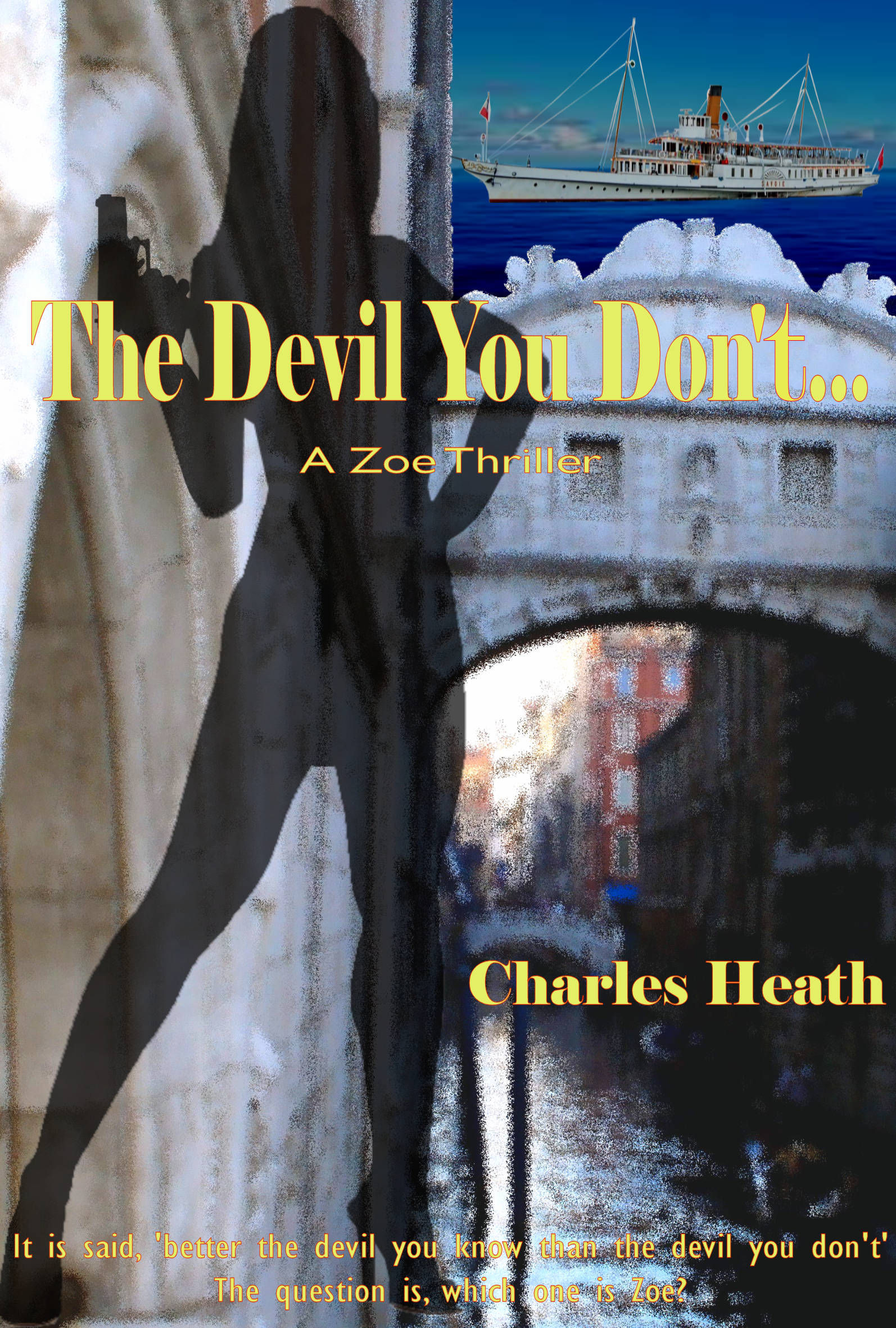
“The Devil You Don’t”, she was the girl you would not take home to your mother!

Now only $0.99 at https://amzn.to/2Xyh1ow

John Pennington’s life is in the doldrums. Looking for new opportunities, prevaricating about getting married, the only joy on the horizon was an upcoming visit to his grandmother in Sorrento, Italy.

Suddenly he is left at the check-in counter with a message on his phone telling him the marriage is off, and the relationship is over.

If only he hadn’t promised a friend he would do a favor for him in Rome.

At the first stop, Geneva, he has a chance encounter with Zoe, an intriguing woman who captures his imagination from the moment she boards the Savoire, and his life ventures into uncharted territory in more ways than one.

That ‘favor’ for his friend suddenly becomes a life-changing event, and when Zoe, the woman who he knows is too good to be true, reappears, danger and death follow.

Shot at, lied to, seduced, and drawn into a world where nothing is what it seems, John is dragged into an adrenaline-charged undertaking, where he may have been wiser to stay with the ‘devil you know’ rather than opt for the ‘devil you don’t’.

newdevilcvr6

Searching for locations: The Erqi Memorial Tower, Zhengzhou, China

A convoluted explanation on the reasons for this memorial came down to it being about the deaths of those involved in the 1923 Erqi strike, though we’re not really sure what the strike was about.

So, after a little research, this is what I found:

The current Erqi Tower was built in 1971 and was, historically, the tallest building in the city. It is a memorial to the Erqi strike and in memory of Lin Xiangqian and other railway workers who went on strike for their rights, which happened on February 7, 1923.

It has 14 floors and is 63 meters high. One of the features of this building is the view from the top, accessed by a spiral staircase, or an elevator, when it’s working (it was not at the time of our visit).

There seems to be an affinity with the number 27 with this building, in that

  • It’s the 27th memorial to be built
  • to commemorate the 27th workers’ strike
  • located in the 27th plaza of Zhengzhou City.

We drive to the middle of the city where we once again find traveling in kamikaze traffic more entertaining than the tourist points

When we get to the drop-off spot, it’s a 10-minute walk to the center square where the tower is located on one side. Getting there we had to pass a choke point of blaring music and people hawking goods, each echoing off the opposite wall to the point where it was deafening. Too much of it would be torture.

But, back to the tower…

It has 14 levels, but no one seemed interested in climbing the 14 or 16 levels to get to the top. The elevator was broken, and after the great wall episode, most of us are heartily sick of stairs.

The center square was quite large but paved in places with white tiles that oddly reflected the heat rather than absorb it. In the sun it was very warm.

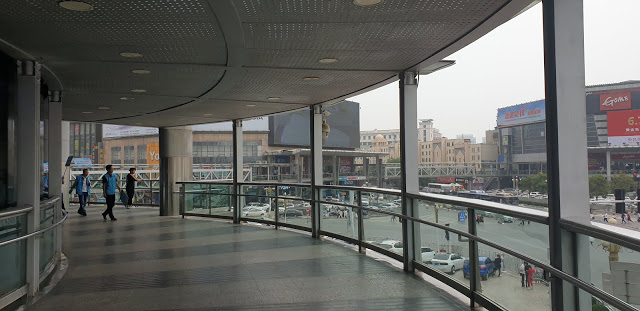
Around the outside of two-thirds of the square, and crossing the roads, was an elevated walkway, which if you go from the first shops and around to the other end, you finish up, on the ground level, at Starbucks.

This is the Chinese version and once you get past the language barrier, the mixology range of cold fruity drinks are to die for, especially after all that walking. Mine was a predominantly peach flavor, with some jelly and apricot at the bottom. I was expecting sliced peaches but I prefer and liked the apricot half.

A drink and fruit together was a surprise.

Then it was the walk back to the meeting point and then into the hotel to use the happy house before rejoining the kamikaze traffic.

We are taken then to the train station for the 2:29 to our next destination, Suzhou, the Venice of the East.

An excerpt from “Mistaken Identity” – a work in progress

The odds of any one of us having a doppelganger are quite high. Whether or not you got to meet him or her, or be confronted by them was significantly lower. Except of course, unless you are a celebrity.

It was a phenomenon remarkable only for the fact, at times, certain high profile people, notorious or not, had doubles if only to put off enemies or the general public. Sometimes we see people in the street, people who look like someone we knew, and made the mistake of approaching them like a long lost friend, only to discover an embarrassed individual desperately trying to get away for what they perceive is a stalker or worse.

And then sometimes in is a picture that looms up on a TV screen, an almost exact likeness of you. At first you are fascinated, and then according to the circumstances, and narrative that is attached to that picture, either flattered or horrified.

For me one turned to the other when I saw an almost likeness of me flash up on the screen when I turned the TV on in my room. What looked to be my photo, with only minor differences, was in the corner of the screen, the news reader speaking in rapid Italian, so fast I could only translate every second or third word.

But the one word I did recognize was murder. The photo of the man up on the screen was the subject of an extensive manhunt. The crime, murder of woman in the very same hotel I was staying, and it was being played out live several floors above me. The gist of the story, the woman had been seen with, and staying with the man who was my double, and, less than an hour ago, the body had been discovered by a chambermaid.

The killer, the announcer said, was believed to be still in the hotel because the woman had died shortly before she had been discovered.

I watched, at first fascinated at that I was seeing. I guess I should have been horrified, but at that moment it didn’t register that I might be mistaken for that man.

Not until an another five minutes had passed, and I was watching the police in full riot gear, with a camera crew following behind, coming up a passage towards a room. Live action of the arrest of the suspected killer the breathless commentator said.

Then, suddenly, there was a pounding on the door. On the TV screen, plain to see, was the number of my room.
I looked through the peep hole and saw an army of police officers. It didn’t take much to realize what had happened. The hotel staff had identified me as the man in the photograph on the TV and called the police.

Horrified wasn’t what I was feeling right then.

It was fear.

My last memory was the door crashing open, the wood splintering, and men rushing into the room, screaming at me, waving guns, and when I put my hands up to defend myself, I heard a gunshot.

And in one very confused and probably near death experience, I thought I saw my mother, and thinking what was she doing in Rome?

I was the archetypal nobody.

I lived in a small flat, I drove a nondescript car, had an average job in a low profile travel agency, was single, and currently not involved in a relationship, no children, and according to my workmates, no life.

They were wrong. I was one of those people who preferred their own company, I had a cat, and travelled whenever I could. And I did have a ‘thing’ for Rosalie, one of the reasons why I stayed at the travel agency. I didn’t expect anything to come of it, but one could always hope.

I was both pleased and excited to be going to the conference. It was my first, and the glimpse I had seen of it had whetted my appetite for more information about the nuances of my profession.

Some would say that a travel agent wasn’t much of a job, but to me, it was every bit as demanding as being an accountant or a lawyer. You were providing a customer with a service, and arguably more people needed a travel agent than a lawyer. At least that was what I told myself, as I watched more and more people start using the internet, and our relevance slowly dissipating.

This conference was about countering that trend.

The trip over had been uneventful. I was met at the airport and taken to the hotel where the conference was being held with a number of other delegates who had arrived on the same plane. I had mingled with a number of other delegates at the pre conference get together, including one whose name was Maryanne.

She was an unusual young woman, not the sort that I usually met, because she was the one who was usually surrounded by all the boys, the life of the party. In normal circumstances, I would not have introduced myself to her, but she had approached me. Why did I think that may have been significant? All of this ran through my mind, culminating in the last event on the highlight reel, the door bursting open, men rushing into my room, and then one of the policemen opened fire.

I replayed that last scene again, trying to see the face of my assailant, but it was just a sea of men in battle dress, bullet proof vests and helmets, accompanied by screaming and yelling, some of which I identified as “Get on the floor”.

Then came the shot.

Why ask me to get on the floor if all they were going to do was shoot me. I was putting my hands up at the time, in surrender, not reaching for a weapon.

Then I saw the face again, hovering in the background like a ghost. My mother. Only the hair was different, and her clothes, and then the image was going, perhaps a figment of my imagination brought on by pain killing drugs. I tried to imagine the scene again, but this time it played out, without the image of my mother.

I opened my eyes took stock of my surroundings. What I felt in that exact moment couldn’t be described. I should most likely be dead, the result of a gunshot wound. I guess I should be thankful the shooter hadn’t aimed at anything vital, but that was the only item on the plus side.

I was in a hospital room with a policeman by the door. He was reading a newspaper, and sitting uncomfortably on a small chair. He gave me a quick glance when he heard me move slightly, but didn’t acknowledge me with either a nod, or a greeting, just went back to the paper.

If I still had a police guard, then I was still considered a suspect. What was interesting was that I was not handcuffed to the bed. Perhaps that only happened in TV shows. Or maybe they knew I couldn’t run because my injuries were too serious. Or the guard would shoot me long before my feet hit the floor. I knew the police well enough now to know they would shoot first and ask questions later.

On the physical side, I had a large bandage over the top left corner of my chest, extending over my shoulder. A little poking and prodding determined the bullet had hit somewhere between the top of my rib cage and my shoulder. Nothing vital there, but my arm might be somewhat useless for a while, depending on what the bullet hit on the way in, or through.

It didn’t feel like there were any broken or damaged bones.

That was the good news.

On the other side of the ledger, my mental state, there was only one word that could describe it. Terrified. I was looking at a murder charge and jail time, a lot of it. Murder usually had a long time in jail attached to it.

Whatever had happened, I didn’t do it. I know I didn’t do it, but I had to try and explain this to people who had already made up their minds. I searched my mind for evidence. It was there, but in the confused state brought on by the medication, all I could think about was jail, and the sort of company I was going to have.

I think death would have been preferable.

Half an hour later, maybe longer, I was drifting in an out of consciousness, a nurse, or what I thought was a nurse, came into the room. The guard stood, checked her ID card, and then stood by the door.

She came over and stood beside the bed. “How are you?” she asked, first in Italian, and when I pretended I didn’t understand, she asked the same question in accented English.

“Alive, I guess,” I said. “No one has come and told what my condition is yet. You are my first visitor. Can you tell me?”

“Of course. You are very lucky to be alive. You will be fine and make a full recovery. The doctors here are excellent at their work.”

“What happens now?”

“I check you, and then you have a another visitor. He is from the British Embassy I think. But he will have to wait until I have finished my examination.”

I realized then she was a doctor, not a nurse.

My second visitor was a man, dressed in a suit the sort of which I associated with the British Civil Service.  He was not very old which told me he was probably a recent graduate on his first posting, the junior officer who drew the short straw.

The guard checked his ID but again did not leave the room, sitting back down and going back to his newspaper.

My visitor introduced himself as Alex Jordan from the British Embassy in Rome and that he had been asked by the Ambassador to sort out what he labelled a tricky mess.

For starters, it was good to see that someone cared about what happened to me.  But, equally, I knew the mantra, get into trouble overseas, and there is not much we can do to help you.  So, after that lengthy introduction, I had to wonder why he was here.

I said, “They think I am an international criminal by the name of Jacob Westerbury, whose picture looks just like me, and apparently for them it is an open and shut case.”  I could still hear the fragments of the yelling as the police burst through the door, at the same time telling me to get on the floor with my hands over my head.

“It’s not.  They know they’ve got the wrong man, which is why I’m here.  There is the issue of what had been described as excessive force, and the fact you were shot had made it an all-round embarrassment for them.”

“Then why are you here?  Shouldn’t they be here apologizing?”

“That is why you have another visitor.  I only took precedence because I insisted I speak with you first.  I have come, basically to ask you for a favour.  This situation has afforded us with an opportunity.  We would like you to sign the official document which basically indemnifies them against any legal proceedings.”

Curious.  What sort of opportunity was he talking about?  Was this a matter than could get difficult and I could be charged by the Italian Government, even if I wasn’t guilty, or was it one of those hush hush type deals, you do this for us, we’ll help you out with that.  “What sort of opportunity?”

“We want to get our hands on Jacob Westerbury as much as they do.  They’ve made a mistake, and we’d like to use that to get custody of him if or when he is arrested in this country.  I’m sure you would also like this man brought into custody as soon as possible so you will stop being confused with him.  I can only imagine what it was like to be arrested in the manner you were.  And I would not blame you if you wanted to get some compensation for what they’ve done.  But.  There are bigger issues in play here, and you would be doing this for your country.”

I wondered what would happen if I didn’t agree to his proposal.  I had to ask, “What if I don’t?”

His expression didn’t change.  “I’m sure you are a sensible man Mr Pargeter, who is more than willing to help his country whenever he can.  They have agreed to take care of all your hospital expenses, and refund the cost of the Conference, and travel.  I’m sure I could also get them to pay for a few days at Capri, or Sorrento if you like, before you go home.  What do you say?”

There was only one thing I could say.  Wasn’t it treason if you went against your country’s wishes?

“I’m not an unreasonable man, Alex.  Go do your deal, and I’ll sign the papers.”

“Good man.”

After Alex left, the doctor came back to announce the arrival of a woman, by the way she had announced herself, the publicity officer from the Italian police. When she came into the room, she was not dressed in a uniform.

The doctor left after giving a brief report to the civilian at the door. I understood the gist of it, “The patient has recovered excellently and the wounds are healing as expected. There is no cause for concern.”

That was a relief.

While the doctor was speaking to the civilian, I speculated on who she might be. She was young, not more than thirty, conservatively dressed so an official of some kind, but not necessarily with the police. Did they have prosecutors? I was unfamiliar with the Italian legal system.

She had long wavy black hair and the sort of sultry looks of an Italian movie star, and her presence made me more curious than fearful though I couldn’t say why.

The woman then spoke to the guard, and he reluctantly got up and left the room, closing the door behind him.
She checked the door, and then came back towards me, standing at the end of the bed. Now alone, she said, “A few questions before we begin.” Her English was only slightly accented. “Your name is Jack Pargeter?”

I nodded. “Yes.”

“You are in Rome to attend the Travel Agents Conference at the Hilton Hotel?”

“Yes.”

“You attended a preconference introduction on the evening of the 25th, after arriving from London at approximately 4:25 pm.”

“About that time, yes. I know it was about five when the bus came to collect me, and several others, to take us to the hotel.”

She smiled. It was then I noticed she was reading from a small notepad.

“It was ten past five to be precise. The driver had been held up in traffic. We have a number of witnesses who saw you on the plane, on the bus, at the hotel, and with the aid of closed circuit TV we have established you are not the criminal Jacob Westerbury.”

She put her note book back in her bag and then said, “My name is Vicenza Andretti and I am with the prosecutor’s office. I am here to formally apologize for the situation that can only be described as a case of mistaken identity. I assure you it is not the habit of our police officers to shoot people unless they have a very strong reason for doing so. I understand that in the confusion of the arrest one of our officers accidentally discharged his weapon. We are undergoing a very thorough investigation into the circumstances of this event.”

I was not sure why, but between the time I had spoken to the embassy official and now, something about letting them off so easily was bugging me. I could see why they had sent her. It would be difficult to be angry or annoyed with her.

But I was annoyed.

“Do you often send a whole squad of trigger happy riot police to arrest a single man?” It came out harsher than I intended.

“My men believed they were dealing with a dangerous criminal.”

“Do I look like a dangerous criminal?” And then I realized if it was mistaken identity, the answer would be yes.

She saw the look on my face, and said quietly, “I think you know the answer to that question, Mr. Pargeter.”

“Well, it was overkill.”

“As I said, we are very sorry for the circumstances you now find yourself in. You must understand that we honestly believed we were dealing with an armed and dangerous murderer, and we were acting within our mandate. My department will cover your medical expenses, and any other amounts for the inconvenience this has caused you. I believe you were attending a conference at your hotel. I am very sorry but given the medical circumstances you have, you will have to remain here for a few more days.”

“I guess, then, I should thank you for not killing me.”

Her expression told me that was not the best thing I could have said in the circumstances.

“I mean, I should thank you for the hospital and the care. But a question or two of my own. May I?”

She nodded.

“Did you catch this Jacob Westerbury character?”

“No. In the confusion created by your arrest he escaped. Once we realized we had made a mistake and reviewed the close circuit TV, we tracked him leaving by a rear exit.”

“Are you sure it was one of your men who shot me?”

I watched as her expression changed, to one of surprise.

“You don’t think it was one of my men?”

“Oddly enough no. But don’t ask me why.”

“It is very interesting that you should say that, because in our initial investigation, it appeared none of our officer’s weapons had been discharged. A forensic investigation into the bullet tells us it was one that is used in our weapons, but…”

I could see their dilemma.

“Have you any enemies that would want to shoot you Mr Pargeter?”

That was absurd because I had no enemies, at least none that I knew of, much less anyone who would want me dead.

“Not that I’m aware of.”

“Then it is strange, and will perhaps remain a mystery. I will let you know if anything more is revealed in our investigation.”

She took an envelope out of her briefcase and opened it, pulling out several sheets of paper.

I knew what it was. A verbal apology was one thing, but a signed waiver would cover them legally. They had sent a pretty girl to charm me. Perhaps using anyone else it would not have worked. There was potential for a huge litigation payout here, and someone more ruthless would jump at the chance of making a few million out of the Italian Government.

“We need a signature on this document,” she said.

“Absolving you of any wrong doing?”

“I have apologized. We will take whatever measures are required for your comfort after this event. We are accepting responsibility for our actions, and are being reasonable.”

They were. I took the pen from her and signed the documents.

“You couldn’t add dinner with you on that list of benefits?” No harm in asking.

“I am unfortunately unavailable.”

I smiled. “It wasn’t a request for a date, just dinner. You can tell me about Rome, as only a resident can. Please.”

She looked me up and down, searching for the ulterior motive. When she couldn’t find one, she said, “We shall see once the hospital discharges you in a few days.”

“Then I’ll pencil you in?”

She looked at me quizzically. “What is this pencil me in?”

“It’s an English colloquialism. It means maybe. As when you write something in pencil, it is easy to erase it.”

A momentary frown, then recognition and a smile. “I shall remember that. Thank-you for your time and co-operation Mr. Pargeter. Good morning.”

© Charles Heath 2015-2021

NaNoWriMo 2021 – Day 28

This image has an empty alt attribute; its file name is NaNoWriMo-WriterBadge-851-2x.png

A score to settle

We’re near the end, and I have to say, it has been hard work.

Today I’ve been writing and revising and reading. There are aspects to the flow that are bothering me, and I know I’m supposed to let it mull for a while before I started editing, but I’m like that, I have to do something about it now, not later.

While I’m doing that, I’ve been working on a musical theme for the writing and hit upon the big band sounds of the 1940s and ’50s.

I have always been fascinated by that era of music, particularly Benny Goodman, but not so much the Dorsey brothers.

It’s then led to the final chapter, as I was playing Sing, Sing, Sing, I had the vision, in the ballroom, just our main character, and Teresa, with a few selected guests.

I’m also one of these people who like happy endings to the stories, or at least until the next book in the series starts.

Two days to go and I can rest.

Maybe. Maybe not. We’ll see.

Today’s word count: 4,499 words, for the running total of 79,305.

“What Sets Us Apart”, a mystery with a twist

David is a man troubled by a past he is trying to forget.

Susan is rebelling against a life of privilege and an exasperated mother who holds a secret that will determine her daughter’s destiny.

They are two people brought together by chance. Or was it?

When Susan discovers her mother’s secret, she goes in search of the truth that has been hidden from her since the day she was born.

When David realizes her absence is more than the usual cooling off after another heated argument, he finds himself being slowly drawn back into his former world of deceit and lies.

Then, back with his former employers, David quickly discovers nothing is what it seems as he embarks on a dangerous mission to find Susan before he loses her forever.

http://amzn.to/2Eryfth

whatsetscover

That helicopter story that kept me awake – Episode 33

Our hero knows he’s in serious trouble.

The problem is, there are familiar faces and a question of who is a friend and who is foe made all the more difficult because of the enemy, if it was the enemy, simply because it didn’t look or sound or act like the enemy.

Now, it appears, his problems stem from another operation he participated in, and because of it, he has now been roped into what might be called a suicide mission.

Onboard the plane shortly after it took off, I watched Monroe go to each of the team and give them a folder with their role, and, no doubt, instructions on what they had to do, and to handle the equipment they were assigned.  The list I’d seen required a sound technician, a grip, a cameraman, his assistant, the director, the producer, which I took to be Monroe, and a few other production assistants.

None looked happy, and probably already knew what the cover story would be.  I didn’t see or hear any objections, each just took their folder and started on their homework.

She didn’t spend much time with Jacobi, just enough to tell him he was going to be the guide.  It was a role he was most suited to, and that of local liaison.  At least it would explain why he was with us.

After that, she came to see me.

“Was it your idea or Lallo’s?” I asked.  

“Lallo’s.  I’m as surprised as you, but you have to admit it’s a great cover story.”

“For a group who wouldn’t know one end of the camera from the other.”

“Plenty of time to learn.  You don’t have to worry.  All you have to do is be perennially bad-tempered and yell a lot.  I’m sure you can do that without having me tell you how to.”

“No. probably not.  Bamfield said it all the equipment worked.”

“When we take the C4, detonators, grenades, and a few other assorted armaments out it will.”

“You know where the other stuff is,” I said, hoping she understood that it was the diamonds I was talking about.

“Somewhere in one of the boxes.  It was best not to tell anyone, so if anything happens, we can’t give it away.  We can worry about that once we get past the border.  I suggest you get your head down.  At least one of us has to be sharp at the other end when we land.”

With that, she went back to her corner, ran her eye over the team now deep in their studies, then looked like she was going to get some sleep.

After a few hours, the enthusiasm to learn had died down, and each of the team members made themselves comfortable.  There would be more time to study on the other side of the fuel stop.  Everyone on board got what sleep they could, not that it was the best of places in the cargo hold of a C-130.  One destination we were all familiar with was that of Djibouti when we would set down to refuel at the airbase there.

It was a half-hour stop, and, as Monroe advised, we didn’t leave the plane.  It was best no one knew we were aboard or what we were doing, a feat I thought quite remarkable because if it was my airbase, I’d want to know.

But, as airbases went, it was the same as the rest.

Back in the air, we were heading for Uganda.  It was another 6 or 7 hours, so it was a good time to get some more rest before we landed.  I had no idea when the next time would be that there would be time for some shuteye.

I’d been keeping an eye on Monroe.  She appeared to be the liaison for everything, and had accompanied the pilot to the base tower, most likely to file the flight plan, one of several I imagine, and to report back to Bamfield.  It explained why the pilot returned without her, and she didn’t get back until 15 minutes before we were due to leave.

Should I be worried?  There wasn’t much point.

After an hour, I went up the back of the plane and sat next to Jacobi.  He had been ostracised by the rest of the team; an order given by Monroe for them to leave him alone.  He’d been escorted onto the plane by two burly military policemen, and his bag of equipment given to Monroe for safekeeping, so we were sure from the time he left the cell at the black site to getting on the plane he had communicated with anyone.

Even so, I was sure he had been in similar situations before, and he was still alive to tell about it.  If he had a plan, whatever that plan was, we would soon find out.

In the meantime, I thought he might have an interesting story to tell, and I had a few hours to kill.

He sullenly watched me come down the fuselage, and then sit next to him, loosely putting what passed as a seat belt on just in case we hit an air pocket.  The flight was not as smooth as it might be on a commercial airliner and was certainly a lot noisier.

“Have you spoken to the right people yet?” I almost had to yell in his ear.  

Lallo had said he was going to get Jacobi to call his friendly General in the Congo army to smooth the way, and it would be interesting to know under what circumstances Jacobi had explained our arrival at his border.  And another to tell the kidnappers we were on our way.  Monroe said he had made several supervised phone calls, but not exactly who to.

We had to pray that the General would be among those to also help us locate the targets and, once the exchange was made, assist us in our departure, for a small sum to compensate them for the inconvenience.

He knew why I’d come to see him.  “The captors know we are coming, and hopefully before the time limit has passed.  They will kill them this time if we don’t get there in time.”

“I’m sure they’d like us to think that, but you know as well as I do they need the ransom for their ongoing operations.  Let’s hope it doesn’t come down to plan f which is where they kill us, the hostages, and just take the ransom.  Either way, I hate to be the one who is only going to make things worse, but I don’t get to decide what’s right or wrong.”

“It’s how it works out there.  Everyone is available for a price.  If it wasn’t this lot, it’d be another or another.”

“Or the military, maybe, looking to cash in because the state doesn’t pay them enough.  That’s why we’re putting you at the head of the procession.  If we’re ambushed, you’ll be the first to go.”

“I admire your lack of faith in me.”

“You haven’t done anything to inspire faith, Jacobi.  But so long as you keep your word, and do everything right, I won’t have to shoot you.”

There was no horrified look.  He knew the score of being in the ‘Mr. In-Between’ business.  He would no doubt get a share of the diamonds for brokering the deal, on top of whatever Lallo offered him, and a cut of the General and his men’s fees for guaranteeing our safety.  I guess his business also had its hazards, wasn’t for the faint-hearted, and for those working all sides of the fence, a particularly exciting time.

Generals, soldiers, kidnappers, rebels, practically every man and his dog had an itchy trigger finger.

“It’s not me you have to worry about.”

“How so?”

“I didn’t betray them the last time, and that person was never identified.”

A good point.  “Then let’s hope no one else knows we’re coming, or what we’re bringing as ransom.”

He looked at me, a look that told me I thought he might just make a play for the diamonds himself and forget about the targets.  It was a very tempting ransom.

“You know how it is.  Spies are everywhere.”

“Just make sure you’re not one of them.”

I think I said it with just enough sincerity that he believed me.

“It’s not worth my while, I assure you.  Once you’re involved in a double-cross, you cease to be of worth to anyone.  I will not be the source of your problems if there are any.”

For a man who’d already been caught out in a raft of lies, there was nothing he could say that would make me trust him.  He was going to require an escort once we landed.

I had two perfect candidates for the job.  Williamson and Shurl.  From what I had observed on the ground before we boarded the plane, and in the plane, they stuck together.  I got the impression they knew each other.

After I left Jacobi, I told them what I wanted them to do.

It was the day for sullen responses.  They didn’t want to be babysitters.  Tough.

Next, I went and visited Mobley, sitting closer to the front of the plane, by himself.  Monroe had sat with him for an hour or so before we reached Djibouti, and it had raised a small flag.

I staggered towards him, the pilots deciding to take the rough path through the sky, and almost fell into the seat next to him.

He didn’t look at me the whole time, even when I’d sat down.  Was he pretending to ignore me, or had he decided he was above taking my orders?

“I’ve got a few hours to waste so if you think I’m going away forget it,” I said, loud enough to get his attention.

A slight flutter of an eyelid.  Not asleep.

“Monroe tells me you’re in charge of this motley crew,” he said, still not looking at me.

“Not because I want to be.  I’m not sure what your reason is to be here, and, frankly, I don’t care, but I really don’t want to be here.  I wasn’t given a choice.  I’m guessing you did from what I’ve been told.  We don’t have time to debate the issue.  What I want you to do is when we arrive at the base, is hang back, come up with whatever excuse will fly, and give us several hours head start.  You’ll be with one of Chiswick’s men.  What’s important is to check no one follows us.”

“You think someone might?”  A look of almost interest.

“I’m sure of it.  There’s no way we will get to the base in Uganda, no matter how far from civilization it is, and not be noticed, or worse, that someone already knows we’re coming.”

“What’s the ultimate rendezvous?”

“Over the border in the Congo.”  I passed him a hand-drawn map of the area, from the landing strip to the GPS co-ordinates of the exchange point in the Congo, but not the track that we would be taking, some of which I hoped might be by the river.  I think Monroe had given him as much detail of the job as she could, as she probably had all of them.

“Monroe in the loop?”

“She will be by the time we land.”

“Good.”

Eyes closed again; the conversation was over.

Time to have a talk to Monroe.

“Got some good news,” she said when I sat next to her.

“We’re turning around and going home?”

“Where is home?”

It was an interesting question.  I’d been bounced around so many airbases, I don’t think I’d had a permanent fixed address from the day I signed up.  Was it where I used to live?  No point going back, everyone I’d known back then had either moved on or died.  Technically I was now an orphan, and unlike others, I had no family of my own to go home to.

“No idea anymore, I’m afraid.  So, what’s this good news.”

“We have an exit strategy.  Bamfield told me to tell you everything is in place.  All we have to do is liberate a plane and we’re on our way home.  It’s the reason why Davies is on the mission, Bamfield says she can fly anything.”

“I’ve never heard of a plane called ‘anything’.”

“You know what I mean.”

“Any other details?”

“We’ll know exactly what the score is when we get there.  That’s all I know at the moment.”

“There’s more?”

“Hopefully through the pilot’s last contact with Bamfield.  Otherwise, it’s going to be just another boring day at the office.”

© Charles Heath 2019-2021

An excerpt from “One Last Look”

This is currently available at Amazon herehttp://amzn.to/2CqUBcz


I’d read about out of body experiences, and like everyone else, thought it was nonsense.  Some people claimed to see themselves in the operating theatre, medical staff frantically trying to revive them, and being surrounded by white light.

I was definitely looking down, but it wasn’t me I was looking at.

It was two children, a boy and a girl, with their parents, in a park.

The boy was Alan.  He was about six or seven.  The girl was Louise, and she was five years old.  She had long red hair and looked the image of her mother.

I remember it now, it was Louise’s birthday and we went down to Bournemouth to visit our Grandmother, and it was the last time we were all together as a family.

We were flying homemade kites our father had made for us, and after we lay there looking up at the sky, making animals out of the clouds.  I saw an elephant, Louise saw a giraffe.

We were so happy then.

Before the tragedy.


When I looked again ten years had passed and we were living in hell.  Louise and I had become very adept at survival in a world we really didn’t understand, surrounded by people who wanted to crush our souls.

It was not a life a normal child had, our foster parents never quite the sort of people who were adequately equipped for two broken-hearted children.  They tried their best, but their best was not good enough.

Every day it was a battle, to avoid the Bannister’s and Archie in particular, every day he made advances towards Louise and every day she fended him off.

Until one day she couldn’t.

Now I was sitting in the hospital, holding Louise’s hand.  She was in a coma, and the doctors didn’t think she would wake from it.  The damage done to her was too severe.

The doctors were wrong.

She woke, briefly, to name her five assailants.  It was enough to have them arrested.  It was not enough to have them convicted.

Justice would have to be served by other means.


I was outside the Bannister’s home.

I’d made my way there without really thinking, after watching Louise die.  It was like being on autopilot, and I had no control over what I was doing.  I had murder in mind.  It was why I was holding an iron bar.

Skulking in the shadows.  It was not very different from the way the Bannister’s operated.

I waited till Archie came out.  I knew he eventually would.  The police had taken him to the station for questioning, and then let him go.  I didn’t understand why, nor did I care.

I followed him up the towpath, waiting till he stopped to light a cigarette, then came out of the shadows.

“Wotcha got there Alan?” he asked when he saw me.  He knew what it was, and what it was for.

It was the first time I’d seen the fear in his eyes.  He was alone.

“Justice.”

“For that slut of a sister of yours.  I had nuffing to do with it.”

“She said otherwise, Archie.”

“She never said nuffing, you just made it up.”  An attempt at bluster, but there was no confidence in his voice.

I held up the pipe.  It had blood on it.  Willy’s blood.  “She may or may not have Archie, but Willy didn’t make it up.  He sang like a bird.  That’s his blood, probably brains on the pipe too, Archie, and yours will be there soon enough.”

“He dunnit, not me.  Lyin’ bastard would say anything to save his own skin.”  Definitely scared now, he was looking to run away.

“No, Archie.  He didn’t.  I’m coming for you.  All of you Bannisters.  And everyone who touched my sister.”


It was the recurring nightmare I had for years afterwards.

I closed my eyes and tried to shut out the thoughts, the images of Louise, the phone call, the visit to the hospital and being there when she succumbed to her injuries.  Those were the very worst few hours of my life.

She had asked me to come to the railway station and walk home with her, and I was running late.  If I had left when I was supposed to, it would never have happened and for years afterwards, I blamed myself for her death.

If only I’d not been late…

When the police finally caught the rapists, I’d known all along who they’d be; antagonists from school, the ring leader, Archie Bannister, a spurned boyfriend, a boy whose parents, ubiquitously known to all as ‘the Bannister’s, dealt in violence and crime and who owned the neighbourhood.  The sins of the father had been very definitely passed onto the son.

At school, I used to be the whipping boy, Archie, a few grades ahead of me, made a point of belting me and a few of the other boys, to make sure the rest did as they were told.  He liked Louise, but she had no time for a bully like him, even when he promised he would ‘protect’ me.

I knew the gang members, the boys who tow-kowed to save getting beaten up, and after the police couldn’t get enough information to prosecute them because everyone was too afraid to speak out, I went after Willy.  There was always a weak link in a group, and he was it.

He worked in a factory, did long hours on a Wednesday and came home after dark alone.  It was a half mile walk, through a park.  The night I approached him, I smashed the lights and left it in darkness.  He nearly changed his mind and went the long way home.

He didn’t.

It took an hour and a half to get the names.  At first, when he saw me, he laughed.  He said I would be next, and that was four words more than he knew he should have said.

When I found him alone the next morning I showed him the iron bar and told him he was on the list.  I didn’t kill him then, he could wait his turn, and worry about what was going to happen to him.

When the police came to visit me shortly after that encounter, no doubt at the behest of the Bannister’s, the neighbourhood closed ranks and gave me an ironclad alibi.  The Bannister’s then came to visit me and threatened me.  I told them their days were numbered and showed them the door.

At the trial, he and his friends got off on a technicality.  The police had failed to do their job properly, but it was not the police, but a single policeman, corrupted by the Bannisters.

Archie could help but rub it in my face.  He was invincible.

Joe Collins took 12 bullets and six hours to bleed out.  He apologized, he pleaded, he cried, he begged.  I didn’t care.

Barry Mills, a strong lad with a mind to hurting people, Archie’s enforcer, almost got the better of me.  I had to hit him more times than I wanted to, and in the end, I had to be satisfied that he died a short but agonizing death.

I revisited Willy in the hospital.  He’d recovered enough to recognize me, and why I’d come.  Suffocation was too good for him.

David Williams, second in command of the gang, was as tough and nasty as the Bannisters.  His family were forging a partnership with the Bannister’s to make them even more powerful.  Outwardly David was a pleasant sort of chap, affable, polite, and well mannered.  A lot of people didn’t believe he could be like, or working with, the Bannisters.

He and I met in the pub.  We got along like old friends.  He said Willy had just named anyone he could think of, and that he was innocent of any charges.  We shook hands and parted as friends.

Three hours later he was sitting in a chair in the middle of a disused factory, blindfolded and scared.  I sat and watched him, listened to him, first threatening me, and then finally pleading with me.  He’d guessed who it was that had kidnapped him.

When it was dark, I took the blindfold off and shone a very bright light in his eyes.  I asked him if the violence he had visited upon my sister was worth it.  He told me he was just a spectator.

I’d read the coroner’s report.  They all had a turn.  He was a liar.

He took nineteen bullets to die.

Then came Archie.

The same factory only this time there were four seats.  Anna Bannister, brothel owner, Spike Bannister, head of the family, Emily Bannister, sister, and who had nothing to do with their criminal activities.  She just had the misfortune of sharing their name.

Archie’s father told me how he was going to destroy me, and everyone I knew.

A well-placed bullet between the eyes shut him up.

Archie’s mother cursed me.  I let her suffer for an hour before I put her out of her misery.

Archie remained stony-faced until I came to Emily.  The death of his parents meant he would become head of the family.  I guess their deaths meant as little to him as they did me.

He was a little more worried about his sister.

I told him it was confession time.

He told her it was little more than a forced confession and he had done nothing to deserve my retribution.

I shrugged and shot her, and we both watched her fall to the ground screaming in agony.  I told him if he wanted her to live, he had to genuinely confess to his crimes.  This time he did, it all poured out of him.

I went over to Emily.  He watched in horror as I untied her bindings and pulled her up off the floor, suffering only from a small wound in her arm.  Without saying a word she took the gun and walked over to stand behind him.

“Louise was my friend, Archie.  My friend.”

Then she shot him.  Six times.

To me, after saying what looked like a prayer, she said, “Killing them all will not bring her back, Alan, and I doubt she would approve of any of this.  May God have mercy on your soul.”


Now I was in jail.  I’d spent three hours detailing the deaths of the five boys, everything I’d done; a full confession.  Without my sister, my life was nothing.  I didn’t want to go back to the foster parents; I doubt they’d take back a murderer.

They were not allowed to.

For a month I lived in a small cell, in solitary, no visitors.  I believed I was in the queue to be executed, and I had mentally prepared myself for the end.

Then I was told I had a visitor, and I was expecting a priest.

Instead, it was a man called McTavish. Short, wiry, and with an accent that I could barely understand.

“You’ve been a bad boy, Alan.”

When I saw it was not the priest I told the jailers not to let him in, I didn’t want to speak to anyone.  They ignored me.  I’d expected he was a psychiatrist, come to see whether I should be shipped off to the asylum.

I was beginning to think I was going mad.

I ignored him.

“I am the difference between you living or dying Alan, it’s as simple as that.  You’d be a wise man to listen to what I have to offer.”

Death sounded good.  I told him to go away.

He didn’t.  Persistent bugger.

I was handcuffed to the table.  The prison officers thought I was dangerous.  Five, plus two, murders, I guess they had a right to think that.  McTavish sat opposite me, ignoring my request to leave.

“Why’d you do it?”

“You know why.”  Maybe if I spoke he’d go away.

“Your sister.  By all accounts, the scum that did for her deserved what they got.”

“It was murder just the same.  No difference between scum and proper people.”

“You like killing?”

“No-one does.”

“No, I dare say you’re right.  But you’re different, Alan.  As clean and merciless killing I’ve ever seen.  We can use a man like you.”

“We?”

“A group of individuals who clean up the scum.”

I looked up to see his expression, one of benevolence, totally out of character for a man like him.  It looked like I didn’t have a choice.


Trained, cleared, and ready to go.

I hadn’t realized there were so many people who were, for all intents and purposes, invisible.  People that came and went, in malls, in hotels, trains, buses, airports, everywhere, people no one gave a second glance.

People like me.

In a mall, I became a shopper.

In a hotel, I was just another guest heading to his room.

On a bus or a train, I was just another commuter.

At the airport, I became a pilot.  I didn’t need to know how to fly; everyone just accepted a pilot in a pilot suit was just what he looked like.

I had a passkey.

I had the correct documents to get me onto the plane.

That walk down the air bridge was the longest of my life.  Waiting for the call from the gate, waiting for one of the air bridge staff to challenge me, stepping onto the plane.

Two pilots and a steward.  A team.  On the plane early before the rest of the crew.  A group that was committing a crime, had committed a number of crimes and thought they’d got away with it.

Until the judge, the jury and their executioner arrived.

Me.

Quick, clean, merciless.  Done.

I was now an operational field agent.


I was older now, and I could see in the mirror I was starting to go grey at the sides.  It was far too early in my life for this, but I expect it had something to do with my employment.

I didn’t recognize the man who looked back at me.

It was certainly not Alan McKenzie, nor was there any part of that fifteen-year-old who had made the decision to exact revenge.

Given a choice; I would not have gone down this path.

Or so I kept telling myself each time a little more of my soul was sold to the devil.

I was Barry Gamble.

I was Lenny Buckman.

I was Jimmy Hosen.

I was anyone but the person I wanted to be.

That’s what I told Louise, standing in front of her grave, and trying to apologize for all the harm, all the people I’d killed for that one rash decision.  If she was still alive she would be horrified, and ashamed.

Head bowed, tears streamed down my face.

God had gone on holiday and wasn’t there to hand out any forgiveness.  Not that day.  Not any day.


New York, New Years Eve.

I was at the end of a long tour, dragged out of a holiday and back into the fray, chasing down another scumbag.  They were scumbags, and I’d become an automaton hunting them down and dispatching them to what McTavish called a better place.

This time I failed.

A few drinks to blot out the failure, a blonde woman who pushed my buttons, a room in a hotel, any hotel, it was like being on the merry-go-round, round and round and round…

Her name was Silvia or Sandra, or someone I’d met before, but couldn’t quite place her.  It could be an enemy agent for all I knew or all I cared right then.

I was done.

I’d had enough.

I gave her the gun.

I begged her to kill me.

She didn’t.

Instead, I simply cried, letting the pent up emotion loose after being suppressed for so long, and she stayed with me, holding me close, and saying I was safe, that she knew exactly how I felt.

How could she?  No one could know what I’d been through.

I remembered her name after she had gone.

Amanda.

I remembered she had an imperfection in her right eye.

Someone else had the same imperfection.

I couldn’t remember who that was.

Not then.


I had a dingy flat in Kensington, a place that I rarely stayed in if I could help it.  After five-star hotel rooms, it made me feel shabby.

The end of another mission, I was on my way home, the underground, a bus, and then a walk.

It was late.

People were spilling out of the pub after the last drinks.  Most in good spirits, others slightly more boisterous.

A loud-mouthed chap bumped into me, the sort who had one too many, and was ready to take on all comers.

He turned on me, “Watch where you’re going, you fool.”

Two of his friends dragged him away.  He shrugged them off, squared up.

I punched him hard, in the stomach, and he fell backwards onto the ground.  I looked at his two friends.  “Take him home before someone makes mincemeat out of him.”

They grabbed his arms, lifted him off the ground and took him away.

Out of the corner of my eye, I could see a woman, early thirties, quite attractive, but very, very drunk.  She staggered from the bar, bumped into me, and finished up sitting on the side of the road.

I looked around to see where her friends were.  The exodus from the pub was over and the few nearby were leaving to go home.

She was alone, drunk, and by the look of her, unable to move.

I sat beside her.  “Where are your friends?”

“Dunno.”

“You need help?”

She looked up, and sideways at me.  She didn’t look the sort who would get in this state.  Or maybe she was, I was a terrible judge of women.

“Who are you?” she asked.

“Nobody.”  I was exactly how I felt.

“Well Mr Nobody, I’m drunk, and I don’t care.  Just leave me here to rot.”

She put her head back between her knees, and it looked to me she was trying to stop the spinning sensation in her head.

Been there before, and it’s not a good feeling.

“Where are your friends?” I asked again.

“Got none.”

“Perhaps I should take you home.”

“I have no home.”

“You don’t look like a homeless person.  If I’m not mistaken, those shoes are worth more than my weekly salary.”  I’d seen them advertised, in the airline magazine, don’t ask me why the ad caught my attention.

She lifted her head and looked at me again.  “You a smart fucking arse are you?”

“I have my moments.”

“Have them somewhere else.”

She rested her head against my shoulder.  We were the only two left in the street, and suddenly in darkness when the proprietor turned off the outside lights.

“Take me home,” she said suddenly.

“Where is your place?”

“Don’t have one.  Take me to your place.”

“You won’t like it.”

“I’m drunk.  What’s not to like until tomorrow.”

I helped her to her feet.  “You have a name?”

“Charlotte.”


The wedding was in a small church.  We had been away for a weekend in the country, somewhere in the Cotswolds, and found this idyllic spot.  Graves going back to the dawn of time, a beautiful garden tended by the vicar and his wife, an astonishing vista over hills and down dales.

On a spring afternoon with the sun, the flowers, and the peacefulness of the country.

I had two people at the wedding, the best man, Bradley, and my boss, Watkins.

Charlotte had her sisters Melissa and Isobel, and Isobel’s husband Giovanni, and their daughter Felicity.

And one more person who was as mysterious as she was attractive, a rather interesting combination as she was well over retirement age.  She arrived late and left early.

Aunt Agatha.

She looked me up and down with what I’d call a withering look.  “There’s more to you than meets the eye,” she said enigmatically.

“Likewise I’m sure,” I said.  It earned me an elbow in the ribs from Charlotte.  It was clear she feared this woman.

“Why did you come,” Charlotte asked.

“You know why.”

Agatha looked at me.  “I like you.  Take care of my granddaughter.  You do not want me for an enemy.”

OK, now she officially scared me.

She thrust a cheque into my hand, smiled, and left.

“Who is she,” I asked after we watched her depart.

“Certainly not my fairy godmother.”

Charlotte never mentioned her again.


Zurich in summer, not exactly my favourite place.

Instead of going to visit her sister Isobel, we stayed at a hotel in Beethovenstrasse and Isobel and Felicity came to us.  Her husband was not with her this time.

Felicity was three or four and looked very much like her mother.  She also looked very much like Charlotte, and I’d remarked on it once before and it received a sharp rebuke.

We’d been twice before, and rather than talk to her sister, Charlotte spent her time with Felicity, and they were, together, like old friends.  For so few visits they had a remarkable rapport.

I had not broached the subject of children with Charlotte, not after one such discussion where she had said she had no desire to be a mother.  It had not been a subject before and wasn’t once since.

Perhaps like all Aunts, she liked the idea of playing with a child for a while and then give it back.

Felicity was curious as to who I was, but never ventured too close.  I believed a child could sense the evil in adults and had seen through my facade of friendliness.  We were never close.

But…

This time, when observing the two together, something quite out of left field popped into my head.  It was not possible, not by any stretch of the imagination, but I thought she looked like my mother.

And Charlotte had seen me looking in their direction.  “You seem distracted,” she said.

“I was just remembering my mother.  Odd moment, haven’t done so for a very long time.”

“Why now?”  I think she had a look of concern on her face.

“Her birthday, I guess,” I said, the first excuse I could think of.

Another look and I was wrong.  She looked like Isobel or Charlotte, or if I wanted to believe it possible, Melissa too.


I was crying, tears streaming down my face.

I was in pain, searing pain from my lower back stretching down into my legs, and I was barely able to breathe.

It was like coming up for air.

It was like Snow White bringing Prince Charming back to life.  I could feel what I thought was a gentle kiss and tears dropping on my cheeks, and when I opened my eyes, I saw Charlotte slowly lifting her head, a hand gently stroking the hair off my forehead.

And in a very soft voice, she said, “Hi.”

I could not speak, but I think I smiled.  It was the girl with the imperfection in her right eye.  Everything fell into place, and I knew, in that instant that we were irrevocably meant to be together.

“Welcome back.”


© Charles Heath 2016-2019

onelastlookcoverfinal2