Where does time go?

When has time gone?  I mean, just yesterday it felt like the start of a new year, and all those projects I had lined up are still on paper, somewhere.

Has anyone else over 65 got the feeling time is speeding up rather than slowing down?  It sounds weird doesn’t it, that as you slow down as old age approaches, time goes faster, and those things you wanted to get done seem further and further away.

When you’re young it always seems like you will have all the time in the world, and that seems to play out over the first forty or fifty years, putting this off, putting that off, while all the little details of life take more and more of your time.

And there’s that one huge thing that hangs over your head, the fact that you might never get to that time when you said you would have time for it.  People are dying younger again, of stress, bad habits and overexercising.

I’ll never be guilty of the last once.  It’ll probably be bad habits, something we are all guilty of.

That’s also a reason why I don’t have New Year’s resolution, and I try not to make plans for anything too far ahead.

It’s also the reason why we decided to travel and do all those things people say they’re going to do when they retire, only to discover they can’t for one reason or another, or they just simply died.

Stopping work after being so wrapped up in it, can kill you, and it’s not beyond the realms of possibility that you can quite literally die of boredom.

It’s why I write.  Keeps the mind active, gives me something to do, and believe me when I’m writing I’m never bored, and is a perfect fit between bouts of being a grandfather, a taxi service, and doing everything else that needs a not so handy handyman.

Time flying is the same reason why my granddaughters have grown so much because it seems like it was only yesterday they were babies, and now the eldest is 16.  When did she get so grown up?

Oh, well, back to childminding duties.  It’s school holidays and tomorrow we’re off the travel down ‘the coast’ what most ubiquitously call the Gold Coast, or otherwise known as Surfer’s Paradise.  IT’s glitzy, has a dark side, and always looks shiny until the sun goes down.  We go there during the day.  Tomoorow will be the first time in over a year.

If we can get the kids off their computers and smartphones.

In a word: Mark

A teacher will mark a test in order to give the student a mark out of 100.  Yes, to mark a test means to ascertain right and wrong answers and score it accordingly, and getting a mark out of 100 could determine a great many different outcomes at school.

Whereas a mark on your clothes could mean you’ve been playing with fire, rolled in the mud or if much older having a salacious affair with an unexplainable lipstick mark on your collar.

A mark is someone that a con man believes will be easily deceived.

A mark is a catch in certain types of football.

You can have an identifying mark on some item of property.

it’s literally the x marks the spot for someone who cannot write, i.e. make your mark

There can be a mark on a rope that indicates the depth of water.

And many, many more…

But not to be confused with marque, which could be the make or model of a particular type of car

Or marc with is the refuse of grapes after being pressed


Inspiration, maybe – Volume 1

50 photographs, 50 stories, of which there is one of the 50 below.

They all start with –

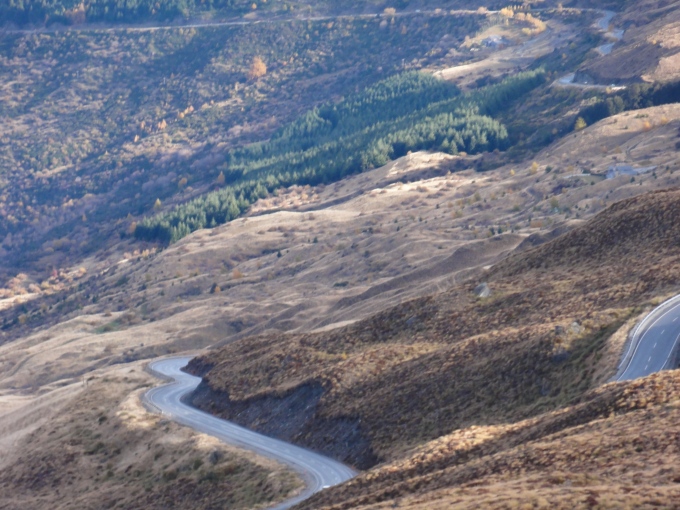
A picture paints … well, as many words as you like.  For instance:

lookingdownfromcoronetpeak

And the story:

It was once said that a desperate man has everything to lose.

The man I was chasing was desperate, but I, on the other hand, was more desperate to catch him.

He’d left a trail of dead people from one end of the island to the other.

The team had put in a lot of effort to locate him, and now his capture was imminent.  We were following the car he was in, from a discrete distance, and, at the appropriate time, we would catch up, pull him over, and make the arrest.

There was nowhere for him to go.

The road led to a dead-end, and the only way off the mountain was back down the road were now on.  Which was why I was somewhat surprised when we discovered where he was.

Where was he going?

“Damn,” I heard Alan mutter.  He was driving, being careful not to get too close, but not far enough away to lose sight of him.

“What?”

“I think he’s made us.”

“How?”

“Dumb bad luck, I’m guessing.  Or he expected we’d follow him up the mountain.  He’s just sped up.”

“How far away?”

“A half-mile.  We should see him higher up when we turn the next corner.”

It took an eternity to get there, and when we did, Alan was right, only he was further on than we thought.”

“Step on it.  Let’s catch him up before he gets to the top.”

Easy to say, not so easy to do.  The road was treacherous, and in places just gravel, and there were no guard rails to stop a three thousand footfall down the mountainside.

Good thing then I had the foresight to have three agents on the hill for just such a scenario.

Ten minutes later, we were in sight of the car, still moving quickly, but we were going slightly faster.  We’d catch up just short of the summit car park.

Or so we thought.

Coming quickly around another corner we almost slammed into the car we’d been chasing.

“What the hell…” Aland muttered.

I was out of the car, and over to see if he was in it, but I knew that it was only a slender possibility.  The car was empty, and no indication where he went.

Certainly not up the road.  It was relatively straightforward for the next mile, at which we would have reached the summit.  Up the mountainside from here, or down.

I looked up.  Nothing.

Alan yelled out, “He’s not going down, not that I can see, but if he did, there’s hardly a foothold and that’s a long fall.”

Then where did he go?

Then a man looking very much like our quarry came out from behind a rock embedded just a short distance up the hill.

“Sorry,” he said quite calmly.  “Had to go if you know what I mean.”

I’d lost him.

It was as simple as that.

I had been led a merry chase up the hill, and all the time he was getting away in a different direction.

I’d fallen for the oldest trick in the book, letting my desperation blind me to the disguise that anyone else would see through in an instant.

It was a lonely sight, looking down that road, knowing that I had to go all that way down again, only this time, without having to throw caution to the wind.

“Maybe next time,” Alan said.

“We’ll get him.  It’s just a matter of time.”

© Charles Heath 2019-2021

Find this and other stories in “Inspiration, maybe”  available soon.

InspirationMaybe1v1

The Perils of Travelling: Every plane trip is, well, different

The course of plane travel can run like clockwork, or rapidly come apart at the seems.

Every time you go to the airport, it can become an adventure.  Checking in, battling the airline’s kiosk, printing and attaching bag labels, going to bag drop, remembering that every airline does it differently.

Hong Kong airport is huge and there are endless boarding gates.  Being dropped off in the zone that belongs to the airline you’re flying is simple.  The next step is to find the aisle letter where your flight is checking in and then do the automated boarding pass and baggage label.

If it’s international travel which it is today, there’s the added stress of negotiating immigration and the duty-free stores.  We followed the rules, got there early, had the usual problems at the kiosk requiring the assistance of two Cathay Pacific staff, and finally made it to the initial departure concourse.

Next, there’s the temptation of overpriced airport food if you’re hungry which we are not.  But we have a McCafe coffee to satisfy a caffeine fix before the flight.

The shops are all expensive at the initial departure concourse, so we decide to see if there are other shops near our departure gate.  To get to our particular departure gate we descend to the train and get off at the 40-80 station.  It’s a short journey, and once back up on the concourse level we find a collection of more affordable shops where we buy every man and his dog a selection of sweets.

From there it’s a couple of travellators, which sounds rediculously short, but are, in reality, very, very long, to our gate and we get there ten minutes before boarding is supposed to commence.
Today we are traveling on an Airbus A350-900, a relatively new plane so you would think there couldn’t be anything wrong with it.  We had the same plane coming to Hong Kong and was, literally, plain sailing.

We find a seat in the gate lounge and wait along with everyone else.  I’m still surprised at the number of able-bodied people who take the disabled seats for the sake of being closer to the start of the line and worse was a woman who not only took up one of the seats but also another for her cabin baggage which was extensive.

Boarding starts late, and routinely for the first and business, and disabled passengers.  The rest now start to line up in the economy line.  Some people haven’t moved, perhaps they know something we don’t.

We eventually join the line and go through initial formalities while waiting.  And waiting.  As the minute’s tick by nothing is happening other than what appears to be growing consternation by the gate staff.  The tipping point for immediate concern is when the previously boarded passengers begin to come back through the boarding gate.

One of those who had been on board came our way and said there was a problem with the plane.  They were told it was due to technical difficulties the official non-scary description for your plane Is broken.  Because of consternation among the queued economy passengers, there was an official announcement that advised of the technical difficulties, and boarding would be delayed.

We all sit back down, but this time there were a number of disabled and elderly people who needed seats, and our able-bodied lady and her baggage didn’t move.  Shame on her.  We are lucky that where we were in the waiting line it was adjacent to nearby seats putting us closer to the head of the line when it reformed.

Now we were able to watch the other passengers jockeying for position to race to be first in the economy class boarding queue the second time around.  I think they realize they have the same seat if they are at the front of the line or the back.  Because we were all asked to sit down, those at the front of the queue would now find themselves at the end if they’d decided to sit and wait.

After a delay of about an hour and a half, we are finally boarding.  The worst aspect of this delay is losing our slot in the departures and I’m guessing this was going to have an effect on our actual takeoff time.  It appears to be the case.  Boarding does not take very long and shortly after the doors are closed we’re pushing back from the gate.

From there, it becomes a chess game when we get a slot.  We are in a queue of planes waiting their turn, and before the main runway planes are separated into two queues, and we are in the second.  Since we are the only one, I suspect we’re in the delayed take-off queue, and sit watching four or so other planes take off before we finally get on the runway.

All around us, planes seem to be going by and taking off while we wait, and wait, and wait…

On the plane, we discover one of the toilets is out of action so perhaps that was the technical difficulty.  It’s not full so one toilet down will have little effect. 

Leaving in the early afternoon will get us into Brisbane late at night.  It was meant to be around 11 pm, but with the delays, and possibly making up time in flight, it will now be after midnight when we arrive.  Fortunately, we have a 24-hour airport.

The flight from HongKong to Brisbane is without event.  Lunch after takeoff, then a few hours later, an hour or so before landing, we have dinner.  Both of us are not hungry.

We land after midnight, tired but glad to be home.  I guess it could have been worse.

An excerpt from “The Things We Do For Love”; In love, Henry was all at sea!

In the distance he could hear the dinner bell ringing and roused himself.  Feeling the dampness of the pillow, and fearing the ravages of pent up emotion, he considered not going down but thought it best not to upset Mrs. Mac, especially after he said he would be dining.

In the event, he wished he had reneged, especially when he discovered he was not the only guest staying at the hotel.

Whilst he’d been reminiscing, another guest, a young lady, had arrived.  He’d heard her and Mrs. Mac coming up the stairs, and then shown to a room on the same floor, perhaps at the other end of the passage.

Henry caught his first glimpse of her when she appeared at the door to the dining room, waiting for Mrs. Mac to show her to a table.

She was about mid-twenties, slim, long brown hair, and the grace and elegance of a woman associated with countless fashion magazines.  She was, he thought, stunningly beautiful with not a hair out of place, and make-up flawlessly applied.  Her clothes were black, simple, elegant, and expensive, the sort an heiress or wife of a millionaire might condescend to wear to a lesser occasion than dinner.

Then there was her expression; cold, forbidding, almost frightening in its intensity.  And her eyes, piercingly blue and yet laced with pain.  Dracula’s daughter was his immediate description of her.

All in all, he considered, the only thing they had in common was, like him, she seemed totally out of place.

Mrs. Mac came out of the kitchen, wiping her hands on her apron.  She was, she informed him earlier, chef, waitress, hotelier, barmaid, and cleaner all rolled into one.  Coming up to the new arrival she said, “Ah, Miss Andrews, I’m glad you decided to have dinner.  Would you like to sit with Mr. Henshaw, or would you like to have a table of your own?”

Henry could feel her icy stare as she sized up his appeal as a dining companion, making the hair on the back on his neck stand up.  He purposely didn’t look back.  In his estimation, his appeal rating was minus six.  Out of a thousand!

“If Mr. Henshaw doesn’t mind….”  She looked at him, leaving the query in mid-air.

He didn’t mind and said so.  Perhaps he’d underestimated his rating.

“Good.”  Mrs. Mac promptly ushered her over.  Henry stood, made sure she was seated properly and sat.

“Thank you.  You are most kind.”  The way she said it suggested snobbish overtones.

“I try to be when I can.”  It was supposed to nullify her sarcastic tone but made him sound a little silly, and when she gave him another of her icy glares, he regretted it.

Mrs. Mac quickly intervened, asking, “Would you care for the soup?”

They did, and, after writing the order on her pad, she gave them each a look, imperceptibly shook her head, and returned to the kitchen.

Before Michelle spoke to him again, she had another quick look at him, trying to fathom who and what he might be.  There was something about him.

His eyes, they mirrored the same sadness she felt, and, yes, there was something else, that it looked like he had been crying?  There was a tinge of redness.

Perhaps, she thought, he was here for the same reason she was.

No.  That wasn’t possible.

Then she said, without thinking, “Do you have any particular reason for coming here?”  Seconds later she realized she’s spoken it out loud, had hadn’t meant to actually ask, it just came out.

It took him by surprise, obviously not the first question he was expecting her to ask of him.

“No, other than it is as far from civilization, and home, as I could get.”

At least we agree on that, she thought.

It was obvious he was running away from something as well.

Given the isolation of the village and lack of geographic hospitality, it was, from her point of view, ideal.  All she had to do was avoid him, and that wouldn’t be difficult.

After getting through this evening first.

“Yes,” she agreed.  “It is that.”

A few seconds passed, and she thought she could feel his eyes on her and wasn’t going to look up.

Until he asked, “What’s your reason?”

Slight abrupt in manner, perhaps as a result of her question, and the manner in which she asked it.

She looked up.  “Rest.  And have some time to myself.”

She hoped he would notice the emphasis she had placed on the word ‘herself’ and take due note.  No doubt, she thought,  she had completely different ideas of what constituted a holiday than he, not that she had actually said she was here for a holiday.

Mrs. Mac arrived at a fortuitous moment to save them from further conversation.


Over the entree, she wondered if she had made a mistake coming to the hotel.  Of course, there had been no possible way she could know than anyone else might have booked the same hotel, but realized it was foolish to think she might end up in it by herself.

Was that what she was expecting?

Not a mistake then, but an unfortunate set of circumstances, which could be overcome by being sensible.

Yet, there he was, and it made her curious, not that he was a man, by himself, in the middle of nowhere, hiding like she was, but for very different reasons.

On discreet observance whilst they ate, she gained the impression his air of light-heartedness was forced and he had no sense of humor.

This feeling was engendered by his looks, unruly dark hair, and permanent frown.  And then there was his abysmal taste in clothes on a tall, lanky frame.  They were quality but totally unsuited to the wearer.

Rebellion was written all over him.

The only other thought crossing her mind, and rather incongruously, was he could do with a decent feed.  In that respect, she knew now from the mountain of food in front of her, he had come to the right place.

“Mr. Henshaw?”

He looked up.  “Henshaw is too formal.  Henry sounds much better,” he said, with a slight hint of gruffness.

“Then my name is Michelle.”

Mrs. Mac came in to take their order for the only main course, gather up the entree dishes, then return to the kitchen.

“Staying long?” she asked.

“About three weeks.  Yourself?”

“About the same.”

The conversation dried up.

Neither looked at the other, rather at the walls, out the window, towards the kitchen, anywhere.  It was, she thought, almost unbearably awkward.


Mrs. Mac returned with a large tray with dishes on it, setting it down on the table next to theirs.

“Not as good as the usual cook,” she said, serving up the dinner expertly, “but it comes a good second, even if I do say so myself.  Care for some wine?”

Henry looked at Michelle.  “What do you think?”

“I’m used to my dining companions making the decision.”

You would, he thought.  He couldn’t help but notice the cutting edge of her tone.  Then, to Mrs. Mac, he named a particular White Burgundy he liked and she bustled off.

“I hope you like it,” he said, acknowledging her previous comment with a smile that had nothing to do with humor.

“Yes, so do I.”

Both made a start on the main course, a concoction of chicken and vegetables that were delicious, Henry thought, when compared to the bland food he received at home and sometimes aboard my ship.

It was five minutes before Mrs. Mac returned with the bottle and two glasses.  After opening it and pouring the drinks, she left them alone again.

Henry resumed the conversation.  “How did you arrive?  I came by train.”

“By car.”

“Did you drive yourself?”

And he thought, a few seconds later, that was a silly question, otherwise she would not be alone, and certainly not sitting at this table. With him.

“After a fashion.”

He could see that she was formulating a retort in her mind, then changed it, instead, smiling for the first time, and it served to lighten the atmosphere.

And in doing so, it showed him she had another more pleasant side despite the fact she was trying not to look happy.

“My father reckons I’m just another of ‘those’ women drivers,” she added.

“Whatever for?”

“The first and only time he came with me I had an accident.  I ran up the back of another car.  Of course, it didn’t matter to him the other driver was driving like a startled rabbit.”

“It doesn’t help,” he agreed.

“Do you drive?”

“Mostly people up the wall.”  His attempt at humor failed.  “Actually,” he added quickly, “I’ve got a very old Morris that manages to get me where I’m going.”

The apple pie and cream for dessert came and went and the rapport between them improved as the wine disappeared and the coffee came.  Both had found, after getting to know each other better, their first impressions were not necessarily correct.

“Enjoy the food?” Mrs. Mac asked, suddenly reappearing.

“Beautifully cooked and delicious to eat,” Michelle said, and Henry endorsed her remarks.

“Ah, it does my heart good to hear such genuine compliments,” she said, smiling.  She collected the last of the dishes and disappeared yet again.

“What do you do for a living,” Michelle asked in an off-hand manner.

He had a feeling she was not particularly interested and it was just making conversation.

“I’m a purser.”

“A what?”

“A purser.  I work on a ship doing the paperwork, that sort of thing.”

“I see.”

“And you?”

“I was a model.”

“Was?”

“Until I had an accident, a rather bad one.”

“Oh, I’m sorry.”

So that explained the odd feeling he had about her.

As the evening had worn on, he began to think there might be something wrong, seriously wrong with her because she didn’t look too well.  Even the carefully applied makeup, from close up, didn’t hide the very pale, and tired look, or the sunken, dark ringed eyes.

“I try not to think about it, but it doesn’t necessarily work.  I’ve come here for peace and quiet, away from doctors and parents.”

“Then you will not have to worry about me annoying you.  I’m one of those fall-asleep-reading-a-book types.”

Perhaps it would be like ships passing in the night and then smiled to himself about the analogy.

Dinner now over, they separated.

Henry went back to the lounge to read a few pages of his book before going to bed, and Michelle went up to her room to retire for the night.

But try as he might, he was unable to read, his mind dwelling on the unusual, yet the compellingly mysterious person he would be sharing the hotel with.

Overlaying that original blurred image of her standing in the doorway was another of her haunting expressions that had, he finally conceded, taken his breath away, and a look that had sent more than one tingle down his spine.

She may not have thought much of him, but she had certainly made an impression on him.


© Charles Heath 2015-2020

lovecoverfinal1

Timelines, deadlines, and disasters

Unfortunately, I’m not one of those people who work well to timelines, so the very thought of using something like Microsoft Project to get my writing into some sort of timeframe, with deadlines, seemed, to me, to be a bit extreme.

Say for instance the major deadlines for a writing project are

  1.  Write an outline, with as much detail as possible, with an overarching plot, characters, key points in the novel, and scouting for locations
  2. Writing.  This could be broken down into chapters, but more practicable would be sectioned, each consisting of a number of chapters.
  3. Editing, planning for one, two or three, or more edits
  4. Proofreading
  5. Send to editor

Clearly if I was going to take this approach, then I would have to allocate hours of the day specifically for writing and doing all those other writer chores in less time, and with fewer distractions.

And, it might work for a more dedicated author.

But…

I did make a new years resolution that I would try and do things differently this year.

Except…

I set a goal to restart editing of my next novel on 1st Feb. I thought, setting it so far into the year it would be easy.

It would give me the time to clear up all the outstanding, get in the way, distractions, and be free to finally finish it.

But there’s always something else to do, other than what we’re supposed to be doing.

For me it used to be going away, spending long, sleepless hours flying from one side of the world to the other had fuelled my imagination more than I expected and where this used to be the impetus to write more stories that that had not happened yet this year.

I have other stories of course, all in carious stages of writing, but if only I could focus on one story at a time.

So…

I’ve tried to set some new, more realistic goals to finish playing with these other stories as soon as I can, so come the first of March, I can resume work on the next book to be published.

Or not.

“The Devil You Don’t”, she was the girl you would not take home to your mother!

Now only $0.99 at https://amzn.to/2Xyh1ow

John Pennington’s life is in the doldrums. Looking for new opportunities, prevaricating about getting married, the only joy on the horizon was an upcoming visit to his grandmother in Sorrento, Italy.

Suddenly he is left at the check-in counter with a message on his phone telling him the marriage is off, and the relationship is over.

If only he hadn’t promised a friend he would do a favor for him in Rome.

At the first stop, Geneva, he has a chance encounter with Zoe, an intriguing woman who captures his imagination from the moment she boards the Savoire, and his life ventures into uncharted territory in more ways than one.

That ‘favor’ for his friend suddenly becomes a life-changing event, and when Zoe, the woman who he knows is too good to be true, reappears, danger and death follow.

Shot at, lied to, seduced, and drawn into a world where nothing is what it seems, John is dragged into an adrenaline-charged undertaking, where he may have been wiser to stay with the ‘devil you know’ rather than opt for the ‘devil you don’t’.

newdevilcvr6

Where does time go?

When has time gone?  I mean, just yesterday it felt like the start of a new year, and all those projects I had lined up are still on paper, somewhere.

Has anyone else over 65 got the feeling time is speeding up rather than slowing down?  It sounds weird doesn’t it, that as you slow down as old age approaches, time goes faster, and those things you wanted to get done seem further and further away.

When you’re young it always seems like you will have all the time in the world, and that seems to play out over the first forty or fifty years, putting this off, putting that off, while all the little details of life take more and more of your time.

And there’s that one huge thing that hangs over your head, the fact that you might never get to that time when you said you would have time for it.  People are dying younger again, of stress, bad habits and overexercising.

I’ll never be guilty of the last once.  It’ll probably be bad habits, something we are all guilty of.

That’s also a reason why I don’t have New Year’s resolution, and I try not to make plans for anything too far ahead.

It’s also the reason why we decided to travel and do all those things people say they’re going to do when they retire, only to discover they can’t for one reason or another, or they just simply died.

Stopping work after being so wrapped up in it, can kill you, and it’s not beyond the realms of possibility that you can quite literally die of boredom.

It’s why I write.  Keeps the mind active, gives me something to do, and believe me when I’m writing I’m never bored, and is a perfect fit between bouts of being a grandfather, a taxi service, and doing everything else that needs a not so handy handyman.

Time flying is the same reason why my granddaughters have grown so much because it seems like it was only yesterday they were babies, and now the eldest is 16.  When did she get so grown up?

Oh, well, back to childminding duties.  It’s school holidays and tomorrow we’re off the travel down ‘the coast’ what most ubiquitously call the Gold Coast, or otherwise known as Surfer’s Paradise.  IT’s glitzy, has a dark side, and always looks shiny until the sun goes down.  We go there during the day.  Tomoorow will be the first time in over a year.

If we can get the kids off their computers and smartphones.

“Sunday in New York”, a romantic adventure that’s not a walk in the park!

“Sunday in New York” is ultimately a story about trust, and what happens when a marriage is stretched to its limits.

When Harry Steele attends a lunch with his manager, Barclay, to discuss a promotion that any junior executive would accept in a heartbeat, it is the fact his wife, Alison, who previously professed her reservations about Barclay, also agreed to attend, that casts a small element of doubt in his mind.

From that moment, his life, in the company, in deciding what to do, his marriage, his very life, spirals out of control.

There is no one big factor that can prove Harry’s worst fears, that his marriage is over, just a number of small, interconnecting events, when piled on top of each other, points to a cataclysmic end to everything he had believed in.

Trust is lost firstly in his best friend and mentor, Andy, who only hints of impending disaster, Sasha, a woman whom he saved, and who appears to have motives of her own, and then in his wife, Alison, as he discovered piece by piece damning evidence she is about to leave him for another man.

Can we trust what we see with our eyes or trust what we hear?

Haven’t we all jumped to conclusions at least once in our lives?

Can Alison, a woman whose self-belief and confidence is about to be put to the ultimate test, find a way of proving their relationship is as strong as it has ever been?

As they say in the classics, read on!

Purchase:

http://tinyurl.com/Amazon-SundayInNewYork

In a word: Mark

A teacher will mark a test in order to give the student a mark out of 100.  Yes, to mark a test means to ascertain right and wrong answers and score it accordingly, and getting a mark out of 100 could determine a great many different outcomes at school.

Whereas a mark on your clothes could mean you’ve been playing with fire, rolled in the mud or if much older having a salacious affair with an unexplainable lipstick mark on your collar.

A mark is someone that a con man believes will be easily deceived.

A mark is a catch in certain types of football.

You can have an identifying mark on some item of property.

it’s literally the x marks the spot for someone who cannot write, i.e. make your mark

There can be a mark on a rope that indicates the depth of water.

And many, many more…

But not to be confused with marque, which could be the make or model of a particular type of car

Or marc with is the refuse of grapes after being pressed