In a word: Toe

A toe is one of five at the end of your foot, and from time to time you wriggle.  It’s also one of the first things to go when you get frostbite.

And when was the last time you stubbed your toe?  It hurts!

It can also mean something at the tip or point, such as the toe of a country like Italy, or England.

What does it mean when someone treads on your toes?   You upset or annoy them.

What if you go toe to toe with someone?  Two people having a ‘robust discussion’.

What about that boss that keeps you on your toes, especially when he’s looking over your shoulder!

And what about a toe-poke, a hard kick of the football with your toe?

Of course, it’s not to be confused with the word tow, which basically means to pull something behind you.

Like a tow truck, pulling a broken down, or smashed up, vehicle.

But, do you toe the line, or tow the line?  Or both at different times?

It seems that to toe the line means to do as you are told, or conform to a standard.

Sadly, that doesn’t describe me!

Inspiration, maybe – Volume 1

50 photographs, 50 stories, of which there is one of the 50 below.

They all start with –

A picture paints … well, as many words as you like.  For instance:

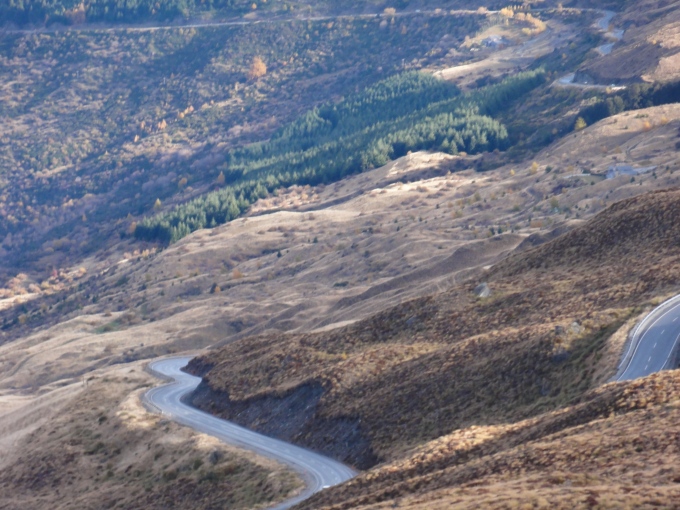
lookingdownfromcoronetpeak

And the story:

It was once said that a desperate man has everything to lose.

The man I was chasing was desperate, but I, on the other hand, was more desperate to catch him.

He’d left a trail of dead people from one end of the island to the other.

The team had put in a lot of effort to locate him, and now his capture was imminent.  We were following the car he was in, from a discrete distance, and, at the appropriate time, we would catch up, pull him over, and make the arrest.

There was nowhere for him to go.

The road led to a dead-end, and the only way off the mountain was back down the road were now on.  Which was why I was somewhat surprised when we discovered where he was.

Where was he going?

“Damn,” I heard Alan mutter.  He was driving, being careful not to get too close, but not far enough away to lose sight of him.

“What?”

“I think he’s made us.”

“How?”

“Dumb bad luck, I’m guessing.  Or he expected we’d follow him up the mountain.  He’s just sped up.”

“How far away?”

“A half-mile.  We should see him higher up when we turn the next corner.”

It took an eternity to get there, and when we did, Alan was right, only he was further on than we thought.”

“Step on it.  Let’s catch him up before he gets to the top.”

Easy to say, not so easy to do.  The road was treacherous, and in places just gravel, and there were no guard rails to stop a three thousand footfall down the mountainside.

Good thing then I had the foresight to have three agents on the hill for just such a scenario.

Ten minutes later, we were in sight of the car, still moving quickly, but we were going slightly faster.  We’d catch up just short of the summit car park.

Or so we thought.

Coming quickly around another corner we almost slammed into the car we’d been chasing.

“What the hell…” Aland muttered.

I was out of the car, and over to see if he was in it, but I knew that it was only a slender possibility.  The car was empty, and no indication where he went.

Certainly not up the road.  It was relatively straightforward for the next mile, at which we would have reached the summit.  Up the mountainside from here, or down.

I looked up.  Nothing.

Alan yelled out, “He’s not going down, not that I can see, but if he did, there’s hardly a foothold and that’s a long fall.”

Then where did he go?

Then a man looking very much like our quarry came out from behind a rock embedded just a short distance up the hill.

“Sorry,” he said quite calmly.  “Had to go if you know what I mean.”

I’d lost him.

It was as simple as that.

I had been led a merry chase up the hill, and all the time he was getting away in a different direction.

I’d fallen for the oldest trick in the book, letting my desperation blind me to the disguise that anyone else would see through in an instant.

It was a lonely sight, looking down that road, knowing that I had to go all that way down again, only this time, without having to throw caution to the wind.

“Maybe next time,” Alan said.

“We’ll get him.  It’s just a matter of time.”

© Charles Heath 2019-2021

Find this and other stories in “Inspiration, maybe”  available soon.

InspirationMaybe1v1

We have this sport called Australian Rules Football

In Melbourne, it’s an institution even a religion.  Traditionally it is played on a Saturday afternoon and luckily for us, we were attending such a game.

Of course, this was before last year.  Last year, with the COVID 19 virus everything, including football has been called off.

Now, we’re subject to the off outbreak that sees games transferred to other states, and sometimes without crowds. We just stick to watching it on TV these days.

Except now we have ‘flattened the curve’ football can start again, sometimes with sometimes without the spectators.  Social distancing means we can’t pack the stadium, or rarely even go to a game.  For a while, it was just to be from our lounge rooms, watching it on the TV.

But, as some of the states began to get on top of the virus, football teams moved from Victoria, and played in Sydney, Adelaide, Perth, and the Northern Territory.

And as the Victorian situation got worse, the decision was made to move the grand final, which had never left the MCG in Victoria, to Brisbane. It was like America never losing the Americas Cup, until they did.

But, below, is the atmosphere that we have been missing, and has returned in a limited sense as coronavirus restrictions eased (but not completely), a game we attended last year:

The stadium is the MSG, one of the biggest and best in Australia.  Shortly after the start, I’d estimate there are about 40,000, but eventually, we were told there was 53,000, spectators here for a clash between the two Melbourne based teams.  It is not unheard of to have in closer to 90,000 spectators, and the atmosphere is at times electric.

For the die-hards like me who can remember the days when there were only Victorian-based teams,  in the modern-day form of the game, to have two such teams is something of a rarity.

However, it’s not so much about the antics on the field as it is the spectators.  They are divided into three groups, the members, the private boxes, and the general public.

But in the end, there is no distinction between any of them because they all know the rules, well, their version of them, and it doesn’t matter who you are, If there is something that goes against your team, it is brings a huge roar of disapproval.

Then there are ebbs and flows in the crowd noise and reactions to events like holding the ball attracting a unified shout ‘ball, or a large collective groan when a free kick should have been paid or by the opposite team’s followers if it should have been.

It is this crowd reaction which makes going to a live game so much better than watching it televised live.  The times when players take marks, get the ball out of congestion, and when goals are scored when your team is behind and when one is needed to get in front.

This is particularly so when one of the stars goes near the ball and pulls off a miracle 1 percent movement of the ball.  These are what we come to see, the high flying marks, the handball threaded through a needle, a kick that reaches one of our players that looked like it would never get there, an intercept mark or steal that throws momentum the opposite way.

This game is not supposed to be a game of inches but fast yards, a kick, a mark, a handball, a run, and bounce.  You need to get the ball to your goal as quickly as possible.

That’s the objective.

But in this modern game, much to the dismay of spectators and commentators alike, there is this thing called flooding where all 36 players are basically in a clump around the ball and it moves basically in inches, not yards.

It is slow and it is ugly.

It is not the game envisioned by those who created it and there is a debate right now about fixing it.

Here, it is an example of the worst sort.  This game is played in four quarters and for the first two, it is ugly scrappy play with little skill on display.  The third shows improvement and it seems the respective coaches had told their players to open it up

They have and it becomes better to look at.

But this is the point where one team usually gets away with a handy lead, a third-quarter effort that almost puts the game out of reach.  The fourth quarter is where the losing team stages a comeback, and sometimes it works sometimes it does not.

The opposition gives it a red hot try but is unsuccessful.  Three goals in a row, it gave their fans a sniff of hope but as the commentators call it, a kick against the flow and my team prevails.

It is the moment to stay for when they play the winning teams song over the stadium’s loudspeaker system, and at least half the spectators sing along.  It is one of that hair raising on the back of your neck moments which for some can be far too few in a season

We have great hopes for our team this year, and it was worth the trek from Brisbane to Melbourne to see it live rather than on the TV

Leaving the ground with thousands of others heading towards the train station for the journey home there is a mixture of feelings, some lamenting their teams, and others jubilant their team won.  There is no rancor, everyone shuffles in an orderly manner, bearing the slow entry to the station, and the long lines to get on the train.

Others who perhaps came by car, or who have decided to wait for a later train or other transport, let their children kick the football around on the leaf-covered parkland surrounding the stadium.

It is an integral part of this game that children experience the football effect.  Kicking a ball with your father, brothers, and sisters, or friends on that late autumn afternoon is a memory that will be cherished for a long long time.

It’s where you pretend you are your favorite player and are every bit as good.  I know that’s what I used to do with my father, and that is what I did with my sons.

But no matter what the state of the game, it is the weekend the football fans look forward to and who turn out in their hundreds of thousands.  It is a game that ignites passions, it brings highs and it brings incredible lows.

And, through thick and thin, we never stop supporting them.

An excerpt from “The Things We Do For Love”; In love, Henry was all at sea!

In the distance he could hear the dinner bell ringing and roused himself.  Feeling the dampness of the pillow, and fearing the ravages of pent up emotion, he considered not going down but thought it best not to upset Mrs. Mac, especially after he said he would be dining.

In the event, he wished he had reneged, especially when he discovered he was not the only guest staying at the hotel.

Whilst he’d been reminiscing, another guest, a young lady, had arrived.  He’d heard her and Mrs. Mac coming up the stairs, and then shown to a room on the same floor, perhaps at the other end of the passage.

Henry caught his first glimpse of her when she appeared at the door to the dining room, waiting for Mrs. Mac to show her to a table.

She was about mid-twenties, slim, long brown hair, and the grace and elegance of a woman associated with countless fashion magazines.  She was, he thought, stunningly beautiful with not a hair out of place, and make-up flawlessly applied.  Her clothes were black, simple, elegant, and expensive, the sort an heiress or wife of a millionaire might condescend to wear to a lesser occasion than dinner.

Then there was her expression; cold, forbidding, almost frightening in its intensity.  And her eyes, piercingly blue and yet laced with pain.  Dracula’s daughter was his immediate description of her.

All in all, he considered, the only thing they had in common was, like him, she seemed totally out of place.

Mrs. Mac came out of the kitchen, wiping her hands on her apron.  She was, she informed him earlier, chef, waitress, hotelier, barmaid, and cleaner all rolled into one.  Coming up to the new arrival she said, “Ah, Miss Andrews, I’m glad you decided to have dinner.  Would you like to sit with Mr. Henshaw, or would you like to have a table of your own?”

Henry could feel her icy stare as she sized up his appeal as a dining companion, making the hair on the back on his neck stand up.  He purposely didn’t look back.  In his estimation, his appeal rating was minus six.  Out of a thousand!

“If Mr. Henshaw doesn’t mind….”  She looked at him, leaving the query in mid-air.

He didn’t mind and said so.  Perhaps he’d underestimated his rating.

“Good.”  Mrs. Mac promptly ushered her over.  Henry stood, made sure she was seated properly and sat.

“Thank you.  You are most kind.”  The way she said it suggested snobbish overtones.

“I try to be when I can.”  It was supposed to nullify her sarcastic tone but made him sound a little silly, and when she gave him another of her icy glares, he regretted it.

Mrs. Mac quickly intervened, asking, “Would you care for the soup?”

They did, and, after writing the order on her pad, she gave them each a look, imperceptibly shook her head, and returned to the kitchen.

Before Michelle spoke to him again, she had another quick look at him, trying to fathom who and what he might be.  There was something about him.

His eyes, they mirrored the same sadness she felt, and, yes, there was something else, that it looked like he had been crying?  There was a tinge of redness.

Perhaps, she thought, he was here for the same reason she was.

No.  That wasn’t possible.

Then she said, without thinking, “Do you have any particular reason for coming here?”  Seconds later she realized she’s spoken it out loud, had hadn’t meant to actually ask, it just came out.

It took him by surprise, obviously not the first question he was expecting her to ask of him.

“No, other than it is as far from civilization, and home, as I could get.”

At least we agree on that, she thought.

It was obvious he was running away from something as well.

Given the isolation of the village and lack of geographic hospitality, it was, from her point of view, ideal.  All she had to do was avoid him, and that wouldn’t be difficult.

After getting through this evening first.

“Yes,” she agreed.  “It is that.”

A few seconds passed, and she thought she could feel his eyes on her and wasn’t going to look up.

Until he asked, “What’s your reason?”

Slight abrupt in manner, perhaps as a result of her question, and the manner in which she asked it.

She looked up.  “Rest.  And have some time to myself.”

She hoped he would notice the emphasis she had placed on the word ‘herself’ and take due note.  No doubt, she thought,  she had completely different ideas of what constituted a holiday than he, not that she had actually said she was here for a holiday.

Mrs. Mac arrived at a fortuitous moment to save them from further conversation.


Over the entree, she wondered if she had made a mistake coming to the hotel.  Of course, there had been no possible way she could know than anyone else might have booked the same hotel, but realized it was foolish to think she might end up in it by herself.

Was that what she was expecting?

Not a mistake then, but an unfortunate set of circumstances, which could be overcome by being sensible.

Yet, there he was, and it made her curious, not that he was a man, by himself, in the middle of nowhere, hiding like she was, but for very different reasons.

On discreet observance whilst they ate, she gained the impression his air of light-heartedness was forced and he had no sense of humor.

This feeling was engendered by his looks, unruly dark hair, and permanent frown.  And then there was his abysmal taste in clothes on a tall, lanky frame.  They were quality but totally unsuited to the wearer.

Rebellion was written all over him.

The only other thought crossing her mind, and rather incongruously, was he could do with a decent feed.  In that respect, she knew now from the mountain of food in front of her, he had come to the right place.

“Mr. Henshaw?”

He looked up.  “Henshaw is too formal.  Henry sounds much better,” he said, with a slight hint of gruffness.

“Then my name is Michelle.”

Mrs. Mac came in to take their order for the only main course, gather up the entree dishes, then return to the kitchen.

“Staying long?” she asked.

“About three weeks.  Yourself?”

“About the same.”

The conversation dried up.

Neither looked at the other, rather at the walls, out the window, towards the kitchen, anywhere.  It was, she thought, almost unbearably awkward.


Mrs. Mac returned with a large tray with dishes on it, setting it down on the table next to theirs.

“Not as good as the usual cook,” she said, serving up the dinner expertly, “but it comes a good second, even if I do say so myself.  Care for some wine?”

Henry looked at Michelle.  “What do you think?”

“I’m used to my dining companions making the decision.”

You would, he thought.  He couldn’t help but notice the cutting edge of her tone.  Then, to Mrs. Mac, he named a particular White Burgundy he liked and she bustled off.

“I hope you like it,” he said, acknowledging her previous comment with a smile that had nothing to do with humor.

“Yes, so do I.”

Both made a start on the main course, a concoction of chicken and vegetables that were delicious, Henry thought, when compared to the bland food he received at home and sometimes aboard my ship.

It was five minutes before Mrs. Mac returned with the bottle and two glasses.  After opening it and pouring the drinks, she left them alone again.

Henry resumed the conversation.  “How did you arrive?  I came by train.”

“By car.”

“Did you drive yourself?”

And he thought, a few seconds later, that was a silly question, otherwise she would not be alone, and certainly not sitting at this table. With him.

“After a fashion.”

He could see that she was formulating a retort in her mind, then changed it, instead, smiling for the first time, and it served to lighten the atmosphere.

And in doing so, it showed him she had another more pleasant side despite the fact she was trying not to look happy.

“My father reckons I’m just another of ‘those’ women drivers,” she added.

“Whatever for?”

“The first and only time he came with me I had an accident.  I ran up the back of another car.  Of course, it didn’t matter to him the other driver was driving like a startled rabbit.”

“It doesn’t help,” he agreed.

“Do you drive?”

“Mostly people up the wall.”  His attempt at humor failed.  “Actually,” he added quickly, “I’ve got a very old Morris that manages to get me where I’m going.”

The apple pie and cream for dessert came and went and the rapport between them improved as the wine disappeared and the coffee came.  Both had found, after getting to know each other better, their first impressions were not necessarily correct.

“Enjoy the food?” Mrs. Mac asked, suddenly reappearing.

“Beautifully cooked and delicious to eat,” Michelle said, and Henry endorsed her remarks.

“Ah, it does my heart good to hear such genuine compliments,” she said, smiling.  She collected the last of the dishes and disappeared yet again.

“What do you do for a living,” Michelle asked in an off-hand manner.

He had a feeling she was not particularly interested and it was just making conversation.

“I’m a purser.”

“A what?”

“A purser.  I work on a ship doing the paperwork, that sort of thing.”

“I see.”

“And you?”

“I was a model.”

“Was?”

“Until I had an accident, a rather bad one.”

“Oh, I’m sorry.”

So that explained the odd feeling he had about her.

As the evening had worn on, he began to think there might be something wrong, seriously wrong with her because she didn’t look too well.  Even the carefully applied makeup, from close up, didn’t hide the very pale, and tired look, or the sunken, dark ringed eyes.

“I try not to think about it, but it doesn’t necessarily work.  I’ve come here for peace and quiet, away from doctors and parents.”

“Then you will not have to worry about me annoying you.  I’m one of those fall-asleep-reading-a-book types.”

Perhaps it would be like ships passing in the night and then smiled to himself about the analogy.

Dinner now over, they separated.

Henry went back to the lounge to read a few pages of his book before going to bed, and Michelle went up to her room to retire for the night.

But try as he might, he was unable to read, his mind dwelling on the unusual, yet the compellingly mysterious person he would be sharing the hotel with.

Overlaying that original blurred image of her standing in the doorway was another of her haunting expressions that had, he finally conceded, taken his breath away, and a look that had sent more than one tingle down his spine.

She may not have thought much of him, but she had certainly made an impression on him.


© Charles Heath 2015-2020

lovecoverfinal1

Are we still in the midst of an apocalypse?

I never thought I’d be sitting down and thinking about mortality.

It comes up, of course, every time you go to a funeral, but it’s not like this, not when anyone you know can get a disease that has no cure, and it can kill you.

I’m looking at a continuous update of the destruction it’s doing to human life all over the planet, millions of people have contracted the virus, and far too many people have died.  And it shows no sign of abating, even in the face of a vaccine.

As a proportion of the earth’s population, it’s probably nothing, but to each and every family member of those who contract it and who eventually die, they are not a statistic, they are someone loved and cherished.

It horrifies me that some people can make light of it.

If doubly horrifies me when they start talking about acceptable losses, or worse, it didn’t kill as many people we thought it would.

The thing is, this virus hasn’t finished with us yet.  It’s still out there, there are people with it, and don’t know they’ve got it and they can spread it as easily as spreading soft butter on a slice of bread.

And yet, there are people out there who claim their freedom is more important than dying,  Tell that to those who have lost loved ones.  Tell that to a child who has lost a father, a mother, a bother, a sister, a friend, or as the virus is more selective, a grandparent, or someone whose health was tenuous for a variety of reasons.

They just don’t get it.

I’m guessing that in some countries where guns are a way of life, and the population is inured to the countless deaths caused by those guns, a virus doesn’t impact them.  They say they are more likely to be killed by the flu, or a cow falling out of the sky on them.

Perhaps the saner of us could pray for a rainstorm of cows when they gather to protest against gun control.  It would make a better headline that we see each morning, the ever-increasing infections, and worse, deaths.

There is no cure, despite what some people will say.  There won’t be a cure, because it’s not the virus we have to remove, it’s the practices that cause those viruses.  We have to find and remove the cause, whether it’s bats, exotic animals, of countries creating biological warfare weapons.

And here’s a tip from a thriller writer who’s been trying to wrap his head around all of the available conspiracy theories, the one I like the most is; the country that magically finding a cure in less than the accepted time-frame is more than likely the country was the one who created it.

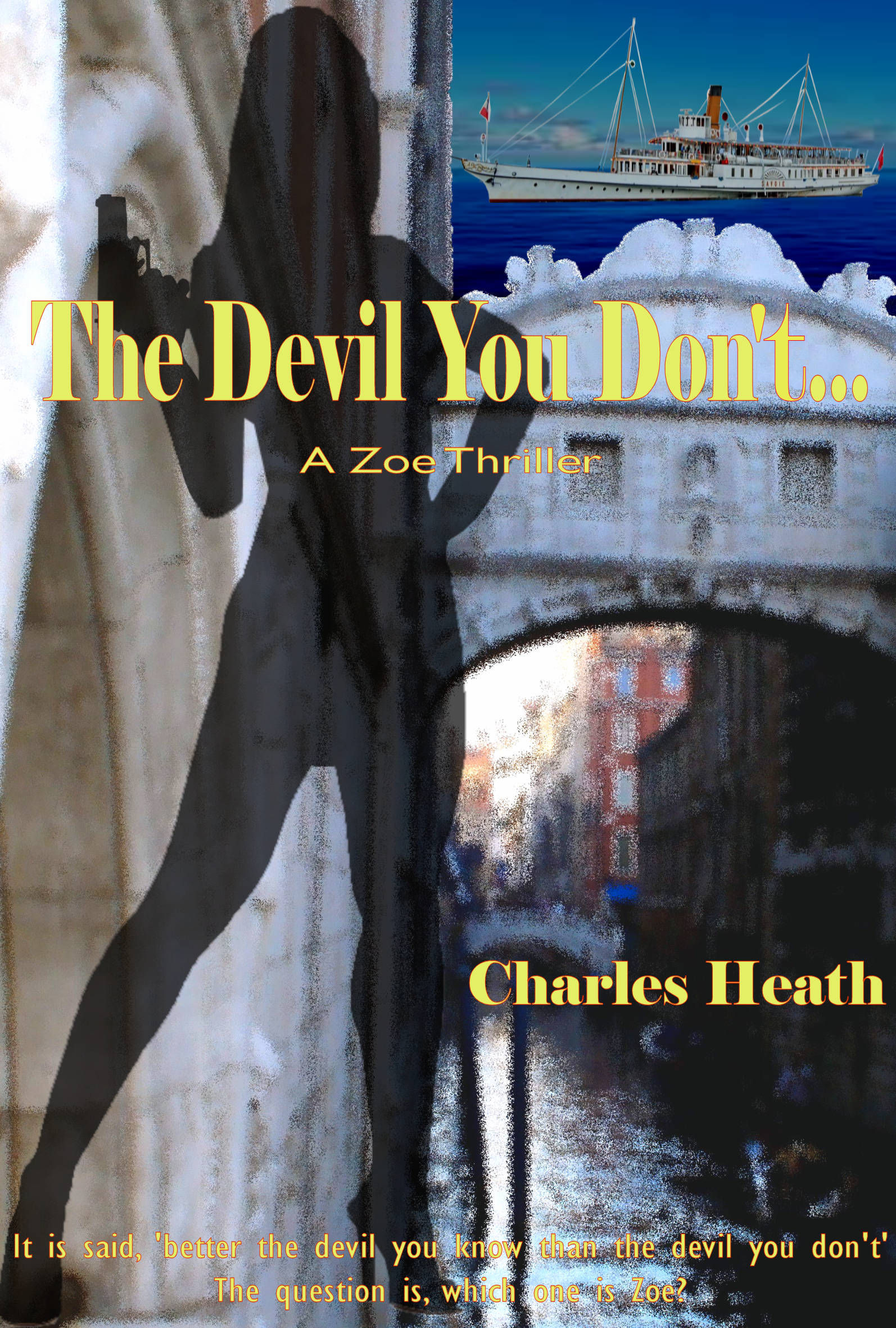
“The Devil You Don’t”, she was the girl you would not take home to your mother!

Now only $0.99 at https://amzn.to/2Xyh1ow

John Pennington’s life is in the doldrums. Looking for new opportunities, prevaricating about getting married, the only joy on the horizon was an upcoming visit to his grandmother in Sorrento, Italy.

Suddenly he is left at the check-in counter with a message on his phone telling him the marriage is off, and the relationship is over.

If only he hadn’t promised a friend he would do a favor for him in Rome.

At the first stop, Geneva, he has a chance encounter with Zoe, an intriguing woman who captures his imagination from the moment she boards the Savoire, and his life ventures into uncharted territory in more ways than one.

That ‘favor’ for his friend suddenly becomes a life-changing event, and when Zoe, the woman who he knows is too good to be true, reappears, danger and death follow.

Shot at, lied to, seduced, and drawn into a world where nothing is what it seems, John is dragged into an adrenaline-charged undertaking, where he may have been wiser to stay with the ‘devil you know’ rather than opt for the ‘devil you don’t’.

newdevilcvr6

An old story, or perhaps a new story

It’s late at night and there are twenty other story ideas that are currently running around in my head, instead of the story I should be working on.

These ideas are impinging on the current story, and somehow are finding their way onto the page.

Writing, cursing, deleting, re-writing, deleting, cursing.

I’m working on the latest book and it is not going well, and I think it is more a case of self-doubt.  It’s why I can’t concentrate.

It’s why I’m thinking about the next story and not staying on track.

This leads me to be over critical of what I have written and much pressing of the delete key.  Only to realize that an action taken in haste can be regrettable, and makes me feel even more depressed when I realize the deletions are irrecoverable.

Damn.

I think I’d be happier in a garret somewhere channeling van Gogh’s rage.

Lesson learned – don’t delete, save it to a text file so it can be retrieved when sanity returns.

I was not happy with the previous start.  Funny about that, because until a few weeks ago I thought the start was perfect.

What a difference a week makes or is that politics?

Perhaps I should consider adding some political satire.

But I digress…

It seems it’s been like that for a few weeks now, not being able to stick to the job in hand, doing anything but what I’m supposed to be doing.  I recognize the restlessness, I’m not happy with the story as it is, so rather than getting on with it, I find myself writing words just for the sake of writing words.

Any words are better than none, right?

So I rewrote the start, added about a hundred pages and now I have to do a mass of rewriting of what was basically the whole book.

But here’s the thing.

This morning I woke up and looked at the new start, and it has inspired me.

Perhaps all I needed was several weeks of teeth gnashing, and self-doubt to get myself back on track.

Who would want to be a writer?

Me!  First in line, every time!

“Sunday in New York”, a romantic adventure that’s not a walk in the park!

“Sunday in New York” is ultimately a story about trust, and what happens when a marriage is stretched to its limits.

When Harry Steele attends a lunch with his manager, Barclay, to discuss a promotion that any junior executive would accept in a heartbeat, it is the fact his wife, Alison, who previously professed her reservations about Barclay, also agreed to attend, that casts a small element of doubt in his mind.

From that moment, his life, in the company, in deciding what to do, his marriage, his very life, spirals out of control.

There is no one big factor that can prove Harry’s worst fears, that his marriage is over, just a number of small, interconnecting events, when piled on top of each other, points to a cataclysmic end to everything he had believed in.

Trust is lost firstly in his best friend and mentor, Andy, who only hints of impending disaster, Sasha, a woman whom he saved, and who appears to have motives of her own, and then in his wife, Alison, as he discovered piece by piece damning evidence she is about to leave him for another man.

Can we trust what we see with our eyes or trust what we hear?

Haven’t we all jumped to conclusions at least once in our lives?

Can Alison, a woman whose self-belief and confidence is about to be put to the ultimate test, find a way of proving their relationship is as strong as it has ever been?

As they say in the classics, read on!

Purchase:

http://tinyurl.com/Amazon-SundayInNewYork

In a word: Toe

A toe is one of five at the end of your foot, and from time to time you wriggle.  It’s also one of the first things to go when you get frostbite.

And when was the last time you stubbed your toe?  It hurts!

It can also mean something at the tip or point, such as the toe of a country like Italy, or England.

What does it mean when someone treads on your toes?   You upset or annoy them.

What if you go toe to toe with someone?  Two people having a ‘robust discussion’.

What about that boss that keeps you on your toes, especially when he’s looking over your shoulder!

And what about a toe-poke, a hard kick of the football with your toe?

Of course, it’s not to be confused with the word tow, which basically means to pull something behind you.

Like a tow truck, pulling a broken down, or smashed up, vehicle.

But, do you toe the line, or tow the line?  Or both at different times?

It seems that to toe the line means to do as you are told, or conform to a standard.

Sadly, that doesn’t describe me!

Do you do any armchair travelling?

Once upon a time…

It was impossible to travel to any destination you would like to go to in the world.

Except perhaps if you had a travel guide, a book about a particular place, or watch a geographical documentary, which was limited to one person’s point of view.

Now, with the internet it’s possible to go anywhere, read up on any place, and even see what it looks like.

I have been along many a street in several towns or cities, over 12,000 miles away, as if I was actually there.

I can construct a path from one part of a city to another, and know exactly what there will be along the way.

The thing is, I can be thoroughly at home in a place I’ve never been to, and this is invaluable for writers.

And travellers.

I can’t tell you how many times I’ve researched my way around a city long before I got there, and then know exactly where to go and what to do, even how much it costs.

It’s why I’ve never been lost in New York, London, Paris, or any of the cities, and it was particularly invaluable in Philadelphia when we only had an afternoon to see the sights.

Now, whenever I have a part of a story to write, I hit the internet.

In a story im currently writing, I’m flying from Djoubuti to an airstrip in Northern Uganda, where I’ll be leading a team along a river that is the defacto border between Uganda and the Democratic Republic of the Congo, to a possible plantation that was once an airfield.

Or that might change, but in this particular case I know exactly what the terrain is like where the river is navigable, and where I need to go and how long it will take.

Certain you would have to agree that’s better than having to go there in person and run the risk of being killed or worse.