Another Short Story

From the days of wandering the remote country towns of New South Wales in Australia.


At The End of the Road


The man who had said that we would never make the distance was right.

It had been my idea to go ‘troppo’, forsake everything, hop on a motorbike and go around Australia.  I was, at that stage fed up with everything and, catching Harry in one of his low spots, he decided there and then he would join me.

For the first few days we believed we were stark staring mad and talked about calling it quits, but perseverance made all the difference.  After two months we were glad we had the resolve to keep going, and in that time we had managed to see more of the Australian countryside than we’d seen all our lives.

That was until this particular morning when we arrived in Berrigum, what could have been called a one-horse town.  It consisted of one hotel, one general store (that sold everything from toothpicks to petrol) and an agricultural machinery depot.  It also had a station and some wheat silos, and this appeared to be the only reason for a town in this particular spot in the middle of nowhere.

And it was the railway station that interested Harry, who was, by this time, getting a little homesick and fed up with his motorbike.

After coughing and spluttering for the last week it had finally died, and the five-mile walk to Berrigum had not helped either his temper, or his disposition, and had only served to firm his resolve to return home.

It was hot but not unbearably so, unlike a hot summer’s day in the city, and even worse still in public transport.  For miles around as we tramped those five miles all we could see was acres and acres of wheat, but no sign of life.  It was the same when we reached the town.  It appeared all the people were either hiding or had left.  Harry suspected the latter given the state of the road, and the buildings, more or less the epitome of a ghost town.

Standing at the end of what could have been called the main street with only our own dust for company, one look took in the whole town.  In a car, one wouldn’t have given it a second look, if one had time to give it a first.  I didn’t remember seeing neither any speed restriction signs nor signpost advertising a town ahead.

And since no amount of argument could sway him from his resolve, the first objective was to get a train timetable, if such a thing existed, and make arrangements for Harry’s return.

The station was as deserted as the town itself, and a quick glance in the stationmaster’s office showed no sign of life.

Leaving the bikes on the platform outside the office, we headed for the hotel for both a drink and make enquiries about rail services.  Being a hot day and the morning’s tramp somewhat hot and dusty, we were looking forward to a cold glass (or two) of beer.

The hotel looked as though it was a hundred years old though there was no doubting a few relentless summers would reduce it to the same state.  It was as bad inside as out, though the temperature was several degrees lower, and we could sit down in what appeared to be the main bar.  We were the only occupants and still to find any sign of life.  Overhead, two fans were struggling to move the hot air around.

More than once Harry reckoned it was a ghost town and I was beginning to believe him when, after five minutes, no one arrived.

After ten, we stood, ready to leave, only to stop halfway out of our chairs when a voice behind us said, “Surely you’re not going back out there without refreshment?”

“I was beginning to think the town was deserted,” I said.

“It is during the day, but when the sun goes down…”

I didn’t ask.  We followed him to the bar where he had stationed himself behind the counter.  “The name is Jack.”  He stretched out his hand towards us.  “We don’t bother with last names here.”

“Bill,” I said, shaking it, and nodding to Harry, “Harry.”

Harry nodded and shook his hand too.

“The first one’s on the house.”  He poured three glasses and put ours in front of us.  “Cheers.”

In all cases, it went down without touching the sides (as they say) and he poured a second, at the same time asking, “What brings you to our little corner of the earth?”

“Just passing through,” I said, “Or at least for me.”

“And you?”  Jack looked at Harry.

“I can’t hack the pace.  I can truthfully say I have thoroughly enjoyed the trip so far, except for a few mishaps, but for me, it’s time to get back to the big smoke.  My ‘do your own thing’ has run out of momentum.  Do you know if there is a train that goes anywhere important?”

The publican looked at him almost pityingly.  “Important, eh?”  He rubbed his chin feigning thought.  “You make it sound like you are in purgatory.”

“Aren’t we?”

I suppose one could hardly blame Harry for his attitude.  After all, in the beginning, he had numerous accidents, caught a virus that stayed with him (and a couple of torrential downpours had done little to help it), and now his motorbike had finally died.  No wonder his humour was at an all-time low.

For a moment I thought the publican was going to tell Harry what he thought of him, but then he smiled and the tension passed.  “Perhaps to a city fellow like you it might be,” he said.  “The mail train which has a passenger carriage comes through once a week, and, my good man, you’re in luck.  Today’s the day.”

“Good.  How do I get a ticket?”

“You’d have to see the Station Master.”

“And where might he be at the moment?  We were at the station a while back and there was no sign of life.”

“Nor will there be until the train comes.  Meanwhile, there’s time enough for lunch.  I’m sure you will stay?”  He looked questioningly at us.

I looked at Harry, who nodded.

“Why not.”


Over lunch, we talked.

I remember not so long ago when I had to attend a large number of lunches where the talk was of business, or, if anything, mostly about subjects that I had no interest in.  It was always some posh restaurant, time seemed important, the atmosphere never really relaxed, and to get into a relaxed state it took a large amount of alcohol to deaden the despair and distaste of those one had to fete in order to secure their business.

How different it was here.

We talked about the country, and, after seeing as much of it, and worked on it as we had to fund our odyssey, we could talk about it authoritatively.  And, most of all, it was interesting.

The atmosphere too was entirely different than it had been in the city.  Out here the people were always friendly, people always willing to stop and talk, particularly farmers; share a drink or some food.

There was none of this carefree purposefulness in the city, and more than once I’d thought of the fact one could travel in the same train with the same people for year after year and still not know any of them.  It was the same at work.  Even after five years I still hadn’t known three-quarters of the office staff, and most of them probably didn’t want to know me.  Harry was virtually the only real friend I’d had at work.

But here, in ‘the middle of nowhere’ as Harry had called it, I felt as though I’d known the publican all of my life instead of the few short hours.


Some hours later and after much argument, where Jack and I tried to talk Harry into staying (Jack said he knew someone who could fix anything including Harry’s bike), Harry remained unconvinced and resolute.  Jack, to round off the occasion (we were the first real guests from outside he had had in a week) provided another on-the-house ale and then saw us to the station.  “After all”, he had said, “I’ve nothing else to do at the moment.”

By that time the station was showing a little more life than it had before.  A station assistant, moving several parcels with a hand trolley, slowly ambled towards the end of the platform.

And whether it could be called a platform was a debatable point.  It was a gravel and grass affair that looked more like part of a cutting through a hill than a station.

At the station, Jack portentously announced he was also the stationmaster and would be only too happy to take care of Harry’s requirements.  It would be, he added, “the first passenger ticket sold for several months.”  Certainly, the ticket he handed Harry bore witness to that.  It had yellowed with age.

One would have thought with the imminent arrival of the train there would be more people, but no.  The only event had been the station assistant’s stroll to the end of the platform and back.  Now both he and Jack had disappeared into the office and we were left alone on the platform.  Very little in the whole town stirred, nor had it the whole time we’d been there.

“Well,” I said to break the silence.  “I’m sorry to see you going through with it.  I thought I might have been able to talk you out of it…”  I shrugged, leaving the sentence unfinished.

“I’m sorry to be going too, but a body can take only so much bad luck, and God knows that’s all I’ve had.”

“Yes.”  I couldn’t think of much else to say.  “But it’s been good to have your company these last few months.”

“And you.  When do you think you’ll get back?”

“When I get sick of it I suppose.”

“Look us up then when you get back.”

“I will.”

Thankfully the appearance of the train in the distance broke off the conversation.  I had begun to think of what it was going to be like out on the road with no one to talk to but myself.  The thought was a little depressing and I tried not to let it show.

We said little else until the train pulled in, three flat cars, seven enclosed wagons, a passenger carriage and the guard’s van.  The train stopped with only part of the passenger carriage and the guard’s van at the station.

The guard took aboard the parcels the station assistant had left for him earlier, and then put those that were for Berrigum on the trolley.

I shook Harry’s hand and said I’d see him around.  Then he, the motorbike, and the guard were aboard and the train was off, disappearing slowly into the afternoon haze.

The station assistant then repeated his amble to the end of the platform to collect the hand trolley.

“Staying or moving on.”  Jack had come up behind me and gave me a bit of a start.

“Staying I guess, until tomorrow or maybe later.”

“I had heard one of the farm hands is leaving tomorrow heading back to Sydney.  There could be a vacancy.”

“Sounds like a plan,” I said.

“I could put in a word for you.”

“Thanks.”

Jack just grinned and we headed for the hotel.


© Charles Heath 2016-2019
A Short Story

I’ve been toiling away and this is the result.  My stories are usually longer, but I thought I’d try my hand at writing a piece of short fiction.


The Price of Fame


I looked at the invitation, a feeling of dread coming over me.  It was not entirely unexpected but like a great many things that had suddenly come into my life it caused equal measures of fear and excitement.

The gold edging and the perfect script displaying my name in the exact centre of the envelope made it almost unique.  Very few people ever received such an invitation.

I held it in my hand for a longer than necessary, then put it down on the desk carefully, as if it would explode if I dropped it.

My first instinct, driven by fear, was not to accept.

But, fear or not, there was no question of me not attending.  Circumstances had painted me into a corner; I’d agreed to go a long time ago when I thought there was no chance it would come to pass.

Way back then, I had been compared to the aspiring painter in an attic having to die before I made any sort of impression.  In those days people thought it amusing.  I thought it was amusing.  Kirsty, in particular, had thought it was as impossible as I had.

Now it was not amusing.  Not even remotely.


My life was once quiet, peaceful, sedate, even boring.  That didn’t mean I lacked imagination, it was just not out on display for everyone to see.  Inspired by reading endless books, I had the capacity to transport myself into another world, divorced from reality, where my boring existence became whatever I wanted it to be.

It was also instrumental in bringing Kirsty into my life.  In reality, I thought she’d never take a second look at me, let alone a first.  So I pretended to be someone else.  Original, witty, charming, underneath more scared than I’d ever known.

And yet she knew, she’d always known, and didn’t care.

As we spent more time together, she discovered I liked to write, not finish anything, just start, write a hundred pages, then lose interest.  Like everything I did.  Start, and never finish.

Why not?  It would never be published.  It would never succeed.

So she bribed me.  If I didn’t finish my first book and send it away, I couldn’t marry her.  It didn’t matter if it was rejected, all I had to do was finish a book, and send it.

The thought of marrying her had not entered my mind, because I hadn’t thought she would.  Incentive enough, I picked out one of the unfinished manuscripts and humoured her.  She read bits of it, not saying a word.  Sometimes she’d put a note or two on the manuscript, her equivalent to sweet nothings, and with it I gained an inner confidence in my own ability, not only to write, but in many other aspects of my life.

When it was finished, it was Kirsty who sent it off.  She read it, packaged it, addressed it, and sent it, before I had a chance to change her mind.  Once gone, I heaved a huge sigh of relief.  It was done. That was, as far as I was concerned, the end of it.


It was not possible that one letter could change a person’s life so dramatically.  I came home to the all knowing smile, and mischievous whimsicality that had always suggested trouble.

Trouble indeed!

My book was accepted.  With a cheque called an advance.  For more money than I knew what to do with.

This was followed not long after by publication.  And a dramatic change to my life, one I didn’t want.  To become a public person, to face an enormous number of people, people I didn’t know.

I went back to being scared.


Kirsty smiled at me, and told me how wonderful I looked in my monkey suit.  Why couldn’t I go in jeans and a dress shirt?  All the best actors in Hollywood did it.

“This is not Hollywood.  You’re not an actor.”  It was a simple, practical, answer.

The hell I wasn’t.  I could act sick, dying, fake a heart attack, anything.  “What am I going to say?”

“You could talk about books.”  Quiet, efficient, oozing the confidence I didn’t feel.

She didn’t fuss.  She took it in her stride.  She dressed in her usual simple elegance, in a manner that made me love to be seen with her.  I couldn’t tie my tie, so she did it for me.  She straightened my jacket, because I couldn’t do that either.  Nerves.  Can’t live with them, can’t live without them.  Or was that a reference to wives, or mistresses, or something else?

The palms of my hands were sweating.  Meatball hands, I thought, the sort of palms that betrayed the pretenders.  Me, I was the pretender.  My neck felt too large for the shirt.  Beads of sweat formed on my brow.  Where was a sponge when you needed one?

“I can’t do this.”

“You can.”

We hadn’t even left the hotel yet.

“How long before the execution.”

She looked at me with her whimsical smile.  “Long enough for me to give you a hard time.”


I lost count of the number of times I had to go to the bathroom, for one thing or another.  Nerves I said.  Perhaps a dozen Valium or something similar.  Did I have any?  Had she hidden them?  Why did she keep smiling?

In the car, I looked at my watch at least a dozen times.  I couldn’t breathe.  It was too hot, too cold.  She held my hand, and it served best to stop the trembling that had set in.  Why did I agree to this?  Why?

We were greeted by the Events Manager, who was polite and genuinely interested.  He took us inside where he introduced the interviewer, another woman who oozed confidence and charm, who went over the format, and generally tried to set me at ease.

I didn’t let Kirsty’s hand go.  Not yet.  She was my lifeline, the umbilical cord.  When it was severed, I knew I was going to die.

Bathroom?  Where was the bathroom?  Hell, five minutes to go, and I felt like passing out.  No, Kirsty couldn’t come in.  Comb my hair.  Straighten my tie, no it was straight.  Maybe I could hide in here?  I looked around.  No, maybe not.

Time.

The cue man was standing beside me, hand gently on my back.  He knew the score.  He knew I would turn and run the first chance I got.  Kirsty was on the other side, smiling.  Did she know too?

Then the announcement, my cue to walk on.

The gentle shove, the bright lights, the deafening applause, the seemingly endless walk to the chair, dear God, would I make it without tripping over?

How many times had I made this trip?  I stood, facing the audience, waved, then sat.  It was the fifteenth.  You’d think I’d learned by now.

There was nothing to it.


© Charles Heath 2016-2019


A case for Harry Walthenson PI, a new episode

How thrilled Harry Walthenson, Private Detective, had been to see his name painted on the translucent glass window in the door to his office.

Located in Gramercy Park, in an old building full of atmosphere, he had a space renovated to resemble that of Spade and Archer in a scene right out of the Maltese Falcon.

His desk had an antique phone like those used in the 1930s, and a lamp that cast eerie shadows at night.  Along one wall was a couch, his bed for more nights than he wanted to remember, and on the other a filing cabinet, waiting for the big case files.

Up till now it had been missing cats and dogs.

Then, everything changed…

Starts at episode 1 – The Wrong Place, The Wrong Time

http://bit.ly/2J4aEBP

Episode 91 – Not necessarily an explanation

http://bit.ly/2xFZ5vK

Enjoy

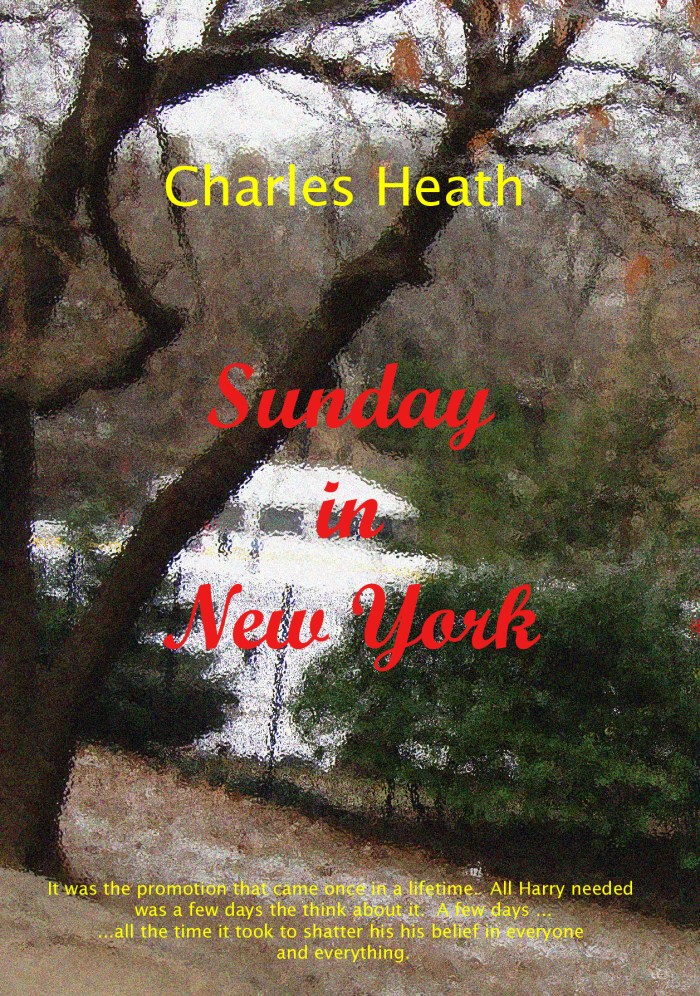
“Sunday in New York”, it’s a bumpy road to love

“Sunday in New York” is ultimately a story about trust, and what happens when a marriage is stretched to its limits.

When Harry Steele attends a lunch with his manager, Barclay, to discuss a promotion that any junior executive would accept in a heartbeat, it is the fact his wife, Alison, who previously professed her reservations about Barclay, also agreed to attend, that casts a small element of doubt in his mind.

From that moment, his life, in the company, in deciding what to do, his marriage, his very life, spirals out of control.

There is no one big factor that can prove Harry’s worst fears, that his marriage is over, just a number of small, interconnecting events, when piled on top of each other, points to a cataclysmic end to everything he had believed in.

Trust is lost firstly in his best friend and mentor, Andy, who only hints of impending disaster, Sasha, a woman whom he saved, and who appears to have motives of her own, and then in his wife, Alison, as he discovered piece by piece damning evidence she is about to leave him for another man.

Can we trust what we see with our eyes or trust what we hear?

Haven’t we all jumped to conclusions at least once in our lives?

Can Alison, a woman whose self-belief and confidence is about to be put to the ultimate test, find a way of proving their relationship is as strong as it has ever been?

As they say in the classics, read on!

Purchase:

http://tinyurl.com/Amazon-SundayInNewYork

Sunday In New York

A Chapter from “Echoes from the Past”

Currently available from Amazon

http://tinyurl.com/Amazon-EchoesFromThePast


Chapter One

I looked down on 5th Avenue and could just see, in the distance, Saks, and opposite, the Rockefeller Center.  Recently I’d gone ice skating there with a woman I had begun to care for more than I should, and who liked spending time with me.

It was a relationship that had evolved slowly and was now moving into dangerous territory.  From the moment our eyes first met across the ice, I knew that outing had been a mistake.  Whatever I’d been thinking it couldn’t happen, but against better judgement, I had let it happen.

It was not her fault, it was mine.  I was not the person she thought I was, the person I wanted to be, and if the circumstances of my past were not as they were, the person she was most likely looking for.

It had happened before, and it would happen again, and the result would be the same.  I would move on, find a new city, a new job, a new life, and continue to hide in plain sight.

Waiting for an eventuality that may never happen, but if it did, it would happen to me alone, not the woman I loved.

I sighed inwardly, thinking about how unfair life could be.  And how much, this time, I wanted it to be different.

From my office window, high up in the sky, I could see several Fire Department vehicles going through yet another drill and could just hear the sound of the sirens floating up to the 32nd floor.  Darkness was closing in, and the fast-moving red strobing lights stood out against the neon signs, the street lighting, and the Christmas decorations.

It was that time of the year again, a time that brought back very sad memories.  For most people, it was when families came together to celebrate.  That was not possible for me.  I’d thought with the passing of time it would no longer hurt so much, but it did.  I felt a tear in my eye and pulled a tissue out of the box on my desk to wipe it away.

Enough with the sentimentality.

Behind me, I heard files being dropped on my desk.  It was Friday when Maria from Accounting brought me the latest customers who were overdue in paying their investment contributions.  The stack was getting bigger every week.

I turned to face her.  She was only three years younger than me but looked ten.  Italian parents, conservative dressed, reserved manner, but usually friendly and outgoing, she was well liked by all.  What surprised me, out of all the people she could choose as a friend, and since our ice skating expedition something more than that, she chose me.

I was not exactly the easiest of people to get along with, for obvious reasons.

I soon discovered this was the only time she and I could meet in the office without the prying eyes of our workmates making more of it than it was.  Office romances, not that either of us would acknowledge we were having one, were frowned upon.  Worse, rumours were very easily started, and much harder to quash.

“To be honest, I’m glad I don’t have your job, Will.”

She looked at the stack and then gave me a special look, one I wanted to believe was reserved just for me.  Her smile always tugged at a heart string or maybe two.  This night it did more than that.

I shrugged and tried to be casual.  “I was told I had a gift.”

“Ah, the statement of faith, just before the sucker punch.”

Everyone knew to call customers in distress was a difficult job at best.  It required tact and diplomacy, a trait I’d acquired over time because of my situation.  It had been a strange match of opportunity and unrealized talent when a disgruntled customer had come into the office and verbally attacked Mr Bartleby, a senior partner.

I’d talked the customer down, and talked myself into the job.  I’d only agreed to do it because it came with the promise of a promotion.  Now I was considering an exit strategy, it probably didn’t matter.

“Doing anything for the weekend?”  She asked the same question every Friday.  The last time, I surprised her by asking if she skated on ice, not expecting she did.  She said yes.

It didn’t take long to realize she would have said yes to climbing Mount Everest.  It was her first time on skates, and we learned a lot about each other over the half hour she managed to stay upright.

For her bravery, I took her to dinner and then took her home.  She asked me to stay for a while, to patch up her wounds, perhaps the modern day equivalent of ‘would you like to come up and see my paintings’.

Whatever her intentions or my desires, we just talked over a bottle of wine and then coffee.  I didn’t have to leave, but it was better for both of us that I did.

I closed my eyes to break the connection.  I could feel it.  I was starting to fall in love with this girl, this woman, and I knew I had to be careful.  It would not be long before the questions started; questions I couldn’t answer.

“No.  I wasn’t intending to do much.”

“Then perhaps you might consider joining the rest of us monkeys for beer, wine and a lively discussion about anything but work.   Harry’s found a new bar, up on 6th Avenue.”

Harry was our social director, not a real one but self-appointed, and he organised most of the unofficial staff gatherings.  He was a bit too self-important for me, an ‘I am’ sort of guy, but he went to Harvard and had probably earned the right.  I wasn’t on his social radar so he rarely invited me to anything.  If he did, I generally declined.  Those gatherings were the hunting grounds of the go-getters, the rookies looking for an edge to climb the corporate ladder.  I was all about keeping a low profile.

“Is he asking, or you?”

A momentary frown settled on her face.  We’d had a similar discussion once before, and I’d realized then she tried only to see the good in people.  Perhaps that was why I was so lucky.

“Does it matter?”

I pretended to think about it for a minute, and then said, “No.”

Her smile returned.  “Do you want me to come to fetch you?”

“As appealing as that sounds, I have a couple of matters to tidy up.  You go, and I’ll drop in later.”

The expression on her face told me she didn’t believe me.  It was not without merit, because I had told her the same before and not followed through.  Then, it didn’t matter because I hadn’t known her all that well.  Now, it seemed everything had changed.

“You are not just saying that to get rid of me, are you?”  The tone matched the doubtful expression.

Blunt, but fairly accurate.  I didn’t want to underestimate this girl.  In normal circumstances, I might have considered something else, other than drinks.  Instead, I said, “I would have preferred a walk in Central Park, but I don’t think the weather is going to behave.”

Then I had a moment where I thought if I told her something closer to the truth, it might help me climb my way out of the deep hole I was digging for myself.  “To be honest, I’m not very good at these social gatherings.”

Another change in expression, she had many faces for many occasions.  This one was of surprise, or was it agreement?

“Then you and I could go somewhere else if you like.”

Not exactly the result I was looking for.

“We could, but then you would miss out on being with your friends and most likely miss the next scandal to envelop us.”

The last one was about Bartleby junior and a certain socialite.  Everyone knew what he was like except one person, his current fiancée Katrina.

“True.”  She shrugged.  I had just become a lost cause.  “I will look out for you.  But remember, I will be disappointed if you don’t come.”

She gave me a last look, somewhat whimsical I thought, as I watched her walk across the floor to the elevator lobby.  It was like watching the love of my life leaving, without turning back.


I’d promised myself a long time ago that I would not get involved with a woman, but I soon learned how difficult a promise like that was to keep, especially when the woman’s name was Katrina.

I’d not known real love before, and it was not difficult to fall under her spell.  She was as beautiful as she was beguiling.

A long time ago, in what felt like another lifetime, Katrina Winslow and I worked together.  She taught me my first job at Bentley, Bowman and Bartleby, Accountants.  And, as with anyone with whom you work so closely, we became friends, and then something more than that.

By the time I realised what had happened, it was too late.  She was the daughter of parents who cared about their daughter, and the people with whom she associated.  They had me investigated.

I remember that Monday morning as if it was yesterday when she came into my office.  We had spent a perfect weekend together, and when I left her Sunday night, I was full of those starry-eyed dreams people in love had.

An hour later, all of those dreams had been shattered, not only for me but for her too.  I had no answers for her questions, answers the investigators could not find.  I knew from the first day I met her she was out of my league, but I honestly believed love could conquer all.

Her father didn’t.  It ended, and in time I realized it was for the best.  I had nothing to offer her, and I could never give answers to any of the questions she might ask.

Not long after, Maria told me about her engagement to Marcus Bartleby, son of the remaining live partner whose name graced the building, and signs throughout the city.  I told myself he would be the sort of man her father believed she deserved, but in my heart, I knew what sort of person Marcus was, and equally, there was nothing I could do about it.

I had a secret, one that I could never tell anyone.  And until I could find a way of reconciling my past I could never contemplate having a future, make any friends, or find any sort of peace or happiness.

With Katrina, with Maria, or anyone else.


The truth is my life was the equivalent of a metaphorical train wreck.  You wouldn’t know it, looking at me, but how I looked now, how I acted and reacted was a product of many years of practice.  From the moment I had seen my parents murdered at the age of fourteen, I’d been on the run.  Being that young, it was tough on the road, and I had to get street smart, and defensive, very quickly.  I’d learned the hard way, through the school of hard knocks.  By comparison, the Bartleby’s of this world had got it easy.

But, don’t get me wrong.  It was not something I was bitter about.  It was what it was.  I did what I had to do, and what I have to.  I accepted they had and always would have everything handed to them on a platter.  It was the way of the world.

On the upside, I had only myself to please.  I did not have to rely on anyone else, nor was I responsible for anyone but myself.  I had no family to speak of, or that I would acknowledge.

My father had been an orphan and had spent a relatively lonely life up to the point where he married my mother.

The family I had on my mother’s side were the reason I ran away and kept running, and fortunately, I had not seen any of them since the day I finally escaped.

On the downside, I’d never stayed in one place too long, and never had the time to get a good education, a prerequisite for a good job.  Instead, I had a lot of experience in jobs that didn’t have much of a career path.

I’d thought of night school, even tried it once, but it didn’t work out.  That was the catalyst for joining the army, the one place where people like me finished up.  It was a place to call home wherever they dumped you, and you made friends that didn’t care who or what you were, or cared too much about your past.

I was sent to Iraq, the first time around, with a great bunch of guys, until most of the platoon was killed in a suicide bombing, and the few that survived, including me, were physically repaired and discharged.

In the years since I’d stopped in ten cities.  New York was the most recent, and I’d been here the longest.  I’d carved a path across America from the Mid West, a place called Columbus, Nebraska, through to New York, with a lot of places in between.  It was an interesting way to see the country when in normal circumstances I would have little reason to leave my home town.

Now, after all the running, all the looking over my shoulder, there was a desire to stop.  The problem was I couldn’t.  I couldn’t afford to feel safe, because the moment I did, the moment I let down my guard, it would be when I’d make a mistake, a mistake that could have horrific consequences.  Not only for me but others around me.

I’d learned that lesson well, soon after I had run away from home, but before I left my home town.  Escape was a relief, and when they had not caught up with me after a week, I started to feel safe.

I let down my guard.  I allowed my trust of the one person in that family I thought was my friend to influence my actions.  She had unwittingly led the family to me after being used as a decoy.  I hadn’t thought of that possibility.

They handed me to the man who murdered my parents.  He told me he’d been willing to track me to the ends of the earth, as long as it took.  He held me captive for a few hours until I escaped, and I had no intention of being caught again.

From that day, I never trusted anyone again.

I remembered the demonic look in his eyes when he told me he would never stop looking.  He was out there, somewhere, and I had to remain vigilant.  The passing of time, for this murderer, was irrelevant.

And, standing there, looking out the window and down 5th Avenue, I could feel the itch, the one I couldn’t scratch.  The one that told me my pursuer, a man who went by the name of Edward Jamieson, wasn’t very far away.


© Charles Heath 2015-2019

In a word: Can

Yes, another three letter word with a multitude of meanings, like

I can do this, it’s what we tell ourselves when faced with an impossible mission

You might want to carry a can, perhaps of drink, once made out of steel but now from aluminium.  It can also hold food, like baked beans

You might have a jerry can, which holds petrol, mighty handy if you are driving and run out.  It’s happened to me once

There’s the can-can, but that’s a dance

Can you do this, can I have a drink, you can park over there, it seems we can seek or be given permission

It is an informal name for either prison or a toilet, though it depends on where you are

And in the United States, a ‘tin can’ can also be used to describe a navy vessel

If you get canned from your job, it really means you got fired

In the can means the film has been completed

Of course, there is always a trash can which makes both a mess and a loud noise when they tip over, particularly at night

And, which also make a good set of wickets, painted on, when playing backyard cricket with your friends


I’ve always wanted to go on a Treasure Hunt – Part 17

Here’s the thing…

Every time I close my eyes, I see something different.

I’d like to think the cinema of my dreams is playing a double feature but it’s a bit like a comedy cartoon night on Fox.

But these dreams are nothing to laugh about.

Once again there’s a new instalment of an old feature, and we’re back on the treasure hunt.


I could hardly say no, but it was not going to be a place either of us would want to be if he came back, and especially if he had company.

But, Boggs didn’t seem to care, and strolled up to the dock, and then walked down to the boat.  IT wasn’t gated like some of the others were, but they had very expensive yachts that no doubt belongs to the local millionaires, people like the Benderby’s and their country club friends.

I remember my father talking about them once, and he had little respect for any of them.,  They, he said, had no time or money to worry about the welfare of their employees, but never lacked for anything themselves.

Looking at those yachts now, I could believe him.

I couldn’t say the same for Rico’s boat.  It was old, made of wood, and looked like boats I’d seen in old movies.  It was about 40 or 50 foot long, with a tall mast and a sail tied up ready to unfurl when out to see.

It had a large diesel engine, and it was this Rico used to get out of the bay until he was past the sandbank at the entrance.

On the transom, it had the words ‘Freedom Runner’ starting to peel and fade, and you could just make out the old name of the boat, ‘Elsie’, perhaps the wife or lover of the previous owner.  That must have been a long time ago, because I’d known Rico as long as I’d known Boggs, and that was nearly 18 years.

I had to ask, “You think Rico is running a collection service?”

“Someone is, according to the police chief.”

“How do you know that?  I thought the police were our sworn enemy.”

Considering the trouble we’d got into over the years, and the number of times the police chief had locked us up in the cells as punishment, we just spent our days avoiding him..  Perhaps the punishment had worked.

“He was around out place the other night.”

I wasn’t aware that Boggs was up to anything that would interest the law, but, then, he never told me everything he did.

“Why?”

“Come to see my mother.”

“What’s she been doing?”

“Nothing.  He was asking her out on a date.  Probably trying to cosy up to her so he can snoop on what Rico’s doing.  There’s no other reason why he would be interested in her.”

Actually, he was wrong.  Boggs mother was, for her age, quite attractive, or so my mother said.  She said a few other uncomplimentary things about her, but I was not going to repeat them to Boggs.

Nor did I agree with my mother’s assessment.  At times I saw more of Boggs mother than my own.

“Or maybe not.  But if she was to go out with him, that would make Rico think twice about doing anything, including giving you a hard time, or trying to steal the map.”

“You don’t know Rico.  He is just plain stupid.”

“He hasn’t been caught.”

“Yet.”

Then Boggs decided to walk over to the side of the boat and step onto the deck.

”What are you doing?” I hissed.

People on the other boats tied up to the pier were looking or pretending not to look, but I had no doubt they would report our actions to Rico

“Going on board.  I don’t think Rico would mind.”

It was said with a fair degree of bravado, but the halting tone told me otherwise.

“Are you coming?”

Damn him.  It was not as if he was going me a choice.

I shrugged.  God help us if Rico came back.


© Charles Heath 2019

“The Things We Do For Love” – Coming soon

Is love the metaphorical equivalent to ‘walking the plank’; a dive into uncharted waters?

For Henry the only romance he was interested in was a life at sea, and when away from it, he strived to find sanctuary from his family and perhaps life itself.  It takes him to a small village by the sea, s place he never expected to find another just like him, Michelle, whom he soon discovers is as mysterious as she is beautiful.

Henry had long since given up the notion of finding romance, and Michelle couldn’t get involved for reasons she could never explain, but in the end both acknowledge that something happened the moment they first met.  

Plans were made, plans were revised, and hopes were shattered.

A chance encounter causes Michelle’s past to catch up with her, and whatever hope she had of having a normal life with Henry, or anyone else, is gone.  To keep him alive she has to destroy her blossoming relationship, an act that breaks her heart and shatters his.

But can love conquer all?

It takes a few words of encouragement from an unlikely source to send Henry and his friend Radly on an odyssey into the darkest corners of the red light district in a race against time to find and rescue the woman he finally realizes is the love of his life.

The cover, at the moment, looks like this:

lovecoverfinal1

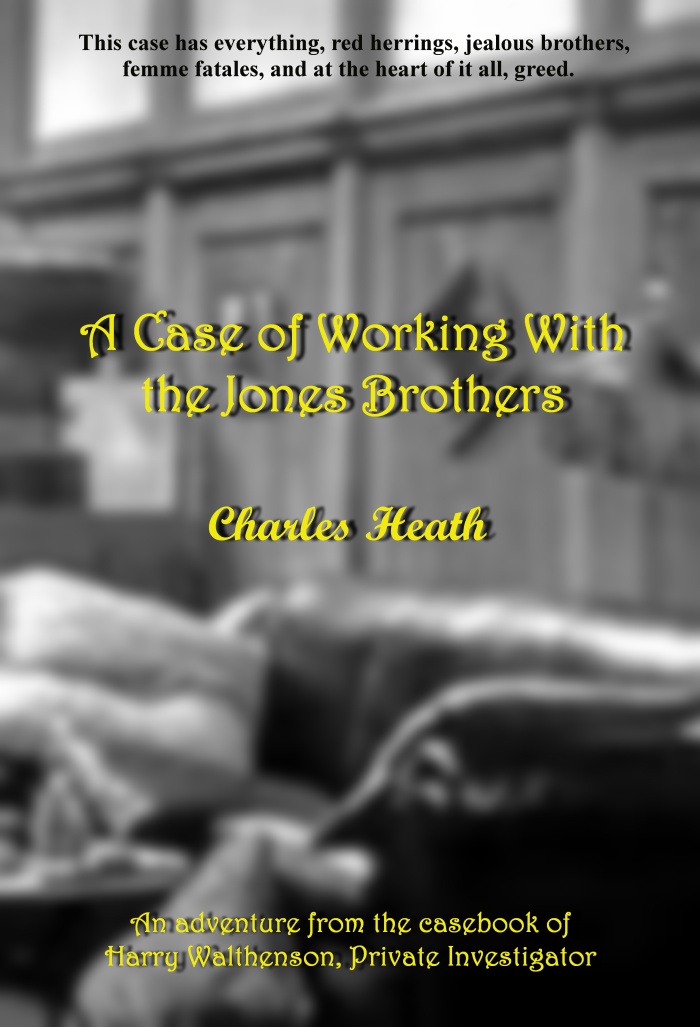
The first case of PI Walthenson – “A Case of Working With the Jones Brothers”

This case has everything, red herrings, jealous brothers, femme fatales, and at the heart of it all, greed.

Coming soon!

PIWalthJones1

The hardest chore of all – shopping

It’s one of those events that we all hate.  Ok let me qualify that statement, it’s an event that we men hate when of other half goes clothes shopping.

Here’s the deal, why is it they head straight to the right clothes rack to begin with, select the clothes they eventually buy, then proceed to spend the next hour and a half looking at everything else, none of which they eventually purchase.

I asked once, a rather dangerous thing to do, and I was told that everything else had to be eliminated to justify the original selections.

Ok, I think I’d rather negotiate a stretch of quicksand than to ask again.

So what does one do while waiting?

There is that heart sinking feeling that will not leave you, that you will be asked that inevitable but unanswerable question, ‘how does this look on me?’

Sadly there is no correct answer.  As all men are aware it doesn’t matter what you say, it will come back to either of, if you like it, ‘so you don’t care what I get?’, or if you don’t like it (and bearing in mind that this is never a view to put forward under any circumstances), ‘so you don’t really care at all?’

And while you have those dreaded thoughts running through your mind, there is the fact all waiting chairs for men are uncomfortable, probably intentionally, while you wait patiently listening to the in-store music which in this case is quite good.

I cannot identify the songs because it’s not the normal rock and roll but something with a pleasant beat and to a certain extent soothing.

Perhaps a team of very highly paid psychiatrists have especially worked up a playlist of such music because it tends to put the shopper in the mood to relax and buy more.  That also is aided but the very helpful and polite sales staff, who might convince you to make that extra purchase without you realizing it.  To them, you look good in everything.

Welcome to the world of 21st-century salesmanship.

Of course, I have shazam checking out the playlist and to me, it’s a rather obscure list of songs that I’d not really heard before.

Currently its playing ‘It’s all about love’ by Wild Royal Coast.  Tell me, have you heard of them?  Next, ‘Crazy’ by Friendless Feat Dem Feels.  Ok, now we’re going down that rabbit hole of obscure bands.

Moving on, it’s now time to look at the clientele.  Well, perhaps not.  It’s all shapes and sizes and ages but the one common denominator there are very few men accompanying the women.  Perhaps unlike me, they have perfected the art of excusing themselves from the quicksand of having to offer an opinion that can quite possibly lead to either a breakup or, at worst, a messy and complicated divorce.

And by a quirk of ironical fate, he will be left all of her clothes as part of the settlement.