I am my own worst enemy, again!

I think most authors are.

Just when you think that the story is done, and you’re on the third re-read, just to make sure…

Damn!

I don’t like the way that chapter reads, and what’s worse, it’s about the tenth time I’ve looked at it.

It doesn’t matter the last three times you read it, it was just fine, or, the editor has read it and the chapter passed without any major comment.

I think the main problem I have is letting go.  For some odd reason, certain parts of a story sometimes seem to me as though they are not complete, or can be missing a vital clue or connection for the continuity of the story.

That, of course, happens when you rewrite a section that is earlier on in the story, and then have to make ongoing changes.

Yes, I hear the stern warnings, that I should have made a comprehensive outline at the beginning, but the trouble is, I can change the ending, as I’m writing it and then have to go back and add the hooks earlier on.  Not the best method, but isn’t that what an editor is for, to pick up the missed connections, and out of the blue events that happen for no reason?

I find that often after leaving a finished story for a month before the next reading, the whole picture must formulate itself in my head, so when I re-read, there was always a problem, one I didn’t want to think about until the re-read.

Even then it might survive a second pass.

I know the scene is in trouble when I get to it and alarm bells are going off.  I find anything else to do but look at it.

So, here I am, making major changes.

But, at least now I am satisfied with where it’s going.

Only 325 pages to go!

Past conversations with my cat – 2

20160902_094127

This is Chester.  T for Tonkinese, capital T for trouble.

If you think you can win an argument with a Tonkinese you are sadly mistaken!

So, we got over the abandonment issues, and have moved onto the sleeping arrangements.  There seems to be some misconceptions on Chester’s part.

He thinks the bed is his domain.

Right.

We have provided him with several very comfortable, warn, and inviting places about the house where is he quite welcome to sleep, or keep a watchful eye over his domain.

That’s right, I thought I owned the house.

He has his own bed in our room where he can stay when he feels lonely, but it seems he has to be near us.

When he’s not walking across the bed, and us, or ‘resting’ on our feet.

And if we move, you’d think we’d taken a big stick to him.

Come to think of it …

Just to show his displeasure at his bed, the blankets always seem to be on the floor, and when I ask what happened, it was, of course, Mr Nobody.

After I’ve picked them up six times in a day, I ask him what his last slave died of?

And there’s the Siamese coming out, a snarl, and then aloof dismissal.

There is banishment to the great outdoors, but that’s another story.

“The Things We Do For Love” – Coming soon

Is love the metaphorical equivalent to ‘walking the plank’; a dive into uncharted waters?

For Henry the only romance he was interested in was a life at sea, and when away from it, he strived to find sanctuary from his family and perhaps life itself.  It takes him to a small village by the sea, s place he never expected to find another just like him, Michelle, whom he soon discovers is as mysterious as she is beautiful.

Henry had long since given up the notion of finding romance, and Michelle couldn’t get involved for reasons she could never explain, but in the end both acknowledge that something happened the moment they first met.  

Plans were made, plans were revised, and hopes were shattered.

A chance encounter causes Michelle’s past to catch up with her, and whatever hope she had of having a normal life with Henry, or anyone else, is gone.  To keep him alive she has to destroy her blossoming relationship, an act that breaks her heart and shatters his.

But can love conquer all?

It takes a few words of encouragement from an unlikely source to send Henry and his friend Radly on an odyssey into the darkest corners of the red light district in a race against time to find and rescue the woman he finally realizes is the love of his life.

The cover, at the moment, looks like this:

lovecoverfinal1

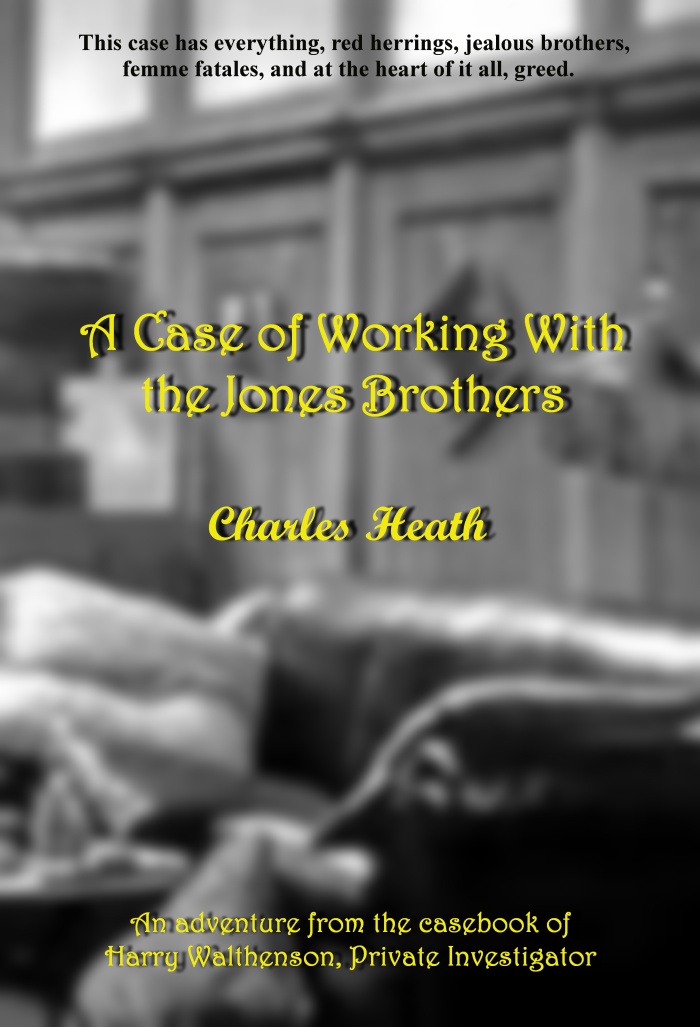
The first case of PI Walthenson – “A Case of Working With the Jones Brothers”

This case has everything, red herrings, jealous brothers, femme fatales, and at the heart of it all, greed.

Coming soon!

PIWalthJones1

Questions, sometimes without answers

#Creative Writing, #Blog, #Writing

At what point does a writer become a journalist?

Quite often journalists become writers because of their vast experience in observing and writing about the news, sometimes in the category of ‘truth is stranger than fiction’.

I did journalism at University, and thought I would never get to use it.  I had to interview people, write articles, and act as an editor.  The hardest part was the headlines.

How much does that resemble the job of coming up with a title for your book?

Well, several opportunities arose over the last few months to dig out the journalist hat, put it on, and go to work.

Where?

Hospital.  I’ve had to go there a few times more in the last few months than I have in recent years.

And I’d forgotten just how hospitals are interesting places, especially the waiting room in Emergency.

After the second or third visit, I started to observe the people who were waiting, and ran through various scenarios as to the reason for their visit.  None may have been true, but it certainly was an exercise in creative writing, and would make an excellent article.

Similarly, once we got inside the inner sanctum, where the real work is done, there is any number of crises and operations going on, and plenty of material for when I might need to include a hospital scene in one of my stories.

Or I could write a volume in praise of the people who work there and what they have to endure.  Tending the sick, injured and badly injured is not a job for the faint hearted.

Research, if it could be called that, turns up in the unlikeliest of places.  Doctors who answer questions, not necessarily about the malady, nurses who tell you about what it’s like in Emergency on nights you really don’t want to be there, and other patients and their families, all of whom have a story to tell, or just wait patiently for a diagnoses and then treatment so they can go home.

We get to go this time about four in the morning.  Everyone is tired.  More people are waiting.  Outside it is cool and the first rays of light are coming over the horizon as dawn is about to break.

I ponder the question without an answer, a question one of the nurses asked a youngish doctor, tossed out in conversation, but was there a more intent to it; what he was doing on Saturday night.

He didn’t answer.  Another crisis, another patient.

I suspect he was on duty in Emergency.


“The Devil You Don’t”, be careful what you wish for

John Pennington’s life is in the doldrums.  Looking for new opportunities, prevaricating about getting married, the only joy on the horizon was an upcoming visit to his grandmother in Sorrento, Italy.

Suddenly he is left at the check-in counter with a message on his phone telling him the marriage is off, and the relationship is over.

If only he hadn’t promised a friend he would do a favor for him in Rome.

At the first stop, Geneva, he has a chance encounter with Zoe, an intriguing woman who captures his imagination from the moment she boards the Savoire, and his life ventures into uncharted territory in more ways than one.

That ‘favor’ for his friend suddenly becomes a life-changing event, and when Zoe, the woman who he knows is too good to be true, reappears, danger and death follows.

Shot at, lied to, seduced, and drawn into a world where nothing is what it seems, John is dragged into an adrenaline-charged undertaking, where he may have been wiser to stay with the ‘devil you know’ rather than opt for the ‘devil you don’t’.

Purchase:

http://amzn.to/2o7ZtxZ


newdevilcvr3

Past Conversations with my cat – 1

20151219_163950

This is Chester.

Don’t be fooled by the benign expression, I’m getting the ‘your conversation better improve, and quickly’ look.

I guess it’s the talkative Tonkinese in him, tempered by the crabby Siamese part.

But …

We were talking about the state of the world, and he agrees it isn’t looking good, especially for travelers in Europe.  Of course, he is averse to either of us leaving him alone for any length of time, so he would say it was unsafe and we’d better stay at home.hat

I suppose that selfish part comes from the Burmese in him.

However …

I have scratched Germany, Austria, France and England off the list for the time being and consider it’s time to see a lot more of Italy.

We’ve been there several times, to Rome, in summer, to look at the Ancient ruins (Chester was rather impressed when I showed him a picture of the Collosseum), to Florence several times, just for the ambiance, and to Venice simply because we love it.

Then, we have also spent a few days in Tuscany, in an apartment very close to the town center of Greve in Chianti.

Chester, of course, was dismissive, but, he says, if we agree to take him with us …


Being Inspired – the book

Over the past year or so I have been selecting photographs I’ve taken on many travels, and put a story to them.

When I reached a milestone of 50, I decided to make them into a book, and, in doing so, I have gone through each and revised them, making some longer, and almost a short story.

50 photographs, 50 stories.  I’ve called it, “Inspiration, Maybe”

It will be available soon.

InspirationMaybe1v1

It’s a long hard road …

Self-published authors are fully aware that perhaps the easiest part of the writing journey is the actual writing.  Well, compared to the marketing aspect I believe it is.

I have read a lot of articles, suggestions and tips and tricks to market the book to the reading public.  It is, to say the least, a lot harder to market eBooks than perhaps their hard or paper covered relatives.  This is despite the millions of eReaders out there.

Then there is that other fickle part of the publishing cycle, the need for reviews.  Good reviews of course.  As we are learning, reviews can be bought.  Currently, Amazon is out there seeking out these reviews and reviewers and it will be interesting to see the result of their actions.

All the advice I have seen and read tells me that reviews should not be paid for, that reviews will come with sales.  It might be a difficult cycle, more reviews means more sales, etc.  And getting those first sales …

Therein lies the conundrum.  It is a question of paying for advertising or working it out for ourselves.  I guess if I were to get more sales, I could afford the advertising … yes, back on the merry-go-round!

And yet, the harder the road, the more I enjoy what I do.  It is exhilarating while writing, it is a joy to finish the first draft, it is an accomplishment when it is published, but when you sell that first book, well, there is no other feeling like it.

I am inspired.

Now, where are those notes for the next story …

Was it just another surveillance job – Episode 9

I’m back home and this story has been sitting on a back burner for a few months, waiting for some more to be written.

The trouble is, there are also other stories to write, and I’m not very good at prioritising.

But, here we are, a few minutes opened up and it didn’t take long to get back into the groove.

An interrogation and a revelation.


I think I just about reached that same conclusion just seconds before she uttered it.  But, I didn’t think this was the time to air my own thoughts on the matter.

The question I did ask was, “It appears our service has been compromised.”

She glanced at me almost condescendingly.  “It appears so.  Have you got your cell phone?”

I had it with me and gave it to her.  I had it ready because I knew they would ask for it.  It had a record of orders given, and phone conversations made, before, during, and after the operation.

For a review, or in this case, a search for the guilty.

I watched her put in the passcode, and go to the messages, and bring up the one sent to me, to attend the briefing.  It was all in order, no different to the previous five, with all the right designations and protocols.

“There was no reason to suspect it was anything but a real callout.”

Another glance at the screen, she put it on the desk next to the file.  “No, it looks real enough.”

Thought best kept to myself; how the hell did someone outside our organisation, know so well our inner workings?  I wanted to ask the question but refrained from doing so.

It also explained, now that I thought about it, the reason why the target had said he was one of us.  We had been hunting him so someone else, and enemy organisation perhaps, so they could kill him.  The question was, why?  Had he made a discovery, the evidence he was referring to that a certain Alfred Nobbin might have.

Perhaps a good idea, for the time being, to keep that snippet of information to myself.  After all, this new person in front of me could be one of Severin’s people.

Where I was sitting was not a familiar place to me, though I had been to the building before, which is why I knew where to go for this interview.  AS for the people, everyone I’d met so far, other than the other team members, bar one, I’d known from training.

So, now another expected question from me, or at least, if I was on the other side of the table, it’s one I’d expect to be asked.  “Just who was I working for, if it was not for us?”

Assuming she was one of us.

“That’s what we intend to find out.  Who was the target?”

I gave her the description we’d been given, and a copy of his photograph that had been circulated at the briefing.  I’d kept one of them, and luckily no one noticed it missing.  It was fortuitous that’s I’d copied the photo before I had to give it to her, which was right then.

There was not a flicker of recognition in her eyes.

“So, not one of us?” I asked.

For an interrogation, she wasn’t asking many relevant questions.

She looked up.  “Why would you say that, if your mission was to keep him under surveillance?”

“Which we now know was not sanctioned, so we have to assume that we had been persuaded to find and track one of our own agents.  You look as though you didn’t recognise him?”

“I don’t try to remember every agent we have in the field, here and overseas.  There a few too many for that.  But I’ve got a request out for his identity.  He didn’t say who he was?”

“No.”

“Anything at all that might be useful?”

“That he was one of us, who’d made a mistake, and feared we’d set the dogs on him.”

“Yes.  Someone definitely did that.”


© Charles Heath 2019