I’m supposed to be winding down!

It’s late at night and I just watched the start of a James Bond movie.

Not the sort of thing to be doing just before going to bed.  I watched the start, typically one of the best parts of the film, and then turned it off.

Then, while trying to switch my mind off so that I could get some sleep, it started running a hundred different scenarios that I might use in a story.

The catchy start, the sort that drags the reader into the book with a bang, high action, with bullets, grenades, a rocket launcher, maybe, a car or a helicopter chase, and a lot of death and mayhem.

Soldiers would tell you this is a typical day in a war zone, with real people, and innocent people as casualties.

Certain police forces would tell you this is what it’s like going up against drug cartels and organized crime.

Spy stories always make good reading and sometimes better movies because it is not something er, on average, equate with reality.  We have a hero, we have innocent people being saved, and the bad guys always lose.

Well, most of the time.  Sometimes they may be allowed to have a small win until the next book in the series.

It’s escapist entertainment, something that takes us away from the daily drudge.

Yes, I can see the beginnings of a story, helicopters, bullets, cars, danger.

Let me get back to you, I have to write this down before I lose it.


When will it ever be done?

I finally sat down and rewrote the next five episodes of my serialized private detective novel featuring Harry Walthenson.

I don’t know what it is about doing these rewrites, but it seems every time I want to do one, I find something else to do.

I mean, it’s not a problem when I get started, it just getting started that’s the problem.

Is this a subtle sign I don’t want to write it?

Or is it my mind is too cluttered with everything else, and by itself, it determines what I do next?

I wish it would make me sit down and write the ending to my NaNoWriMo project.  I have at best two chapters to go, but then I said that three chapters ago, so maybe therein lies the problem.

How long is a piece of string?

Then, of course, I’m in the middle of editing two new novels and I wanted to get these out before Christmas, but it seems the planets are out of alignment.

Make a list and prioritize, you say?

I’ve got a whiteboard and tried that.  The only person who takes notice of what I’ve written is my youngest granddaughter.

Maybe after the holidays…


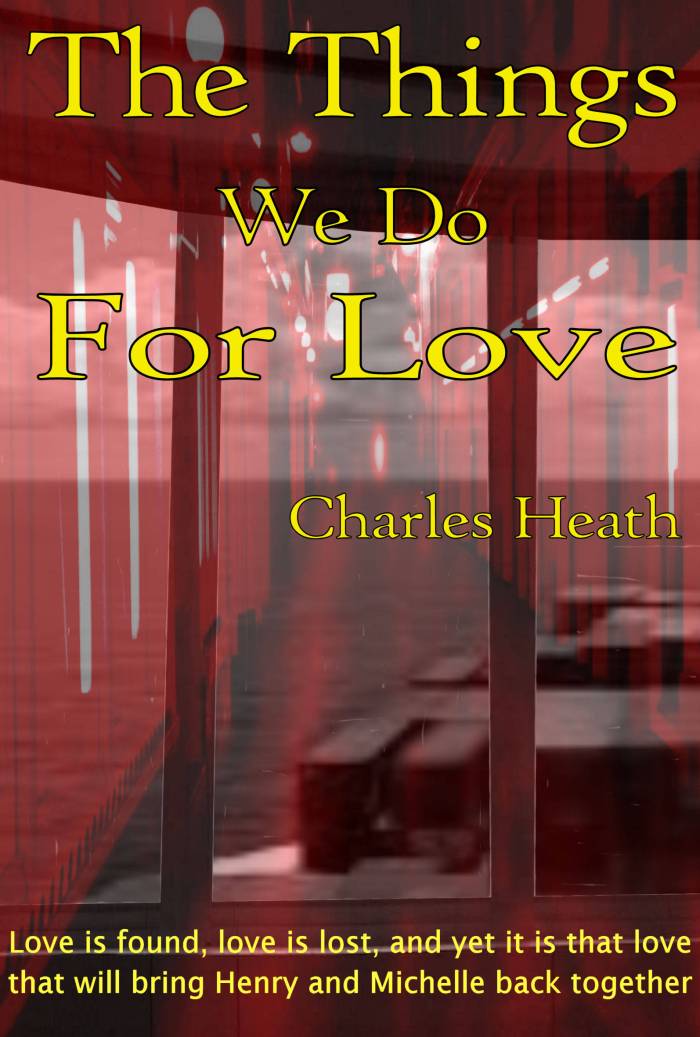
“The Things We Do For Love” – Coming soon

Like Sunday in New York, this is another attempt at writing a romance novel.  I’m one of those deluded fools who believe in happy endings.

I guess that was a ‘spoiler’!

This is the description I’m currently working with.


Is love the metaphorical equivalent to ‘walking the plank’; a dive into uncharted waters.

For Henry the only romance he was interested in was a life at sea, and when away from it, he strived to find sanctuary from his family and perhaps life itself.  Tonbright, a small village by the sea, is one such a place, but he never expected to find another, Michelle, whom he soon discovers is as mysterious as she is beautiful.

Henry had long since given up the notion of finding romance, and Michelle couldn’t get involved for reasons she could never explain, but in the end both acknowledge that something had happened.  Plans were made, plans were revised, and hopes were shattered.

A chance encounter causes Michelle’s past to catch up with her, and whatever hope she had of having a normal life with Henry, or anyone else, is gone.  To keep him alive she has to destroy her blossoming relationship, an act that breaks her heart and shatters his.

But can love conquer all?

It takes a few words of encouragement from an unlikely source to send Henry and his friend Radly on an odyssey into the darkest corners of the red light district in a race against time to find and rescue the woman he finally realizes is the love of his life.


The cover, at the moment, looks like this:

lovecoverfinal1


Just one of many reading lists – part 2

Everyone, it seems, will publish what they call the top 100 books that you should read.  Some are voted on, some belong to the opinion of the editor of the book review section of a newspaper, and, as you know, there are a lot of newspapers, a lot of editors, and a lot of opinions.

I’m not a newspaper, I’m not an editor, but I have a list, based on personal experience, and many, many years of reading.

It’s in no particular order.

21.  Passage of Arms by Eric Ambler, I have to say I have read most of his novels and they are very good

22.  Jane Eyre by Charlotte Bronte, a very powerful story of a courageous, independent woman

23.  The Riddle of the Sands by Erskine Childers, a 1903 secret service story, and a good example of an early espionage novel

24.  The Father Brown stories by G. K. Chesterton, which features a Roman Catholic priest who is also an amateur detective

25.  The Grantchester Mysteries by James Runcie, similar to the above, but featuring an Anglican vicar Sidney Chambers and set in the 1950s.  Recently brought to life on television.

26.  The High Commissioner by Jon Cleary, an Australian author, this novel introduces Sargeant Scobie Malone, in the first of many adventures

27.  A Tale of Two Cities by Charles Dickens, the first Dickens book I read, possibly because it was one of the shortest, and paved the way to reading all of his books.  Who could forget Madame Defarge

28.  Brideshead Revisited by Evelyn Waugh, another of those delightful but depressing stories of the 20s through to the 40s, perhaps for some, the golden age.  What could be said, in the end, about the Flytes?

29.  The Godfather by Mario Puzo, is the story of the Corleone mafia family, and for me, the most interesting part was that of the horse’s head, and of course, the death and mayhem

30.  The Shipping News by Annie Prouix, a Pulitzer Prize winner, and a story about a man, Quoyle, who against all odds puts his life slowly back together

31.  Detection Unlimited by Georgette Heyer, noted mostly for her Regency romances, she also wrote a series of detective novels.  This was her last detective novel published in 1953

32.  Poldark by Winston Graham, a series of stories about the Poldarks and Cornwall, and his arch-nemesis, George Warleggan

33.  Our Man in Havana by Graham Greene, one of many very interesting novels, this the first I read, followed by the Quiet American and Travels With My Aunt.  Seeing movies of some didn’t enhance the reading experience.

34.  The Mayor Of Casterbridge by Thomas Hardy, another of his interesting but sometimes hard to read novels of rural England.  This led to Jude the Obscure and others in the ‘series’.  It all started with Tess of the D’Urbervilles.

35.  A Farewell to Arms by Ernest Hemingway, set during the Italian campaign of World War 1.  He also wrote The Old Man of the Sea

36.  Lucky Jim by Kingsley Amis, I don’t think he was all that lucky

37.  Whiskey Galore by Compton MacKenzie, the story of the ‘resue’ of several hundred cases of whiskey and the locals’ efforts to hide it.  Also famous for writing Monarch of the Glen, later a television series

38.  The Expedition of Humphry Clinker by Tobias Smollett, a collection of satirical observations of English life in the 1700s in spa towns and seaside resorts

39.  Barchester Towers by Anthony Trollope, part of the series known as the Chronicles of Barsetshire and features the unpopular Bishop Proudie and Mrs. Proudie

40. The Mysterious Affair at Styles by Agatha Christie, Christie’s first book published in 1920, and introduced Poirot, Arthur Hastings, and Inspector Japp.  Who knew so many books would follow

The list continues
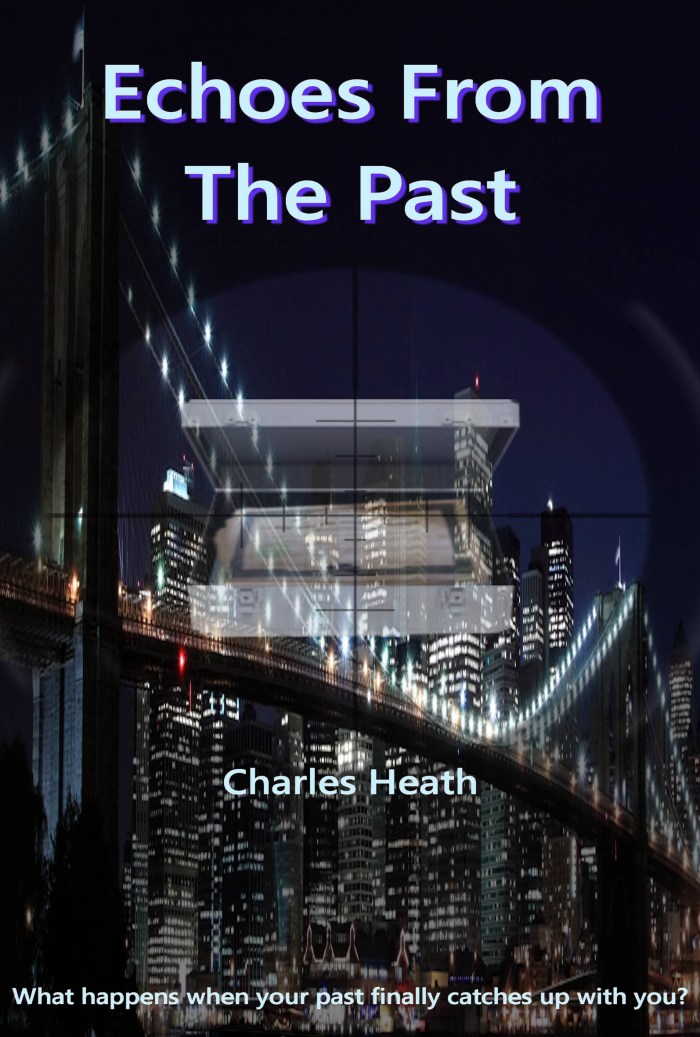
“Echoes From The Past”, buried, but not deep enough

What happens when your past finally catches up with you?

Christmas is just around the corner, a time to be with family. For Will Mason, an orphan since he was fourteen, it is a time for reflection on what his life could have been, and what it could be.

Until a chance encounter brings back to life the reasons for his twenty years of self-imposed exile from a life only normal people could have. From that moment Will’s life slowly starts to unravel and it’s obvious to him it’s time to move on.

This time, however, there is more at stake.

Will has broken his number one rule, don’t get involved.

With his nemesis, Eddie Jamieson, suddenly within reach, and a blossoming relationship with an office colleague, Maria, about to change everything, Will has to make a choice. Quietly leave, or finally, make a stand.

But as Will soon discovers, when other people are involved there is going to be terrible consequences no matter what choice he makes.

http://amzn.to/2F7gqAL

newechocover5rs


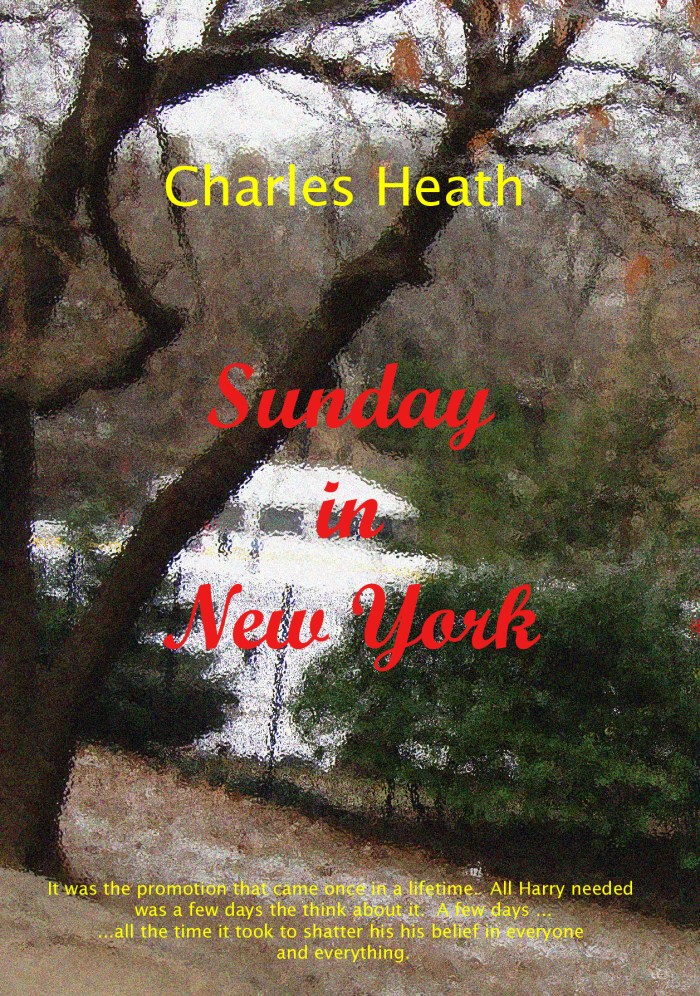
“Sunday in New York”, it’s a bumpy road to love

“Sunday in New York” is ultimately a story about trust, and what happens when a marriage is stretched to its limits.

When Harry Steele attends a lunch with his manager, Barclay, to discuss a promotion that any junior executive would accept in a heartbeat, it is the fact his wife, Alison, who previously professed her reservations about Barclay, also agreed to attend, that casts a small element of doubt in his mind.

From that moment, his life, in the company, in deciding what to do, his marriage, his very life, spirals out of control.

There is no one big factor that can prove Harry’s worst fears, that his marriage is over, just a number of small, interconnecting events, when piled on top of each other, points to a cataclysmic end to everything he had believed in.

Trust is lost firstly in his best friend and mentor, Andy, who only hints of impending disaster, Sasha, a woman whom he saved, and who appears to have motives of her own, and then in his wife, Alison, as he discovered piece by piece damning evidence she is about to leave him for another man.

Can we trust what we see with our eyes or trust what we hear?

Haven’t we all jumped to conclusions at least once in our lives?

Can Alison, a woman whose self-belief and confidence is about to be put to the ultimate test, find a way of proving their relationship is as strong as it has ever been?

As they say in the classics, read on!

Purchase:

http://tinyurl.com/Amazon-SundayInNewYork

Sunday In New York

Just one of many reading lists – part 1

Everyone, it seems, will publish what they call the top 100 books that you should read.  Some are voted on, some belong to the opinion of the editor of the book review section of a newspaper, and, as you know, there are a lot of newspapers, a lot of editors, and a lot of opinions.

I’m not a newspaper, I’m not an editor, but I have a list, based on personal experience, and many, many years of reading.

It’s in no particular order.

  1.  The life and opinions of Tristram Shandy, Gentleman by Laurence Sterne.  Don’t ask me why but I found this an interesting slice of life in England in the 1700s
  2. Vanity Fair by William Thackeray.  I met a direct descendant of him in England on a research visit which fuelled an interest in the book.  Another large tome recently brought to life by the mini-series on television.
  3. The Moonstone by Wilkie Collins.  Arguably the first detective novel, it was fuel for the imagination of any budding detective novel author.  He also wrote The Woman in White.
  4. Middlemarch by George Eliot, a remarkable novel, and famous for the fact it was written by a woman who thought it was best to use a male name in order to get recognition.
  5. Any of the Sherlock Holmes stories by Arthur Conan Doyle
  6. New Grub Street by George Gissing, very, very gritty
  7. The Thirty-Nine Steps by John Buchan, another of those incredibly well-written spy stories
  8. A Passage to India by E.M. Forster, a novel that brings up the subject of the British Empire
  9. The Great Gatsby by F. Scott Fitgerald, a story from the jazz age and the mysterious Gatsby whom no one could figure out
  10. The Maltese Falcon by Dashiell Hammett, one of the few books that opened up the world of the Private Detective, and fostered a brilliant movie with Humprey Bogart as Sam Spade.
  11. The Big Sleep by Raymond Chandler, the author who introduced us to Philip Marlowe, with two definitive characterizations by Humprey Bogart and Robert Mitchum
  12. The Grapes of Wrath by John Steinbeck, the classic about a family in the Great Depression, and my first introduction to Henry Fonda
  13. To Kill a Mockingbird by Harper Lee.  I had to read this when I was at school and probably a time when I didn’t understand it’s importance.  Seeing the film with Gregory Peck much later helped.
  14. Catch 22 by Joseph Heller.  A friend recommended this and after I read it, I wondered what the hell it was about.  Only now do I understand it’s anti-war undertones
  15. Far from the Madding Crowd by Thomas Hardy was the novel that introduced me to Hardy
  16. Rural Rides by William Cobbett is a slice of life in the southern English countryside in the 1800s
  17. Pride and Prejudice by Jane Austen, the first book of hers I read and found it fascinating.  Of course, when Mr. Darcy was brought to life it found a whole new generation of readers
  18. Great Expectations by Charles Dickens, the remarkable story of Pip, Miss Havisham, and the mysterious benefactor
  19. Fahrenheit 451 by Ray Bradbury, apparently the temperature that paper burns, but this is more about Guy Montag and the saving of books rather than burning them
  20. Madame Bovary by Gustave Flaubert, probably the most depressing novel I’ve ever read, about a woman married to a mediocre doctor and seeks to escape to a fantasy world that leads to disappointment and devastating consequences

The list continues …

Not your average to be read list

A long time ago, when I was 17 or 18, I used to do a lot of reading.  It was a long ride in on the train from home to work, and back again, and I did, then, have the time to read.

Having my own money, I was able to buy my own books, and these generally ran to mysteries and thriller, and naval stories.  The later took my interest for a while because I had notions of becoming an Ensign until I realized I needed better educational qualifications and a higher level of fitness.

So much for those aspirations, so I just read about what it would be like.

However…

I worked with a number of interesting characters, including one, a chap who was about 25, really old and wise to a 17-year-old, who deplored my reading choices.

It seemed Agatha Christie, Ngaio Marsh, Brian Callison, Hammond Innes, and Alistair Maclean didn’t quite fit the reading profile he thought I should follow.

Well, I hadn’t been to university, and I hadn’t realized there was such a thing as English, or any other, literature.  He was adamant that if I wanted to call myself a ‘man of books’ I had to read ‘proper’ books.

So, what eventuated, was a reading list.

If I wanted to converse with him on literature, I had to read every book on the list.

And I wanted to appear, at least, slightly more sophisticated, that the reader of penny dreadfuls.  I didn’t know what that meant, and in those days there was no internet, so it remained for a long time a phrase of mystery.

But, the reading list,

‘Hard Times,’ and ‘Bleak House’ by Charles Dickens

‘Seven Pillars of Wisdom’ by T.E. Lawrence, yes, that famous man who was better known as Lawrence of Arabia

‘Tess of the D’Urbervilles’ by Thomas Hardy, which fuelled a desire to read most of Hardy’s books

‘The Day of the Triffids’, by John Wyndham, a rather strange addition to the list since it was science fiction.  I suspect he was a closet Trekker.

‘To the Lighthouse’, by Virginia Wolff

‘Pride and Prejudice’ by Jane Austen

‘And Quietly Flows the Don’ by Mikhail Alexandrovich Sholokhov.  I had great fears that I would have to learn Russian, but that wasn’t the only shock, so was the size of the book

‘War and Peace’, talking about long books, by Leo Tolstoy

‘One Day in the Life of Ivan Denisovich’ by Aleksandr Solzhenitsyn, and thereby concluding the Russian classics

Of course, your definition of literature can change, and as a result of reading all of these books, and it took quite some time, and this led to selecting a more interesting collection of books to read, which he, in some small measure, took the credit for.

I discovered R.F Delderfield, and the trilogy, ‘A Horseman Riding By’, which led to ‘The Headmaster’, ‘The Avenue’, and ‘God is an Englishman’

C.S. Forester and the Hornblower series, but who also wrote several mysteries

F. Scott Fitzgerald and ‘The Great Gatsby’ as well as several other classics

Eric Ambler, master of thrillers from the ’30s and ’50s, particularly spy novels, and was probably the one who introduced me to the world of espionage

and last but not least, Dashiell Hammett’s ‘The Maltese Falcon’.


“The Devil You Don’t”, be careful what you wish for

John Pennington’s life is in the doldrums.  Looking for new opportunities, prevaricating about getting married, the only joy on the horizon was an upcoming visit to his grandmother in Sorrento, Italy.

Suddenly he is left at the check-in counter with a message on his phone telling him the marriage is off, and the relationship is over.

If only he hadn’t promised a friend he would do a favor for him in Rome.

At the first stop, Geneva, he has a chance encounter with Zoe, an intriguing woman who captures his imagination from the moment she boards the Savoire, and his life ventures into uncharted territory in more ways than one.

That ‘favor’ for his friend suddenly becomes a life-changing event, and when Zoe, the woman who he knows is too good to be true, reappears, danger and death follows.

Shot at, lied to, seduced, and drawn into a world where nothing is what it seems, John is dragged into an adrenaline-charged undertaking, where he may have been wiser to stay with the ‘devil you know’ rather than opt for the ‘devil you don’t’.

Purchase:

http://amzn.to/2o7ZtxZ


newdevilcvr3

Is there ever enough time for reading?

It’s a good question.

Between everything else I have to do around the house, the time set aside for writing, the time set aside for maintaining social media, the time set aside for family, is there any time left?

About an hour before I go to sleep, though that time is considerably shortened if the book is boring.

Fortunately, quite often they are not.

The other problem is the intervals between new books from my favorite authors is getting less as they take on co-writers, such as James Patterson and Clive Cussler.   And even more are now getting co-authors which means my to be read list is getting longer and longer.

It seems the only time I can steal more than an hour away is when I go away on holidays.  This we try to do several times a year, and this year we’ll be going to Canada and the United States.

There’s only one other problem involved, the fact books are so much cheaper there, and I’ll be buying more.

Damn.  It’s a never-ending cycle.

But, at the moment, the list reads like this,

James Patterson, Murder House, Black Book

Clive Cussler, Fire Ice, White Death

Edward Rutherford, New York, quite apt since we will be going there

Steve Berry, the 14th Colony

David Baldacci, Memory Man

And, of course, about a hundred others.

As odd as it sounds I’m looking forward to the 20 odd hours in the plane.  There’s one book read going there and one book read going back.