What I learned about writing – What Lies beneath

There is always something to see, especially when you are told, ‘nothing to see here, move along’.

That’s the question every thriller/mystery writer wants to get to the bottom of by the end of the story.

As a rule, it’s never really what you see or what you think you see, but it can be hiding in plain sight.

Someone once told me that we are trained to see what we want to see, often not what it is that’s there in front of us. 

Like reading a story with spelling errors, gaps, and bad punctuation, our eyes gloss over those errors because we’re trained to read words quickly using only a few letters.

It’s why we sometimes misinterpret words and find ourselves up that proverbial garden path.  I know I have done it myself.  I know those apps that predict the word you want to use but invariably display the wrong one are as flawed as our eyes and brains can be at times, so I try not to use them.

A good detective looks beneath the surface to see what others don’t.

You look at a shop window and see several products on sale at ridiculously low prices.

A detective looks at the same store window and sees the third dress along on the rack of sale items had a blood stain on the bottom hemline, and deduces the dress was worn by the murderer of a bystander.

Someone in the shop, customer, or employee had a case to answer.

Then, sometimes, we can’t see the wood for the trees.  It’s an interesting expression, but quite true.

Any time I visit a new place, I try to get as much visitor information as possible, and then, based on the description, go visit.

How many times have I been disappointed?  A few.  What they sometimes describe is the ambience, which may be there when there are fewer people about, but not when there are so many you cannot enjoy the view, the sidewalk cafes, and most of all the ambience.

This is translated into your writing, and I like the idea of depicting a place so that if you decide to go there, you see what I see, and not necessarily what the brochures tell you.

Then, of course, there is ‘beauty is in the eye of the beholder’.  That is not easy to convey in words, but I’m working on it.

One day! 

365 Days of writing, 2026 – 105

Day 105 – Graphic novels

Beyond the Comic Strip: A Beginner’s Guide to Creating Your Own Graphic Novel

For a long time, the term “graphic novel” was met with a shrug. People thought of them as “just comic books”—fleeting entertainment for kids. But today, the graphic novel stands as a respected, powerful medium of literature. From memoirs like Persepolis to genre-bending epics like Watchmen, graphic novels prove that when you combine visual language with the written word, you unlock a storytelling potential that prose alone just can’t touch.

If you’ve ever dreamed of telling a story through panels, splash pages, and speech bubbles, you’re in the right place. Let’s break down what graphic novels actually are and how you can start crafting your own.


What Exactly is a Graphic Novel?

At its core, a graphic novel is a book-length narrative told through sequential art.

Unlike a comic book, which is typically a serialised, thin pamphlet released monthly, a graphic novel is a complete, self-contained story (or a collected volume) bound in a book format. It uses the visual medium—panels, gutters, character design, and colour theory—to control the pacing of the reader’s experience in a way that text-only books cannot.

In a graphic novel, the art isn’t just an “illustration” of the story; the art is the story.


How to Create Your Own Graphic Novel: A Step-by-Step Guide

Creating a graphic novel is a marathon, not a sprint. It’s a labour of love that requires patience and a fair bit of planning. Here is your roadmap from concept to finished product.

1. Develop Your “Hook” and Script

Every great graphic novel starts with an idea. But before you pick up a pencil, you need a script.

  • The Synopsis: Summarise your story in a few paragraphs. What is the central conflict? Who is the protagonist?
  • The Script: Write it like a screenplay, but include descriptions of what is happening in each panel. Keep your dialogue tight—remember, you have limited space on the page!

2. Character and World Design

Before you draw the first page, spend time in your sketchbook.

  • Character Sheets: Draw your characters from different angles and with different expressions. If they aren’t consistent, the reader will get confused.
  • World-Building: What does your setting feel like? Create a “visual bible” for your world so the architectural style and atmosphere remain cohesive throughout the book.

3. Thumbnails: The Blueprint

This is the most crucial step. Thumbnails are tiny, rough sketches of every page in your book. They don’t need to look good; they just need to map out the flow.

  • Where does the reader’s eye go?
  • Are the panels too crowded?
  • Does the page turn reveal an exciting surprise?
  • Pro-tip: Don’t skip this! Fixing a mistake in a thumbnail takes seconds; fixing it in an inked final page takes hours.

4. Pencilling and Inking

Now it’s time to commit to the paper (or screen).

  • Pencilling: Draft the layout, body proportions, and backgrounds cleanly.
  • Inking: Use fine-tip pens or digital brushes to finalise the lines. This gives the drawings weight and definition, making them “pop” off the page.

5. Lettering: The Silent Storyteller

Bad lettering can ruin great art. Make sure your word balloons are placed in the order they should be read (top to bottom, left to right). Use clear, readable fonts, and ensure there is enough “breathing room” around the text so the page doesn’t look cluttered.

6. Coloring (or Shading)

If you aren’t doing the book in black and white, this is where you solidify the mood. Colour is a powerful tool—cool blues can signal sadness, while jarring reds can indicate danger. If you’re sticking to black and white, focus on value—using shadows and hatching to create depth and contrast.


Final Thoughts: Just Start

The biggest hurdle isn’t the technical skill—it’s the daunting nature of the project. A graphic novel is a mountain of work, but you climb it one panel at a time.

Don’t aim for perfection on your first attempt. Aim for completion. Whether you’re using traditional pencils and ink or an iPad with Procreate, the most important tool you have is your voice.

So, what story are you going to draw first?

The 2 am Rant: Life’s little experiences seem to have disappeared

I’m on a riverboat, sailing slowly down the Nile, ahead of us the Pyramids, a sight, I’m told, to behold despite the ravages of time.

There are others, a curious bunch of people, drawn from all over the globe, and from different classes, in a time when that seemed to matter.

Of course, it’s 1935.

And it’s all in my head.  Something I’d seen somewhere, or read perhaps, and now that I come to think of it, it was an Agatha Christie murder mystery.

Even now, nearly a hundred years later, it may have been possible to replicate it; only a world war, British Empire aspirations and later abandonment, and civil strife made it difficult, but not impossible.

And then, closing off travel anywhere, COVID-19 finished the job.

For someone who likes to travel the world, looking for locations and inspiration for my stories, that had made life far more unbearable than just having to remain locked up for fear of catching it. And, even though it is gone, we now seem to have was popping up everywhere, closing off things that we just took for granted would be there forever.

Not any more. Nationalism, greed, and in some cases, utter stupidity, are closing off countries that are no longer safe to visit. Even the United States was once thought to be the safest place on earth.

Gone are those treasured moments…

Like sitting at an outside cafe overlooking the main piazza in San Gimignano, having a pizza, an authentic pizza, and a bottle of Moretti beer.

Like wandering the narrow cobbled streets of Florence, staying in what was once a 12th-century monastery, having wild boar pasta, and just a short distance away, a gelato.

Like wandering around similarly narrow and cobbled laneways in Montmartre, stopping at a corner crepe restaurant, where the crepes are to die for.

Taking that away is like taking away a hand or a leg.

How long will it be before the world returns to normal, or will it?

In my conspiracy theory mind, it seems to me there is more going on than just viruses and greed; it has overtones of world domination, or worse, watching the destruction of the world economy, and capitalism for want of a better word, at the same pace that climate change is changing the planet.

Neither occurrence is new; it’s happened time and time again over many millennia, and it’s just that we don’t seem to learn from it.   

Well, maybe not in my lifetime. 

Let’s hope generations to come do.


Searching for Locations: Venice, Italy

Venice is definitely a city to explore.  It has an incredible number of canals and walkways, and each time we would start our exploration at St Marks square when it’s not underwater

Everyone I have spoken to about exploring Venice has told me how easy it is to get lost.  It has not happened to me, but with the infinite number of ways you can go, I guess it is possible.

We started our exploration of Venice in St Marks square, where, on one side there was the Museo di Palazzo Ducale and, next door, the Basilica di San Marco.  Early morning and/or at high tide, water can be seen bubbling up from under the square, partially flooding it.  I have seen this happen several times.  Each morning as we walked from the hotel (the time we stayed in the Savoia and Jolanda) we passed the Bridge of Sighs.

Around the other three sides of the square are archways and shops.  We have bought both confectionary and souvenirs from some of these stores, albeit relatively expensive.  Prices are cheaper in stores that are away from the square and we found some of these when we walked from St Marks square to the Railway station, through many walkways, and crossing many bridges, and passing through a number of small piazzas.

That day, after the trek, we caught the waterbus back to San Marco, and then went on the tour of the Museo di Palazzo Du which included the dungeons and the Bridge of Sighs from the inside.  It took a few hours, longer than I’d anticipated because there was so much to see.

The next day, we caught the waterbus from San Marco to the Ponte di Rialto bridge.  Just upstream from the wharf there was a very large passenger ship, and I noticed there were a number of passengers from the ship on the waterbus, one of whom spoke to us about visiting Venice.  I didn’t realize we looked like professional tourists who knew where we were going.

After a pleasant conversation, and taking in the views up and down the Grand Canal, we disembarked and headed for the bridge, looking at the shops, mostly selling upmarket and expensive gifts, and eventually crossing to the other side where there was a lot of small market type stalls selling souvenirs as well as clothes, and most importantly, it being a hot day, cold Limonata.  This was my first taste of Limonata and I was hooked.

Continuing on from there was a wide street at the end and a number of restaurants where we had lunch.  We had a map of Venice and I was going to plot a course back to the hotel, taking what would be a large circular route that would come out at the Accademia Bridge, and further on to the Terminal Fusina Venezia where there was another church to explore, the Santa Maria del Rosario.

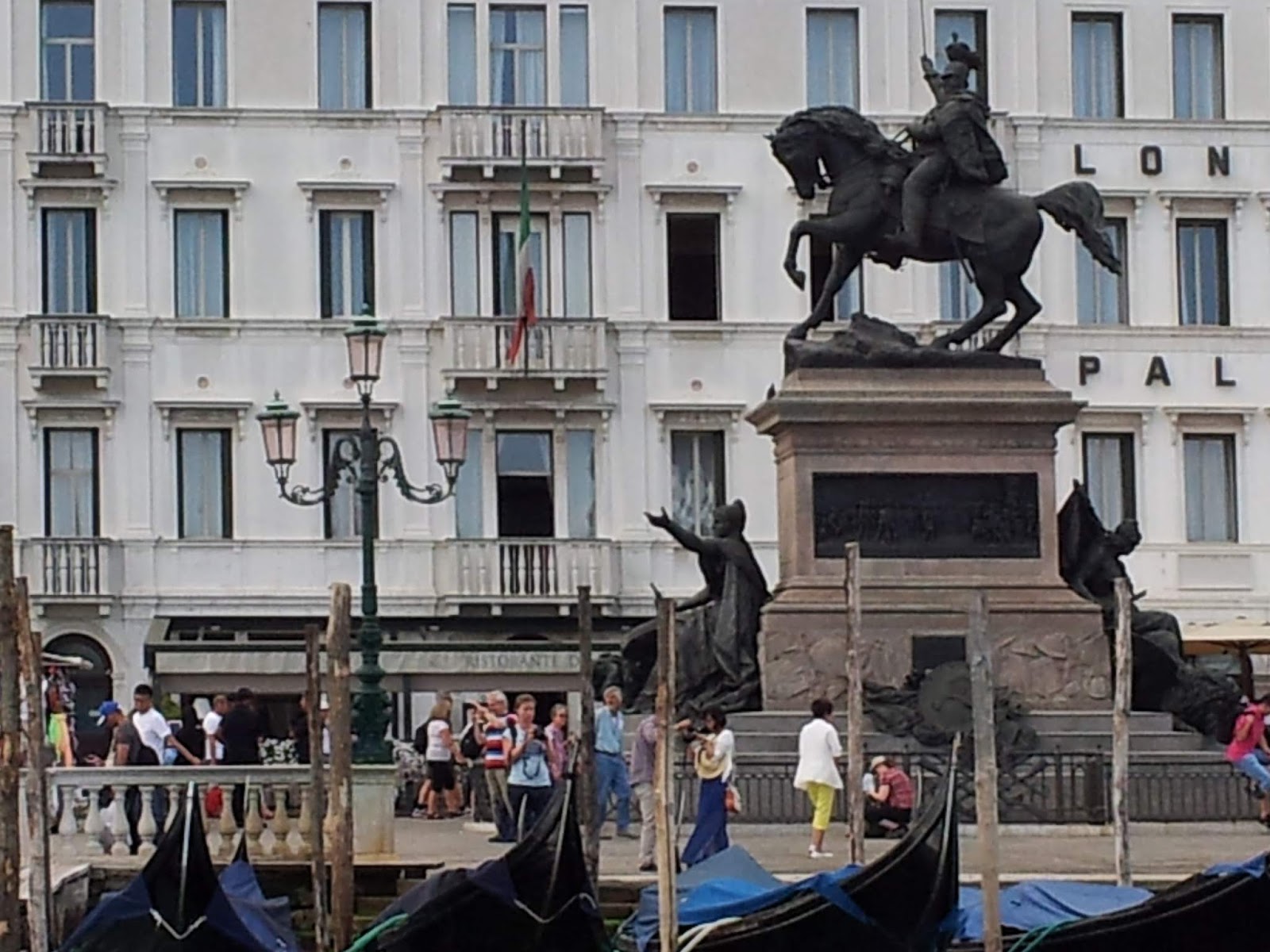
This is a photo of the Hilton Hotel from the other side of the canal.

It was useful knowledge for the second time we visited Venice because the waterbus from the Hilton hotel made its first stop, before San Marco, there.  We also discovered on that second visit a number of restaurants on the way from the terminal and church to the Accademia Bridge.

This is looking back towards San Marco from the Accademia Bridge:

And this, looking towards the docks:

Items to note:

Restaurants off the beaten track were much cheaper and the food a lot different to that in the middle of the tourist areas.

There are a lot of churches, big and small, tucked away in interesting spots where there are small piazza’s.  You can look in all of them, though some asked for a small fee.

Souvenirs, coffee, and confectionary are very expensive in St Marks square.

365 Days of writing, 2026 – 105

Day 105 – Graphic novels

Beyond the Comic Strip: A Beginner’s Guide to Creating Your Own Graphic Novel

For a long time, the term “graphic novel” was met with a shrug. People thought of them as “just comic books”—fleeting entertainment for kids. But today, the graphic novel stands as a respected, powerful medium of literature. From memoirs like Persepolis to genre-bending epics like Watchmen, graphic novels prove that when you combine visual language with the written word, you unlock a storytelling potential that prose alone just can’t touch.

If you’ve ever dreamed of telling a story through panels, splash pages, and speech bubbles, you’re in the right place. Let’s break down what graphic novels actually are and how you can start crafting your own.


What Exactly is a Graphic Novel?

At its core, a graphic novel is a book-length narrative told through sequential art.

Unlike a comic book, which is typically a serialised, thin pamphlet released monthly, a graphic novel is a complete, self-contained story (or a collected volume) bound in a book format. It uses the visual medium—panels, gutters, character design, and colour theory—to control the pacing of the reader’s experience in a way that text-only books cannot.

In a graphic novel, the art isn’t just an “illustration” of the story; the art is the story.


How to Create Your Own Graphic Novel: A Step-by-Step Guide

Creating a graphic novel is a marathon, not a sprint. It’s a labour of love that requires patience and a fair bit of planning. Here is your roadmap from concept to finished product.

1. Develop Your “Hook” and Script

Every great graphic novel starts with an idea. But before you pick up a pencil, you need a script.

  • The Synopsis: Summarise your story in a few paragraphs. What is the central conflict? Who is the protagonist?
  • The Script: Write it like a screenplay, but include descriptions of what is happening in each panel. Keep your dialogue tight—remember, you have limited space on the page!

2. Character and World Design

Before you draw the first page, spend time in your sketchbook.

  • Character Sheets: Draw your characters from different angles and with different expressions. If they aren’t consistent, the reader will get confused.
  • World-Building: What does your setting feel like? Create a “visual bible” for your world so the architectural style and atmosphere remain cohesive throughout the book.

3. Thumbnails: The Blueprint

This is the most crucial step. Thumbnails are tiny, rough sketches of every page in your book. They don’t need to look good; they just need to map out the flow.

  • Where does the reader’s eye go?
  • Are the panels too crowded?
  • Does the page turn reveal an exciting surprise?
  • Pro-tip: Don’t skip this! Fixing a mistake in a thumbnail takes seconds; fixing it in an inked final page takes hours.

4. Pencilling and Inking

Now it’s time to commit to the paper (or screen).

  • Pencilling: Draft the layout, body proportions, and backgrounds cleanly.
  • Inking: Use fine-tip pens or digital brushes to finalise the lines. This gives the drawings weight and definition, making them “pop” off the page.

5. Lettering: The Silent Storyteller

Bad lettering can ruin great art. Make sure your word balloons are placed in the order they should be read (top to bottom, left to right). Use clear, readable fonts, and ensure there is enough “breathing room” around the text so the page doesn’t look cluttered.

6. Coloring (or Shading)

If you aren’t doing the book in black and white, this is where you solidify the mood. Colour is a powerful tool—cool blues can signal sadness, while jarring reds can indicate danger. If you’re sticking to black and white, focus on value—using shadows and hatching to create depth and contrast.


Final Thoughts: Just Start

The biggest hurdle isn’t the technical skill—it’s the daunting nature of the project. A graphic novel is a mountain of work, but you climb it one panel at a time.

Don’t aim for perfection on your first attempt. Aim for completion. Whether you’re using traditional pencils and ink or an iPad with Procreate, the most important tool you have is your voice.

So, what story are you going to draw first?

What I learned about writing: Characters can be the sum of our experiences

Our view of life, love, relationships, and marriage comes from our own experiences. This is basically the same for all of us for everything that happens to us through life, as young children, at school, at work, at leisure, and as we grow as a person.

Our ideas about life will come from the experiences of having our children, watching over our children as they grow up, from our relatives, both our own and those acquired by marriage or relationships, and from our friends.

No two life experiences will be exactly the same. There will be similarities but differences, which may or may not give us a different perspective, whether that might be for the better or for the worse. Not everything that will happen to us will be good or bad, but just an experience that we will remember or forget, take notice of or ignore, helps us grow, or cause us pain.

There will be the experiences we have when interacting with others that are outside our family sphere, but have an influence on us directly or indirectly, like politicians, doctors, government officials, and police. There will also be experiences involving those at work that we interact with in a professional manner, and others who have influence in ways that sometimes can be unimaginable.

These interactions will influence our feelings, thoughts, and how we react and behave, the highs and lows of having children and grandchildren, and interactions with aunts, uncles, and our parents. Equally, there will be moments of despair, of losing a job or missing out on a promotion, of dealing with people in the workplace that make life difficult, dealing with relatives who are not very nice, in short, all of those interactions with all these people around you, and more.

Yes, your life is steered by all of these influences, and your views are often coloured by any or all of these people. They make up the sum of who you are, who you will be, and what you want to be. Those dreams will seem, sometimes, within your grasp, but quite often they will seem as far from your grasp as touching the moon.

But all of this, while it makes up who you are, will also make up who your characters are in a story.

They will be people you know, people you’ve met, people you’ve interacted with, people you’ve seen.

365 Days of writing, 2026 – 104

Day 104 – Writing Exercise

He brushed the curtain to one side and looked out the window.

There had been no reason to.  Usually, he just arrived at a hotel, checked in, partially unpacked, had a shower and went to bed.

His employers didn’t believe that he should arrive in the morning, get settled, study up on the details for the meeting the next morning, and be ready, bright-eyed and bushy-tailed.

Instead, because he was usually on the last plane, it was always late, arriving at the destination just before the airport closed, and often, it was almost impossible to get a cab into the city.

Which invariably made him tired and angry by the time he reached the hotel. 

He would be lucky to get three hours of sleep, if at all.

And lucky enough, this time, to get a room with a balcony.  He decided to get some fresh air before turning in.  The day had been hot, but the night was cool with a gentle breeze.  The room was cold from the air conditioning, which he had turned off.

He should be looking at the agenda for the following day.  Instead, he took a bottle of beer from the bar fridge, turned all the lights off behind him, and went out into the night.

After midnight, darkness had settled.  Office towers had only some areas lit, some floors in darkness, making the view look like a patchwork quilt.  Some floors were ablaze, perhaps waiting for the cleaners, or people were working back.

The neon advertising lights, glaringly bright, vied for attention, from the brighter colourful blinking advertisements atop buildings, standing out starkly against the black backdrop, to those static signs at ground level.

In the distance, a large stadium still had all the arc lights going, and it looked like a patch in daylight.  Had someone forgotten to turn the lights off?

In the morning, he would be hard-pressed to see any of it.

There was no rhyme or reason why his eyes ended up on a dull glow of a desk lamp in an office in a building almost across the road, on a diagonal line from his balcony.

He was standing in the darkness, the lighting of the room in the darkness, except for the bedside lamp, which was just visible from where he was standing.  It was dark on the balcony, and he would’ve been invisible to anyone looking his way.

The glow of the lamp showed a man and a woman in an office.  She was sitting on the desk, and he was sitting in his chair.  They had a look of familiarity about them, perhaps a pair in a relationship, perhaps married, perhaps an affair, his mind turning over the scenarios.

She was stunningly beautiful, still in her work clothes; he guessed she might be a lawyer or accountant, she had that university-acquired air of authority.  The man was all too familiar to him, the smartest man in the room type, the one who commanded attention. 

Politicians, law practice partner or management.  Definitely management.

The way she looked up at him, not the way a wife or girlfriend would.  There was something else going on there.

She laughed, that sort of laugh that changed her manner.  She was madly in love with him, and then he stood and came to her; she melded into his arms with a practised ease of long-term lovers.

Then, suddenly, the lights came on; someone had flicked a master switch. They were suddenly apart, and the whole atmosphere had changed.

Very businesslike.

The cleaners had arrived.

She collected her coat and handbag, gave a coy wave and headed off.  The secret assignation was over. 

It was true, he thought, that the janitorial staff were almost invisible.  The things they must know, if only they knew who they were.

I shrugged.  Enough of inventing the lives of others who were so much better off than I.

A third-year law clerk whose lot in life was to handle the small legal issues of our clients when we had to liaise with out-of-state matters.

This one was a deceased estate that the client’s mother had left behind, and a minor dispute over who had the final will. 

The client claimed to have the last true will and testament of Agatha Bernadette Williams, the lawyers who claim to represent the caretaker and his wife had what was a later will.

It was suspicious in the sense that the son, and rightful heir, according to him, had a detailed record of the last time his mother had made her will, with signed documents and statutory records of interviews and letters between the son and his mother.

The second will was simply writing on a piece of paper and was supported by two witnesses, not the caretaker and his wife, leaving everything to them.

It might not have been a problem if the estate were worth 50,000 dollars rather than fifty million, give or take.

The son considered the claim to be fake, my boss believed what the client told him, so they sent me.  I had very specific instructions.  Prove they were lying.  The problem, the lawyers, the caretaker and his wife had selected were very reputable and charged very high fees for one reason only.  They very rarely lost.

I had to wonder why they sent me into a legal minefield. 

I had a copy of the new will, the old will, reports from a handwriting expert, and a deposition from the son saying that the other will and the manner in which it was created were not done by his mother.

There was another document, the caretaker’s criminal history, and it didn’t make pleasant reading.

Why was it that money, particularly large chunks of it, brought out the worst in people?

I was staying in the hotel I was in because it was not far from the offices of our affiliate lawyers.  It was another reason why I was annoyed.  The affiliate lawyers could have sorted the problem, and I would not have had to get on a plane.

I hated planes.

I wanted to come by train, but my boss, Horace Aloysius Jacketine, the third, mind you, senior partner, determined this matter had to be settled now, today, no excuses, and no delays

I tried to argue the case for the local office, and failed.  One of us had to oversee it.  The lawyer handling the matter, Jennifer Joan Rickerson, herself from a long line of distinguished legal people, was disappointed.  I don’t blame her.  She was overqualified for a matter this small.

She did not play the female lawyer card, but I knew Horace had a low opinion of female lawyers, perhaps because he had been beaten by one once, and I suspected that had been his wife.  He married her, and she was no longer a competition.

Horace was a strange and remarkably out-of-date sort of man.  More than once, I thought he belonged in the late 1800s and had arrived here through a portal.  As you can appreciate, reading science fiction was almost the perfect escape from heavy legal matters.

I rose early and quickly scanned the documentation.  I was supposed to leave with the affiliate lawyers and request that they go through it before I left to return home.  Lawyers never moved that fast, but in this case, there seemed to be a rush for a result from both parties.

Something was not right.

My sixth sense got me the job at the law office.  That year, the candidates were given a case file and told to find what the key issues were so that a winning case could be prepared and executed.

Based on an old case that they had lost? I had heard from a previous intake candidate that it was a case that set the candidates up to fail.  No one had cracked it, and it was rumoured to be one of Horace’s old cases, and he refused to let it go.

I didn’t blame him.  The billable hours would have been worth a fortune.

We were given an hour, sat in a small, stuffy room, with a big binder of papers that hadn’t been filed properly, a fact that I realised later, but there was no need.  Discovery and document collection, and their collating, were always very messy.

I also learned a valuable lesson that day, that it was not a good idea to simply overlook something because it did fit a set of parameters.  The exercise in part was to sort out those who probed and those who glossed.

Five pages in, and my nose was twitching.

On page 397, I had the answer and wrote three lines on a sheet of legal note pad paper with the number they gave me, and I gave it to the receptionist, the same one who had looked down her nose at me when I arrived.

I doubted it would ever reach the person responsible and left feeling rather dejected.

But it did, and I got the job, the only one out of 29 candidates, and my first job was to write up the case in a way that we would have won.

After that, I got to work for Horace, which had its perks and its problems.

I took a dedicated elevator up to the 20th floor, where the law firm lived, atop the building.  It was that floor that cost a small fortune for the uninterrupted views, and the impression it made on the clients, that this was a law firm that consistently won.

We lived in the original historical building where the first law office was, our message being that we had been around for a long time and were reliable and resolute.  I thought the place creaked and groaned like an old sailing ship.

Clients like glass and concrete, not musty dark wood panelling that retained centuries of cigar smoke and carpets, well, I was never quite sure what that aroma was.

This office had lightning-fast elevators, an open layout where everyone had stunning views, and offices with glass walls.  There was nowhere to hide.  The breakout area was nothing less than spectacular.

It was where the receptionist left me, and where I made a cup of coffee with a machine that had a TV screen and lots of pictures of different types of coffee, but not one of just coffee.

Back home, our office had instant coffee in a large tin; you boiled the water and scooped sugar out of a large piece of vintage crockery. I didn’t have milk.

I was waiting for Jennifer Joan Rickerson.  She had an interesting voice on the phone, and I was eager to see if my imagination matched the reality.

“Mr Pargeter?”

The voice.  I turned and nearly dropped my cup.  It was the girl from the late-night office, in different clothes but just as stunning.  I noticed the slight wrinkle of her nose, a sign of disapproval.

I guess I was not her idea of lawyer material.

“I am.”

I was not sure if we shook hands, so I didn’t move, except to put the cup on the sink.

“I think you equally agree with me that there was no reason to send someone from your office.”

“I do.  But you try making the point with my boss. It’s a dotting the i and crossing the t exercise.”

She gave me one last disapproving look before saying, “We’re set up in the conference room.  The Caretaker’s lawyer will be coming in about an hour.”

I followed her into a large, very bright room surrounded by glass, with distracting views.

She sat at the head of the table, and I sat in the cheap seats.  I knew a lot about strategic seating, positions of power, and the place where the poor client, if necessary, was placed at a disadvantage.  She was obviously well-versed in strategy, especially when faced with a third-year legal representative.

The worst seat in the room was my biggest advantage.  That was why they could never see me coming.

“The Catetakers’ legal representatives had sent over their latest documents, which are in the blue folder.”

There were five folders, all different colours.  Their notes on the case were in the yellow folder.  Documents we had sent were in the green and purple folders.  The grey folder was empty; that was for today’s notes.

I took a plain manila folder out of my ancient satchel and slid it across the table.

“Another affidavit from the son.  He’s adamant that his mother would never create such a document, given how structured her life had been for so long.  Oddly, and with no relevance, my father was the most orderly man I ever knew, and in the last year of his life, that all fell apart.  I guess we don’t want to believe that it’s possible.”

Another of those rather interesting expressions that covered a multitude of thoughts.  If only I could read her mind…

“Anything is possible, but as you know, we only deal in facts, not possibilities.”

“Exactly.  What do you make of this case, based on the latest information supplied by the Catetaker?”

It would be interesting to hear what she thought.  I had made an assumption based on a single glance at the top page of the yellow folder.

“They have a strong case.  It’s going to come down to the court deciding the outcome.  Take a look at the documents and see what you think.  It’s going to be a battle to get any form of closure today, contrary to what is expected.”

“And if it was over fifty thousand dollars?” I asked, in my non-confrontational tone.

The look said it all.

©  Charles Heath  2026

Searching for Locations: Venice, Italy

Venice is definitely a city to explore.  It has an incredible number of canals and walkways, and each time we would start our exploration at St Marks square when it’s not underwater

Everyone I have spoken to about exploring Venice has told me how easy it is to get lost.  It has not happened to me, but with the infinite number of ways you can go, I guess it is possible.

We started our exploration of Venice in St Marks square, where, on one side there was the Museo di Palazzo Ducale and, next door, the Basilica di San Marco.  Early morning and/or at high tide, water can be seen bubbling up from under the square, partially flooding it.  I have seen this happen several times.  Each morning as we walked from the hotel (the time we stayed in the Savoia and Jolanda) we passed the Bridge of Sighs.

Around the other three sides of the square are archways and shops.  We have bought both confectionary and souvenirs from some of these stores, albeit relatively expensive.  Prices are cheaper in stores that are away from the square and we found some of these when we walked from St Marks square to the Railway station, through many walkways, and crossing many bridges, and passing through a number of small piazzas.

That day, after the trek, we caught the waterbus back to San Marco, and then went on the tour of the Museo di Palazzo Du which included the dungeons and the Bridge of Sighs from the inside.  It took a few hours, longer than I’d anticipated because there was so much to see.

The next day, we caught the waterbus from San Marco to the Ponte di Rialto bridge.  Just upstream from the wharf there was a very large passenger ship, and I noticed there were a number of passengers from the ship on the waterbus, one of whom spoke to us about visiting Venice.  I didn’t realize we looked like professional tourists who knew where we were going.

After a pleasant conversation, and taking in the views up and down the Grand Canal, we disembarked and headed for the bridge, looking at the shops, mostly selling upmarket and expensive gifts, and eventually crossing to the other side where there was a lot of small market type stalls selling souvenirs as well as clothes, and most importantly, it being a hot day, cold Limonata.  This was my first taste of Limonata and I was hooked.

Continuing on from there was a wide street at the end and a number of restaurants where we had lunch.  We had a map of Venice and I was going to plot a course back to the hotel, taking what would be a large circular route that would come out at the Accademia Bridge, and further on to the Terminal Fusina Venezia where there was another church to explore, the Santa Maria del Rosario.

This is a photo of the Hilton Hotel from the other side of the canal.

It was useful knowledge for the second time we visited Venice because the waterbus from the Hilton hotel made its first stop, before San Marco, there.  We also discovered on that second visit a number of restaurants on the way from the terminal and church to the Accademia Bridge.

This is looking back towards San Marco from the Accademia Bridge:

And this, looking towards the docks:

Items to note:

Restaurants off the beaten track were much cheaper and the food a lot different to that in the middle of the tourist areas.

There are a lot of churches, big and small, tucked away in interesting spots where there are small piazza’s.  You can look in all of them, though some asked for a small fee.

Souvenirs, coffee, and confectionary are very expensive in St Marks square.

What I learned about writing – Just what are you saying?

So here’s the thing.

We all have points of view, nurtured from the day we are born to the day we die.

Along the way, these views can change, as does our opinion of many things.

Political beliefs, religion, and the weather.

As a rule, I tend to avoid both politics and religion, simply because most people hold very strong views.

As for the weather, I’m an expert.  After I look out the window.

But…

Even then, there are people with strong views about that because of or not climate change and secret satellites that change weather patterns…

Yes, yet another WTF moment!

So…

The point I’m trying to make is that our personal beliefs sometimes creep into the characters we create.

At least we think we are creating this particular person, and no matter how hard we try to make them what seems to be the complete antithesis of ourselves, somehow, a little shred is there.

I cannot make a completely obnoxious person, no matter how hard I try, because it’s not me.  I don’t know what it’s like to be one.  I have to read about people like that, and delved into Freud’s thoughts on psychosis to gain some level of understanding

And, sadly, I want to believe there is good somewhere in everyone.

It could possibly be one of those issues a writer has to deal with in character development.

Of course, it’s all the easier if you have had to deal with such people.

My father was a monster who beat all of us, but that may have had something to do with the war and fighting the Japanese in the jungle.

My uncle was a paedophile who assaulted both my brother and me, and a lot of others, in a time when he could get away with it

My mother had no idea how to be a mother or care for us in the way a mother should.

These people gave me the background for certain types of characters.

So did a lot of the people I worked with over the years.  People I saw, people in other countries, people from all walks of life.

All, in their own way, shaped who I am and what I believe in.

And I know enough not to impose my beliefs, such as they are, on anyone.

Jane Austen got it right

“For what do we live but to make sport for our neighbours and laugh at them in our turn?”

365 Days of writing, 2026 – 104

Day 104 – Writing Exercise

He brushed the curtain to one side and looked out the window.

There had been no reason to.  Usually, he just arrived at a hotel, checked in, partially unpacked, had a shower and went to bed.

His employers didn’t believe that he should arrive in the morning, get settled, study up on the details for the meeting the next morning, and be ready, bright-eyed and bushy-tailed.

Instead, because he was usually on the last plane, it was always late, arriving at the destination just before the airport closed, and often, it was almost impossible to get a cab into the city.

Which invariably made him tired and angry by the time he reached the hotel. 

He would be lucky to get three hours of sleep, if at all.

And lucky enough, this time, to get a room with a balcony.  He decided to get some fresh air before turning in.  The day had been hot, but the night was cool with a gentle breeze.  The room was cold from the air conditioning, which he had turned off.

He should be looking at the agenda for the following day.  Instead, he took a bottle of beer from the bar fridge, turned all the lights off behind him, and went out into the night.

After midnight, darkness had settled.  Office towers had only some areas lit, some floors in darkness, making the view look like a patchwork quilt.  Some floors were ablaze, perhaps waiting for the cleaners, or people were working back.

The neon advertising lights, glaringly bright, vied for attention, from the brighter colourful blinking advertisements atop buildings, standing out starkly against the black backdrop, to those static signs at ground level.

In the distance, a large stadium still had all the arc lights going, and it looked like a patch in daylight.  Had someone forgotten to turn the lights off?

In the morning, he would be hard-pressed to see any of it.

There was no rhyme or reason why his eyes ended up on a dull glow of a desk lamp in an office in a building almost across the road, on a diagonal line from his balcony.

He was standing in the darkness, the lighting of the room in the darkness, except for the bedside lamp, which was just visible from where he was standing.  It was dark on the balcony, and he would’ve been invisible to anyone looking his way.

The glow of the lamp showed a man and a woman in an office.  She was sitting on the desk, and he was sitting in his chair.  They had a look of familiarity about them, perhaps a pair in a relationship, perhaps married, perhaps an affair, his mind turning over the scenarios.

She was stunningly beautiful, still in her work clothes; he guessed she might be a lawyer or accountant, she had that university-acquired air of authority.  The man was all too familiar to him, the smartest man in the room type, the one who commanded attention. 

Politicians, law practice partner or management.  Definitely management.

The way she looked up at him, not the way a wife or girlfriend would.  There was something else going on there.

She laughed, that sort of laugh that changed her manner.  She was madly in love with him, and then he stood and came to her; she melded into his arms with a practised ease of long-term lovers.

Then, suddenly, the lights came on; someone had flicked a master switch. They were suddenly apart, and the whole atmosphere had changed.

Very businesslike.

The cleaners had arrived.

She collected her coat and handbag, gave a coy wave and headed off.  The secret assignation was over. 

It was true, he thought, that the janitorial staff were almost invisible.  The things they must know, if only they knew who they were.

I shrugged.  Enough of inventing the lives of others who were so much better off than I.

A third-year law clerk whose lot in life was to handle the small legal issues of our clients when we had to liaise with out-of-state matters.

This one was a deceased estate that the client’s mother had left behind, and a minor dispute over who had the final will. 

The client claimed to have the last true will and testament of Agatha Bernadette Williams, the lawyers who claim to represent the caretaker and his wife had what was a later will.

It was suspicious in the sense that the son, and rightful heir, according to him, had a detailed record of the last time his mother had made her will, with signed documents and statutory records of interviews and letters between the son and his mother.

The second will was simply writing on a piece of paper and was supported by two witnesses, not the caretaker and his wife, leaving everything to them.

It might not have been a problem if the estate were worth 50,000 dollars rather than fifty million, give or take.

The son considered the claim to be fake, my boss believed what the client told him, so they sent me.  I had very specific instructions.  Prove they were lying.  The problem, the lawyers, the caretaker and his wife had selected were very reputable and charged very high fees for one reason only.  They very rarely lost.

I had to wonder why they sent me into a legal minefield. 

I had a copy of the new will, the old will, reports from a handwriting expert, and a deposition from the son saying that the other will and the manner in which it was created were not done by his mother.

There was another document, the caretaker’s criminal history, and it didn’t make pleasant reading.

Why was it that money, particularly large chunks of it, brought out the worst in people?

I was staying in the hotel I was in because it was not far from the offices of our affiliate lawyers.  It was another reason why I was annoyed.  The affiliate lawyers could have sorted the problem, and I would not have had to get on a plane.

I hated planes.

I wanted to come by train, but my boss, Horace Aloysius Jacketine, the third, mind you, senior partner, determined this matter had to be settled now, today, no excuses, and no delays

I tried to argue the case for the local office, and failed.  One of us had to oversee it.  The lawyer handling the matter, Jennifer Joan Rickerson, herself from a long line of distinguished legal people, was disappointed.  I don’t blame her.  She was overqualified for a matter this small.

She did not play the female lawyer card, but I knew Horace had a low opinion of female lawyers, perhaps because he had been beaten by one once, and I suspected that had been his wife.  He married her, and she was no longer a competition.

Horace was a strange and remarkably out-of-date sort of man.  More than once, I thought he belonged in the late 1800s and had arrived here through a portal.  As you can appreciate, reading science fiction was almost the perfect escape from heavy legal matters.

I rose early and quickly scanned the documentation.  I was supposed to leave with the affiliate lawyers and request that they go through it before I left to return home.  Lawyers never moved that fast, but in this case, there seemed to be a rush for a result from both parties.

Something was not right.

My sixth sense got me the job at the law office.  That year, the candidates were given a case file and told to find what the key issues were so that a winning case could be prepared and executed.

Based on an old case that they had lost? I had heard from a previous intake candidate that it was a case that set the candidates up to fail.  No one had cracked it, and it was rumoured to be one of Horace’s old cases, and he refused to let it go.

I didn’t blame him.  The billable hours would have been worth a fortune.

We were given an hour, sat in a small, stuffy room, with a big binder of papers that hadn’t been filed properly, a fact that I realised later, but there was no need.  Discovery and document collection, and their collating, were always very messy.

I also learned a valuable lesson that day, that it was not a good idea to simply overlook something because it did fit a set of parameters.  The exercise in part was to sort out those who probed and those who glossed.

Five pages in, and my nose was twitching.

On page 397, I had the answer and wrote three lines on a sheet of legal note pad paper with the number they gave me, and I gave it to the receptionist, the same one who had looked down her nose at me when I arrived.

I doubted it would ever reach the person responsible and left feeling rather dejected.

But it did, and I got the job, the only one out of 29 candidates, and my first job was to write up the case in a way that we would have won.

After that, I got to work for Horace, which had its perks and its problems.

I took a dedicated elevator up to the 20th floor, where the law firm lived, atop the building.  It was that floor that cost a small fortune for the uninterrupted views, and the impression it made on the clients, that this was a law firm that consistently won.

We lived in the original historical building where the first law office was, our message being that we had been around for a long time and were reliable and resolute.  I thought the place creaked and groaned like an old sailing ship.

Clients like glass and concrete, not musty dark wood panelling that retained centuries of cigar smoke and carpets, well, I was never quite sure what that aroma was.

This office had lightning-fast elevators, an open layout where everyone had stunning views, and offices with glass walls.  There was nowhere to hide.  The breakout area was nothing less than spectacular.

It was where the receptionist left me, and where I made a cup of coffee with a machine that had a TV screen and lots of pictures of different types of coffee, but not one of just coffee.

Back home, our office had instant coffee in a large tin; you boiled the water and scooped sugar out of a large piece of vintage crockery. I didn’t have milk.

I was waiting for Jennifer Joan Rickerson.  She had an interesting voice on the phone, and I was eager to see if my imagination matched the reality.

“Mr Pargeter?”

The voice.  I turned and nearly dropped my cup.  It was the girl from the late-night office, in different clothes but just as stunning.  I noticed the slight wrinkle of her nose, a sign of disapproval.

I guess I was not her idea of lawyer material.

“I am.”

I was not sure if we shook hands, so I didn’t move, except to put the cup on the sink.

“I think you equally agree with me that there was no reason to send someone from your office.”

“I do.  But you try making the point with my boss. It’s a dotting the i and crossing the t exercise.”

She gave me one last disapproving look before saying, “We’re set up in the conference room.  The Caretaker’s lawyer will be coming in about an hour.”

I followed her into a large, very bright room surrounded by glass, with distracting views.

She sat at the head of the table, and I sat in the cheap seats.  I knew a lot about strategic seating, positions of power, and the place where the poor client, if necessary, was placed at a disadvantage.  She was obviously well-versed in strategy, especially when faced with a third-year legal representative.

The worst seat in the room was my biggest advantage.  That was why they could never see me coming.

“The Catetakers’ legal representatives had sent over their latest documents, which are in the blue folder.”

There were five folders, all different colours.  Their notes on the case were in the yellow folder.  Documents we had sent were in the green and purple folders.  The grey folder was empty; that was for today’s notes.

I took a plain manila folder out of my ancient satchel and slid it across the table.

“Another affidavit from the son.  He’s adamant that his mother would never create such a document, given how structured her life had been for so long.  Oddly, and with no relevance, my father was the most orderly man I ever knew, and in the last year of his life, that all fell apart.  I guess we don’t want to believe that it’s possible.”

Another of those rather interesting expressions that covered a multitude of thoughts.  If only I could read her mind…

“Anything is possible, but as you know, we only deal in facts, not possibilities.”

“Exactly.  What do you make of this case, based on the latest information supplied by the Catetaker?”

It would be interesting to hear what she thought.  I had made an assumption based on a single glance at the top page of the yellow folder.

“They have a strong case.  It’s going to come down to the court deciding the outcome.  Take a look at the documents and see what you think.  It’s going to be a battle to get any form of closure today, contrary to what is expected.”

“And if it was over fifty thousand dollars?” I asked, in my non-confrontational tone.

The look said it all.

©  Charles Heath  2026