NaNoWriMo – April – 2026 – Day 32

Without the pressure of a time limit and no distractions, I was able to sit down and go over the plan for the last few chapters.

I had gotten to a point in the story where I was satisfied with what I’d written, but it did have ramifications later on, ramifications that were not in the original plan.

That later on, of course, is now, so once I’d looked at the plan and read the previous two chapters to get my bearings, it was easier to write.

But…

Isn’t there always a but?

As I was writing, another thought came to mind. Some time ago, I realised there needed to be another action sequence arising out of an event that had sparked an impromptu and ill-fated attempted kidnapping.

That had to be avenged, but in the rough draft I had already written, it didn’t figure in the ending.

Now it does, and I have written it, and it’s great.

Even if I say so myself.

Tomorrow I will be covering the fallout from this event.

What I learned about writing – What Lies beneath

There is always something to see, especially when you are told, ‘nothing to see here, move along’.

That’s the question every thriller/mystery writer wants to get to the bottom of by the end of the story.

As a rule, it’s never really what you see or what you think you see, but it can be hiding in plain sight.

Someone once told me that we are trained to see what we want to see, often not what it is that’s there in front of us. 

Like reading a story with spelling errors, gaps, and bad punctuation, our eyes gloss over those errors because we’re trained to read words quickly using only a few letters.

It’s why we sometimes misinterpret words and find ourselves up that proverbial garden path.  I know I have done it myself.  I know those apps that predict the word you want to use but invariably display the wrong one are as flawed as our eyes and brains can be at times, so I try not to use them.

A good detective looks beneath the surface to see what others don’t.

You look at a shop window and see several products on sale at ridiculously low prices.

A detective looks at the same store window and sees the third dress along on the rack of sale items had a blood stain on the bottom hemline, and deduces the dress was worn by the murderer of a bystander.

Someone in the shop, customer, or employee had a case to answer.

Then, sometimes, we can’t see the wood for the trees.  It’s an interesting expression, but quite true.

Any time I visit a new place, I try to get as much visitor information as possible, and then, based on the description, go visit.

How many times have I been disappointed?  A few.  What they sometimes describe is the ambience, which may be there when there are fewer people about, but not when there are so many you cannot enjoy the view, the sidewalk cafes, and most of all the ambience.

This is translated into your writing, and I like the idea of depicting a place so that if you decide to go there, you see what I see, and not necessarily what the brochures tell you.

Then, of course, there is ‘beauty is in the eye of the beholder’.  That is not easy to convey in words, but I’m working on it.

One day! 

365 Days of writing, 2026 – 105

Day 105 – Graphic novels

Beyond the Comic Strip: A Beginner’s Guide to Creating Your Own Graphic Novel

For a long time, the term “graphic novel” was met with a shrug. People thought of them as “just comic books”—fleeting entertainment for kids. But today, the graphic novel stands as a respected, powerful medium of literature. From memoirs like Persepolis to genre-bending epics like Watchmen, graphic novels prove that when you combine visual language with the written word, you unlock a storytelling potential that prose alone just can’t touch.

If you’ve ever dreamed of telling a story through panels, splash pages, and speech bubbles, you’re in the right place. Let’s break down what graphic novels actually are and how you can start crafting your own.


What Exactly is a Graphic Novel?

At its core, a graphic novel is a book-length narrative told through sequential art.

Unlike a comic book, which is typically a serialised, thin pamphlet released monthly, a graphic novel is a complete, self-contained story (or a collected volume) bound in a book format. It uses the visual medium—panels, gutters, character design, and colour theory—to control the pacing of the reader’s experience in a way that text-only books cannot.

In a graphic novel, the art isn’t just an “illustration” of the story; the art is the story.


How to Create Your Own Graphic Novel: A Step-by-Step Guide

Creating a graphic novel is a marathon, not a sprint. It’s a labour of love that requires patience and a fair bit of planning. Here is your roadmap from concept to finished product.

1. Develop Your “Hook” and Script

Every great graphic novel starts with an idea. But before you pick up a pencil, you need a script.

  • The Synopsis: Summarise your story in a few paragraphs. What is the central conflict? Who is the protagonist?
  • The Script: Write it like a screenplay, but include descriptions of what is happening in each panel. Keep your dialogue tight—remember, you have limited space on the page!

2. Character and World Design

Before you draw the first page, spend time in your sketchbook.

  • Character Sheets: Draw your characters from different angles and with different expressions. If they aren’t consistent, the reader will get confused.
  • World-Building: What does your setting feel like? Create a “visual bible” for your world so the architectural style and atmosphere remain cohesive throughout the book.

3. Thumbnails: The Blueprint

This is the most crucial step. Thumbnails are tiny, rough sketches of every page in your book. They don’t need to look good; they just need to map out the flow.

  • Where does the reader’s eye go?
  • Are the panels too crowded?
  • Does the page turn reveal an exciting surprise?
  • Pro-tip: Don’t skip this! Fixing a mistake in a thumbnail takes seconds; fixing it in an inked final page takes hours.

4. Pencilling and Inking

Now it’s time to commit to the paper (or screen).

  • Pencilling: Draft the layout, body proportions, and backgrounds cleanly.
  • Inking: Use fine-tip pens or digital brushes to finalise the lines. This gives the drawings weight and definition, making them “pop” off the page.

5. Lettering: The Silent Storyteller

Bad lettering can ruin great art. Make sure your word balloons are placed in the order they should be read (top to bottom, left to right). Use clear, readable fonts, and ensure there is enough “breathing room” around the text so the page doesn’t look cluttered.

6. Coloring (or Shading)

If you aren’t doing the book in black and white, this is where you solidify the mood. Colour is a powerful tool—cool blues can signal sadness, while jarring reds can indicate danger. If you’re sticking to black and white, focus on value—using shadows and hatching to create depth and contrast.


Final Thoughts: Just Start

The biggest hurdle isn’t the technical skill—it’s the daunting nature of the project. A graphic novel is a mountain of work, but you climb it one panel at a time.

Don’t aim for perfection on your first attempt. Aim for completion. Whether you’re using traditional pencils and ink or an iPad with Procreate, the most important tool you have is your voice.

So, what story are you going to draw first?

An excerpt from “Echoes from the Past”

Available on Amazon Kindle here:  https://amzn.to/2CYKxu4

With my attention elsewhere, I walked into a man who was hurrying in the opposite direction.  He was a big man with a scar running down the left side of his face from eye socket to mouth, and who was also wearing a black shirt with a red tie.

That was all I remembered as my heart almost stopped.

He apologized as he stepped to one side, the same way I stepped, as I also muttered an apology.

I kept my eyes down.  He was not the sort of man I wanted to recognize later in a lineup.  I stepped to the other side and so did he.  It was one of those situations.  Finally getting out of sync, he kept going in his direction, and I towards the bus, which was now pulling away from the curb.

Getting my breath back, I just stood riveted to the spot watching it join the traffic.  I looked back over my shoulder, but the man I’d run into had gone.  I shrugged and looked at my watch.  It would be a few minutes before the next bus arrived.

Wait, or walk?  I could also go by subway, but it was a long walk to the station.  What the hell, I needed the exercise.

At the first intersection, the ‘Walk’ sign had just flashed to ‘Don’t Walk’.  I thought I’d save a few minutes by not waiting for the next green light.  As I stepped onto the road, I heard the screeching of tires.

A yellow car stopped inches from me.

It was a high powered sports car, perhaps a Lamborghini.  I knew what they looked like because Marcus Bartleby owned one, as did every other junior executive in the city with a rich father.

Everyone stopped to look at me, then the car.  It was that sort of car.  I could see the driver through the windscreen shaking his fist, and I could see he was yelling too, but I couldn’t hear him.  I stepped back onto the sidewalk, and he drove on.  The moment had passed and everyone went back to their business.

My heart rate hadn’t come down from the last encounter.   Now it was approaching cardiac arrest, so I took a few minutes and several sets of lights to regain composure.

At the next intersection, I waited for the green light, and then a few seconds more, just to be sure.  I was no longer in a hurry.

At the next, I heard what sounded like a gunshot.  A few people looked around, worried expressions on their faces, but when it happened again, I saw it was an old car backfiring.  I also saw another yellow car, much the same as the one before, stopped on the side of the road.  I thought nothing of it, other than it was the second yellow car I’d seen.

At the next intersection, I realized I was subconsciously heading towards Harry’s new bar.   It was somewhere on 6th Avenue, so I continued walking in what I thought was the right direction.

I don’t know why I looked behind me at the next intersection, but I did.  There was another yellow car on the side of the road, not far from me.  It, too, looked the same as the original Lamborghini, and I was starting to think it was not a coincidence.

Moments after crossing the road, I heard the roar of a sports car engine and saw the yellow car accelerate past me.  As it passed by, I saw there were two people in it, and the blurry image of the passenger; a large man with a red tie.

Now my imagination was playing tricks.

It could not be the same man.  He was going in a different direction.

In the few minutes I’d been standing on the pavement, it had started to snow; early for this time of year, and marking the start of what could be a long cold winter.  I shuddered, and it was not necessarily because of the temperature.

I looked up and saw a neon light advertising a bar, coincidentally the one Harry had ‘found’ and, looking once in the direction of the departing yellow car, I decided to go in.  I would have a few drinks and then leave by the back door if it had one.

Just in case.

© Charles Heath 2015-2020

newechocover5rs

Inspiration, maybe – Volume 1

50 photographs, 50 stories, of which there is one of the 50 below.

They all start with –

A picture paints … well, as many words as you like.  For instance:

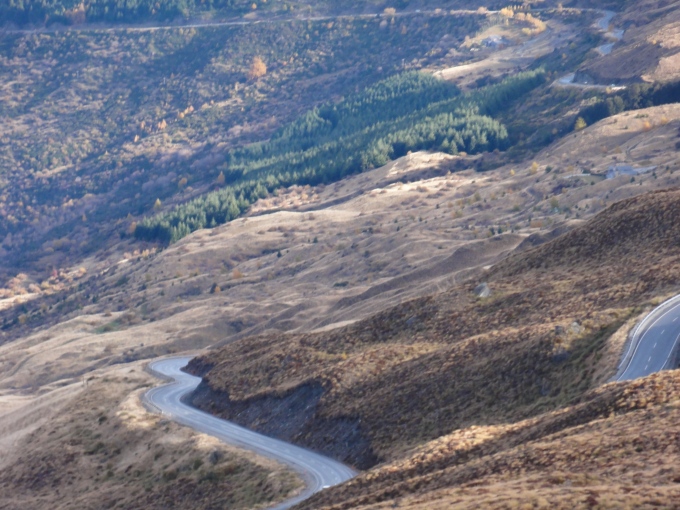
lookingdownfromcoronetpeak

And the story:

It was once said that a desperate man has everything to lose.

The man I was chasing was desperate, but I, on the other hand, was more desperate to catch him.

He’d left a trail of dead people from one end of the island to the other.

The team had put in a lot of effort to locate him, and now his capture was imminent.  We were following the car he was in, from a discreet distance, and, at the appropriate time, we would catch up, pull him over, and make the arrest.

There was nowhere for him to go.

The road led to a dead-end, and the only way off the mountain was back down the road we were now on.  Which was why I was somewhat surprised when we discovered where he was.

Where was he going?

“Damn,” I heard Alan mutter.  He was driving, being careful not to get too close, but not far enough away to lose sight of him.

“What?”

“I think he’s made us.”

“How?”

“Dumb bad luck, I’m guessing.  Or he expected we’d follow him up the mountain.  He’s just sped up.”

“How far away?”

“A half-mile.  We should see him higher up when we turn the next corner.”

It took an eternity to get there, and when we did, Alan was right, only he was further on than we thought.”

“Step on it.  Let’s catch him up before he gets to the top.”

Easy to say, not so easy to do.  The road was treacherous, and in places, just gravel, and there were no guard rails to stop a three-thousand-foot fall down the mountainside.

Good thing then, I had the foresight to have three agents on the hill for just such a scenario.

Ten minutes later, we were in sight of the car, still moving quickly, but we were going slightly faster.  We’d catch up just short of the summit car park.

Or so we thought.

Coming quickly around another corner, we almost slammed into the car we’d been chasing.

“What the hell…” Aland muttered.

I was out of the car and over to see if he was in it, but I knew that it was only a slender possibility.  The car was empty, and no indication of where he had gone.

Certainly not up the road.  It was relatively straightforward for the next mile, at which we would have reached the summit.  Up the mountainside from here, or down.

I looked up.  Nothing.

Alan yelled out, “He’s not going down, not that I can see, but if he did, there’s hardly a foothold and that’s a long fall.”

Then where did he go?

Then a man looking very much like our quarry came out from behind a rock embedded just a short distance up the hill.

“Sorry,” he said quite calmly.  “Had to go if you know what I mean.”

I’d lost him.

It was as simple as that.

I had been led a merry chase up the hill, and all the time he was getting away in a different direction.

I’d fallen for the oldest trick in the book, letting my desperation blind me to the disguise that anyone else would see through in an instant.

It was a lonely sight, looking down that road, knowing that I had to go all that way down again, only this time, without having to throw caution to the wind.

“Maybe next time,” Alan said.

“We’ll get him.  It’s just a matter of time.”

© Charles Heath 2019-2026

Find this and other stories in “Inspiration, maybe”, available soon.

InspirationMaybe1v1

365 Days of writing, 2026 – 105

Day 105 – Graphic novels

Beyond the Comic Strip: A Beginner’s Guide to Creating Your Own Graphic Novel

For a long time, the term “graphic novel” was met with a shrug. People thought of them as “just comic books”—fleeting entertainment for kids. But today, the graphic novel stands as a respected, powerful medium of literature. From memoirs like Persepolis to genre-bending epics like Watchmen, graphic novels prove that when you combine visual language with the written word, you unlock a storytelling potential that prose alone just can’t touch.

If you’ve ever dreamed of telling a story through panels, splash pages, and speech bubbles, you’re in the right place. Let’s break down what graphic novels actually are and how you can start crafting your own.


What Exactly is a Graphic Novel?

At its core, a graphic novel is a book-length narrative told through sequential art.

Unlike a comic book, which is typically a serialised, thin pamphlet released monthly, a graphic novel is a complete, self-contained story (or a collected volume) bound in a book format. It uses the visual medium—panels, gutters, character design, and colour theory—to control the pacing of the reader’s experience in a way that text-only books cannot.

In a graphic novel, the art isn’t just an “illustration” of the story; the art is the story.


How to Create Your Own Graphic Novel: A Step-by-Step Guide

Creating a graphic novel is a marathon, not a sprint. It’s a labour of love that requires patience and a fair bit of planning. Here is your roadmap from concept to finished product.

1. Develop Your “Hook” and Script

Every great graphic novel starts with an idea. But before you pick up a pencil, you need a script.

  • The Synopsis: Summarise your story in a few paragraphs. What is the central conflict? Who is the protagonist?
  • The Script: Write it like a screenplay, but include descriptions of what is happening in each panel. Keep your dialogue tight—remember, you have limited space on the page!

2. Character and World Design

Before you draw the first page, spend time in your sketchbook.

  • Character Sheets: Draw your characters from different angles and with different expressions. If they aren’t consistent, the reader will get confused.
  • World-Building: What does your setting feel like? Create a “visual bible” for your world so the architectural style and atmosphere remain cohesive throughout the book.

3. Thumbnails: The Blueprint

This is the most crucial step. Thumbnails are tiny, rough sketches of every page in your book. They don’t need to look good; they just need to map out the flow.

  • Where does the reader’s eye go?
  • Are the panels too crowded?
  • Does the page turn reveal an exciting surprise?
  • Pro-tip: Don’t skip this! Fixing a mistake in a thumbnail takes seconds; fixing it in an inked final page takes hours.

4. Pencilling and Inking

Now it’s time to commit to the paper (or screen).

  • Pencilling: Draft the layout, body proportions, and backgrounds cleanly.
  • Inking: Use fine-tip pens or digital brushes to finalise the lines. This gives the drawings weight and definition, making them “pop” off the page.

5. Lettering: The Silent Storyteller

Bad lettering can ruin great art. Make sure your word balloons are placed in the order they should be read (top to bottom, left to right). Use clear, readable fonts, and ensure there is enough “breathing room” around the text so the page doesn’t look cluttered.

6. Coloring (or Shading)

If you aren’t doing the book in black and white, this is where you solidify the mood. Colour is a powerful tool—cool blues can signal sadness, while jarring reds can indicate danger. If you’re sticking to black and white, focus on value—using shadows and hatching to create depth and contrast.


Final Thoughts: Just Start

The biggest hurdle isn’t the technical skill—it’s the daunting nature of the project. A graphic novel is a mountain of work, but you climb it one panel at a time.

Don’t aim for perfection on your first attempt. Aim for completion. Whether you’re using traditional pencils and ink or an iPad with Procreate, the most important tool you have is your voice.

So, what story are you going to draw first?

First Dig Two Graves

A sequel to “The Devil You Don’t”

Revenge is a dish best served cold – or preferably so when everything goes right

Of course, it rarely does, as Alistair, Zoe’s handler, discovers to his peril. Enter a wildcard, John, and whatever Alistair’s plan for dealing with Zoe was dies with him.

It leaves Zoe in completely unfamiliar territory.

John’s idyllic romance with a woman who is utterly out of his comfort zone is on borrowed time. She is still trying to reconcile her ambivalence after being so indifferent for so long.

They agree to take a break, during which she disappears. John, thinking she has left without saying goodbye, refuses to accept the inevitable and calls on an old friend for help in finding her.

After the mayhem and being briefly reunited, she recognises an inevitable truth: there is a price to pay for taking out Alistair; she must leave and find them first, and he would be wise to keep a low profile.

But keeping a low profile just isn’t possible, and enlisting another friend, a private detective and his sister, a deft computer hacker, they track her to the border between Austria and Hungary.

What John doesn’t realise is that another enemy is tracking him to find her too. It could have been a grand tour of Europe. Instead, it becomes a race against time before enemies old and new converge for what will be an inevitable showdown.

NaNoWriMo – April – 2026 – Day 32

Without the pressure of a time limit and no distractions, I was able to sit down and go over the plan for the last few chapters.

I had gotten to a point in the story where I was satisfied with what I’d written, but it did have ramifications later on, ramifications that were not in the original plan.

That later on, of course, is now, so once I’d looked at the plan and read the previous two chapters to get my bearings, it was easier to write.

But…

Isn’t there always a but?

As I was writing, another thought came to mind. Some time ago, I realised there needed to be another action sequence arising out of an event that had sparked an impromptu and ill-fated attempted kidnapping.

That had to be avenged, but in the rough draft I had already written, it didn’t figure in the ending.

Now it does, and I have written it, and it’s great.

Even if I say so myself.

Tomorrow I will be covering the fallout from this event.

An excerpt from “Strangers We’ve Become” – Coming Soon

I wandered back to my villa.

It was in darkness.  I was sure I had left several lights on, especially over the door so I could see to unlock it.

I looked up and saw the globe was broken.

Instant alert.

I went to the first hiding spot for the gun, and it wasn’t there.  I went to the backup and it wasn’t there either.  Someone had found my carefully hidden stash of weapons and removed them.

Who?

There were four hiding spots and all were empty.  Someone had removed the weapons.  That could only mean one possibility.

I had a visitor, not necessarily here for a social call.

But, of course, being the well-trained agent I’d once been and not one to be caught unawares, I crossed over to my neighbor and relieved him of a weapon that, if found, would require a lot of explaining.

Suitably armed, it was time to return the surprise.

There were three entrances to the villa, the front door, the back door, and a rather strange escape hatch.  One of the more interesting attractions of the villa I’d rented was its heritage.  It was built in the late 1700s, by a man who was, by all accounts, a thief.  It had a hidden underground room which had been in the past a vault but was now a wine cellar, and it had an escape hatch by which the man could come and go undetected, particularly if there was a mob outside the door baying for his blood.

It now gave me the means to enter the villa without my visitors being alerted, unless, of course, they were near the vicinity of the doorway inside the villa, but that possibility was unlikely.  It was not where anyone could anticipate or expect a doorway to be.

The secret entrance was at the rear of the villa behind a large copse, two camouflaged wooden doors built into the ground.  I move aside some of the branches that covered them and lifted one side.  After I’d discovered the doors and rusty hinges, I’d oiled and cleaned them, and cleared the passageway of cobwebs and fallen rocks.  It had a mildew smell, but nothing would get rid of that.  I’d left torches at either end so I could see.

I closed the door after me, and went quietly down the steps, enveloped in darkness till I switched on the torch.  I traversed the short passage which turned ninety degrees about halfway to the door at the other end.  I carried the key to this door on the keyring, found it and opened the door.  It too had been oiled and swung open soundlessly.

I stepped in the darkness and closed the door.

I was on the lower level under the kitchen, now the wine cellar, the ‘door’ doubling as a set of shelves which had very little on them, less to fall and alert anyone in the villa.

Silence, an eerie silence.

I took the steps up to the kitchen, stopping when my head was level with the floor, checking to see if anyone was waiting.  There wasn’t.  It seemed to me to be an unlikely spot for an ambush.

I’d already considered the possibility of someone coming after me, especially because it had been Bespalov I’d killed, and I was sure he had friends, all equally as mad as he was.  Equally, I’d also considered it nigh on impossible for anyone to find out it was me who killed him because the only people who knew that were Prendergast, Alisha, a few others in the Department, and Susan.

That raised the question of who told them where I was.

If I was the man I used to be, my first suspect would be Susan.  The departure this morning, and now this was too coincidental.  But I was not that man.

Or was I?

I reached the start of the passageway that led from the kitchen to the front door and peered into the semi-darkness.  My eyes had got used to the dark, and it was no longer an inky void.  Fragments of light leaked in around the door from outside and through the edge of the window curtains where they didn’t fit properly.  A bone of contention upstairs in the morning, when first light shone and invariably woke me up hours before I wanted to.

Still nothing.

I took a moment to consider how I would approach the visitor’s job.  I would get a plan of the villa in my head, all entrances, where a target could be led to or attacked where there would be no escape.

Coming in the front door.  If I was not expecting anything, I’d just open the door and walk-in.  One shot would be all that was required.

Contract complete.

I sidled quietly up the passage staying close to the wall, edging closer to the front door.  There was an alcove where the shooter could be waiting.  It was an ideal spot to wait.

Crunch.

I stepped on some nutshells.

Not my nutshells.

I felt it before I heard it.  The bullet with my name on it.

And how the shooter missed, from point-blank range, and hit me in the arm, I had no idea.  I fired off two shots before a second shot from the shooter went wide and hit the door with a loud thwack.

I saw a red dot wavering as it honed in on me and I fell to the floor, stretching out, looking up where the origin of the light was coming and pulled the trigger three times, evenly spaced, and a second later I heard the sound of a body falling down the stairs and stopping at the bottom, not very far from me.

Two assassins.

I’d not expected that.

The assassin by the door was dead, a lucky shot on my part.  The second was still breathing.

I checked the body for any weapons and found a second gun and two knives.  Armed to the teeth!

I pulled off the balaclava; a man, early thirties, definitely Italian.  I was expecting a Russian.

I slapped his face, waking him up.  Blood was leaking from several slashes on his face when his head had hit the stairs on the way down.  The awkward angle of his arms and legs told me there were broken bones, probably a lot worse internally.  He was not long for this earth.

“Who employed you?”

He looked at me with dead eyes, a pursed mouth, perhaps a smile.  “Not today my friend.  You have made a very bad enemy.”  He coughed and blood poured out of his mouth.  “There will be more …”

Friends of Bespalov, no doubt.

I would have to leave.  Two unexplainable bodies, I’d have a hard time explaining my way out of this mess.  I dragged the two bodies into the lounge, clearing the passageway just in case someone had heard anything.

Just in case anyone was outside at the time, I sat in the dark, at the foot of the stairs, and tried to breathe normally.  I was trying not to connect dots that led back to Susan, but the coincidence was worrying me.

A half-hour passed and I hadn’t moved.  Deep in thought, I’d forgotten about being shot, unaware that blood was running down my arm and dripping onto the floor.

Until I heard a knock on my front door.

Two thoughts, it was either the police, alerted by the neighbors, or it was the second wave, though why would they be knocking on the door?

I stood, and immediately felt a stabbing pain in my arm.  I took out a handkerchief and turned it into a makeshift tourniquet, then wrapped a kitchen towel around the wound.

If it was the police, this was going to be a difficult situation.  Holding the gun behind my back, I opened the door a fraction and looked out.

No police, just Maria.  I hoped she was not part of the next ‘wave’.

“You left your phone behind on the table.  I thought you might be looking for it.”  She held it out in front of her.

When I didn’t open the door any further, she looked at me quizzically, and then asked, “Is anything wrong?”

I was going to thank her for returning the phone, but I heard her breathe in sharply, and add, breathlessly, “You’re bleeding.”

I looked at my arm and realized it was visible through the door, and not only that, the towel was soaked in blood.

“You need to go away now.”

Should I tell her the truth?  It was probably too late, and if she was any sort of law-abiding citizen she would go straight to the police.

She showed no signs of leaving, just an unnerving curiosity.  “What happened?”

I ran through several explanations, but none seemed plausible.  I went with the truth.  “My past caught up with me.”

“You need someone to fix that before you pass out from blood loss.  It doesn’t look good.”

“I can fix it.  You need to leave.  It is not safe to be here with me.”

The pain in my arm was not getting any better, and the blood was starting to run down my arm again as the tourniquet loosened.  She was right, I needed it fixed sooner rather than later.

I opened the door and let her in.  It was a mistake, a huge mistake, and I would have to deal with the consequences.  Once inside, she turned on the light and saw the pool of blood just inside the door and the trail leading to the lounge.  She followed the trail and turned into the lounge, turned on the light, and no doubt saw the two dead men.

I expected her to scream.  She didn’t.

She gave me a good hard look, perhaps trying to see if I was dangerous.  Killing people wasn’t something you looked the other way about.  She would have to go to the police.

“What happened here?”

“I came home from the cafe and two men were waiting for me.  I used to work for the Government, but no longer.  I suspect these men were here to repay a debt.  I was lucky.”

“Not so much, looking at your arm.”

She came closer and inspected it.

“Sit down.”

She found another towel and wrapped it around the wound, retightening the tourniquet to stem the bleeding.

“Do you have medical supplies?”

I nodded.  “Upstairs.”  I had a medical kit, and on the road, I usually made my own running repairs.  Another old habit I hadn’t quite shaken off yet.

She went upstairs, rummaged, and then came back.  I wondered briefly what she would think of the unmade bed though I was not sure why it might interest her.

She helped me remove my shirt, and then cleaned the wound.  Fortunately, she didn’t have to remove a bullet.  It was a clean wound but it would require stitches.

When she’d finished she said, “Your friend said one day this might happen.”

No prizes for guessing who that friend was, and it didn’t please me that she had involved Maria.

“Alisha?”

“She didn’t tell me her name, but I think she cares a lot about you.  She said trouble has a way of finding you, gave me a phone and said to call her if something like this happened.”

“That was wrong of her to do that.”

“Perhaps, perhaps not.  Will you call her?”

“Yes.  I can’t stay here now.  You should go now.  Hopefully, by the time I leave in the morning, no one will ever know what happened here, especially you.”

She smiled.  “As you say, I was never here.”

© Charles Heath 2018-2022

strangerscover9

The cinema of my dreams – It all started in Venice – Episode 18

Observing the enemy

“She’s not talking,” the detective who had been trying to get answers to various questions said, after coming out of the room, looking somewhat exasperated.

I’d been watching him spar with her, and her legal representative was telling her that unless the police had concrete evidence, she need not answer any questions, except with a ‘No comment’.  Not once, though, did she ask to leave, which she could do at any time.

That was interesting.

“I’m not surprised.  Technically, she’s done nothing wrong yet.  Perhaps we need to ask some different questions.”

He sighed.  “Then, by all means, do so.  I’ve been told you know more about her connection to Larry Fortescue, a person we are very familiar with, but this is a connection we’re not fully across yet.  You are aware we found several crates in one of her warehouses with his name on them, one of which had several blocks of C4 in it.  She claims it’s not hers and has no idea who it got there, but the fact that she knows him in passing.”

Denying, as one would expect, that there was more to the relationship other than the acquaintanceship, and appropriate for so-called rival crime bosses.

“You have to admit, though, it’s not the sort of stuff your average beauty products salesperson would have lying around.”

Nominally, she called herself a beautician who runs a chain of so-called health clinics, which made the perfect front for other, more nefarious activities, allegedly.  No one had yet proved without a doubt that anything else happened there.

“These days, nothing would surprise me.  Some of the chemicals we also found could very easily be ingredients for bombs, but she had the permits, and it’s all accounted for.  This is the first time we’ve been able to pull her in.”

“A routine check, or a tip?”

“Actually, someone called the hotline to say that men who looked like terrorists in a white van were suspiciously unloading crates.  I kid you not, that was what we were told.”

Men who looked like terrorists.

“Now that Larry is implicated, we’ll be happy to share what we have.  He would be a far likelier owner of the explosive, and this is a rare mistake on his part to leave his name on the crate.  This is the first lead we have on how he keeps one step ahead of us, using others to hold his stuff and why we can never find it in his possession.  He’ll deny it’s his and that it’s one of his enemies setting him up.”

“We’ve been trying to find him.”

“He’s in Sorrento, Italy, visiting his mother, and no doubt combining business with pleasure.  It’s no coincidence she is there; he’s looking for me.”

“Then he’ll be out of luck.  Thanks for the info, I’ll get our people onto tracking him down.  He also has a few questions to answer.”

I looked at the screen on which I had been viewing the interview, noted the smug expression, and the body language that said she thought she was untouchable.

In a sense, she had every right to believe that.  She hadn’t been on Rodby’s radar until she took up with Larry.  Larry was Rodby’s obsession, which I never found out, and knew better than to ask.  Both she and Larry were well known to the police, and both had managed to keep out of jail because they were careful, though Larry had been far more careless in his younger days.

And for a person who was firmly entrenched, but more or less invisible in the criminal landscape, joining with Larry was her biggest mistake.

Rodby had brought a file with him, and I read it in the car on the way here, and it was another very thorough deep dive into a woman who, for all intents and purposes, was nothing like who she portrayed in real life.

A woman with secrets she believed were still intact.

Secrets I could use to gain some leverage, not that I ever liked doing so, because often it involved innocents caught up in a world, not of their choice.

But she chose to be a criminal, and there were always consequences, unintended or otherwise.

Enough thinking, it was time.

© Charles Heath 2022