Over the years, I have traveled extensively and kept journals, with the idea that one day all of those places would become locations in books. Notebooks filled with odd characters, people and incidents observed, and whole tracts of stories written when the on the spot inspiration has been a driving force.
All of this is the basis of the first three novels, Sunday In New York, set, of course, in New York, probably my favorite city in the world, “Echoes From The Past’ equally set in New York, Brooklyn Heights and Philadelphia. The third, The Devil You Don’t, travels through Europe, starting in Geneva, moving to Rome, then Sorrento, and then to Venice.
Now, my passion to write is fuelled by travel and fine dining. When I take a break from these, I get to torment my three wonderful grandchildren whom I actively encourage to read as much as they can, and more recently to also write.
As for almost every other writer, I would not be able to do any of this without my wife who has put up with my moodiness, the times when I'm locked away in a room trying to push out another 2,000 words, and yet despite everything still puts up with me.
I wish I could say the same for our cat. Alas, I am still trying to work out how to be his friend!
Without the pressure of a time limit and no distractions, I was able to sit down and go over the plan for the last few chapters.
I had gotten to a point in the story where I was satisfied with what I’d written, but it did have ramifications later on, ramifications that were not in the original plan.
That later on, of course, is now, so once I’d looked at the plan and read the previous two chapters to get my bearings, it was easier to write.
But…
Isn’t there always a but?
As I was writing, another thought came to mind. Some time ago, I realised there needed to be another action sequence arising out of an event that had sparked an impromptu and ill-fated attempted kidnapping.
That had to be avenged, but in the rough draft I had already written, it didn’t figure in the ending.
Now it does, and I have written it, and it’s great.
Even if I say so myself.
Tomorrow I will be covering the fallout from this event.
There is always something to see, especially when you are told, ‘nothing to see here, move along’.
That’s the question every thriller/mystery writer wants to get to the bottom of by the end of the story.
As a rule, it’s never really what you see or what you think you see, but it can be hiding in plain sight.
Someone once told me that we are trained to see what we want to see, often not what it is that’s there in front of us.
Like reading a story with spelling errors, gaps, and bad punctuation, our eyes gloss over those errors because we’re trained to read words quickly using only a few letters.
It’s why we sometimes misinterpret words and find ourselves up that proverbial garden path. I know I have done it myself. I know those apps that predict the word you want to use but invariably display the wrong one are as flawed as our eyes and brains can be at times, so I try not to use them.
A good detective looks beneath the surface to see what others don’t.
You look at a shop window and see several products on sale at ridiculously low prices.
A detective looks at the same store window and sees the third dress along on the rack of sale items had a blood stain on the bottom hemline, and deduces the dress was worn by the murderer of a bystander.
Someone in the shop, customer, or employee had a case to answer.
Then, sometimes, we can’t see the wood for the trees. It’s an interesting expression, but quite true.
Any time I visit a new place, I try to get as much visitor information as possible, and then, based on the description, go visit.
How many times have I been disappointed? A few. What they sometimes describe is the ambience, which may be there when there are fewer people about, but not when there are so many you cannot enjoy the view, the sidewalk cafes, and most of all the ambience.
This is translated into your writing, and I like the idea of depicting a place so that if you decide to go there, you see what I see, and not necessarily what the brochures tell you.
Then, of course, there is ‘beauty is in the eye of the beholder’. That is not easy to convey in words, but I’m working on it.
Beyond the Comic Strip: A Beginner’s Guide to Creating Your Own Graphic Novel
For a long time, the term “graphic novel” was met with a shrug. People thought of them as “just comic books”—fleeting entertainment for kids. But today, the graphic novel stands as a respected, powerful medium of literature. From memoirs like Persepolis to genre-bending epics like Watchmen, graphic novels prove that when you combine visual language with the written word, you unlock a storytelling potential that prose alone just can’t touch.
If you’ve ever dreamed of telling a story through panels, splash pages, and speech bubbles, you’re in the right place. Let’s break down what graphic novels actually are and how you can start crafting your own.
What Exactly is a Graphic Novel?
At its core, a graphic novel is a book-length narrative told through sequential art.
Unlike a comic book, which is typically a serialised, thin pamphlet released monthly, a graphic novel is a complete, self-contained story (or a collected volume) bound in a book format. It uses the visual medium—panels, gutters, character design, and colour theory—to control the pacing of the reader’s experience in a way that text-only books cannot.
In a graphic novel, the art isn’t just an “illustration” of the story; the art is the story.
How to Create Your Own Graphic Novel: A Step-by-Step Guide
Creating a graphic novel is a marathon, not a sprint. It’s a labour of love that requires patience and a fair bit of planning. Here is your roadmap from concept to finished product.
1. Develop Your “Hook” and Script
Every great graphic novel starts with an idea. But before you pick up a pencil, you need a script.
The Synopsis: Summarise your story in a few paragraphs. What is the central conflict? Who is the protagonist?
The Script: Write it like a screenplay, but include descriptions of what is happening in each panel. Keep your dialogue tight—remember, you have limited space on the page!
2. Character and World Design
Before you draw the first page, spend time in your sketchbook.
Character Sheets: Draw your characters from different angles and with different expressions. If they aren’t consistent, the reader will get confused.
World-Building: What does your setting feel like? Create a “visual bible” for your world so the architectural style and atmosphere remain cohesive throughout the book.
3. Thumbnails: The Blueprint
This is the most crucial step. Thumbnails are tiny, rough sketches of every page in your book. They don’t need to look good; they just need to map out the flow.
Where does the reader’s eye go?
Are the panels too crowded?
Does the page turn reveal an exciting surprise?
Pro-tip: Don’t skip this! Fixing a mistake in a thumbnail takes seconds; fixing it in an inked final page takes hours.
4. Pencilling and Inking
Now it’s time to commit to the paper (or screen).
Pencilling: Draft the layout, body proportions, and backgrounds cleanly.
Inking: Use fine-tip pens or digital brushes to finalise the lines. This gives the drawings weight and definition, making them “pop” off the page.
5. Lettering: The Silent Storyteller
Bad lettering can ruin great art. Make sure your word balloons are placed in the order they should be read (top to bottom, left to right). Use clear, readable fonts, and ensure there is enough “breathing room” around the text so the page doesn’t look cluttered.
6. Coloring (or Shading)
If you aren’t doing the book in black and white, this is where you solidify the mood. Colour is a powerful tool—cool blues can signal sadness, while jarring reds can indicate danger. If you’re sticking to black and white, focus on value—using shadows and hatching to create depth and contrast.
Final Thoughts: Just Start
The biggest hurdle isn’t the technical skill—it’s the daunting nature of the project. A graphic novel is a mountain of work, but you climb it one panel at a time.
Don’t aim for perfection on your first attempt. Aim for completion. Whether you’re using traditional pencils and ink or an iPad with Procreate, the most important tool you have is your voice.
We have visited Venice twice, in 2006 and not so long ago.
Not much had changed from visit to visit.
Instead of staying in a hotel selected by a travel agent, the Savoia and Jolanda on the waterfront of Riva Degli Schiavoni, because I’m a Hilton Honors member, more recently we stayed at the Hilton Molino Stucky. It was located on an island, Giudecca, and had its own transport from the hotel to St Mark’s Square for a very reasonable one-off charge for the stay.
On our first visit, we traveled from Florence to Venice. We were advised to take a water taxi to the hotel, not only the most direct route but to see some of Venice from the water. The only drawback, you have to negotiate a price with the driver.
We were not very good negotiators, and it cost 60 Euros.
But, despite the cost, it was worth every Euro because the taxi driver took us by the scenic route, directly from the Station to the doorstep of our hotel. For a first time in Venice, and you want to see it from the water, a water taxi is the best option.
The first time we stayed at the Savoia and Jolanda Hotel, which was at the time quite old, and the room we had, on the ground floor, was comfortable enough, but being November, they had just stopped using the air conditioning, it was still quite warm and at times uncomfortable.
There were better rooms, but this was beyond the knowledge of the travel agent, and one of the reasons we stopped using agents to book hotels.
The most recent visit we had driven down from Salzburg to Venice airport where we had to return the hire car. From there we were intending to take a private water taxi from the airport to the hotel, for an estimated 120 Euros.
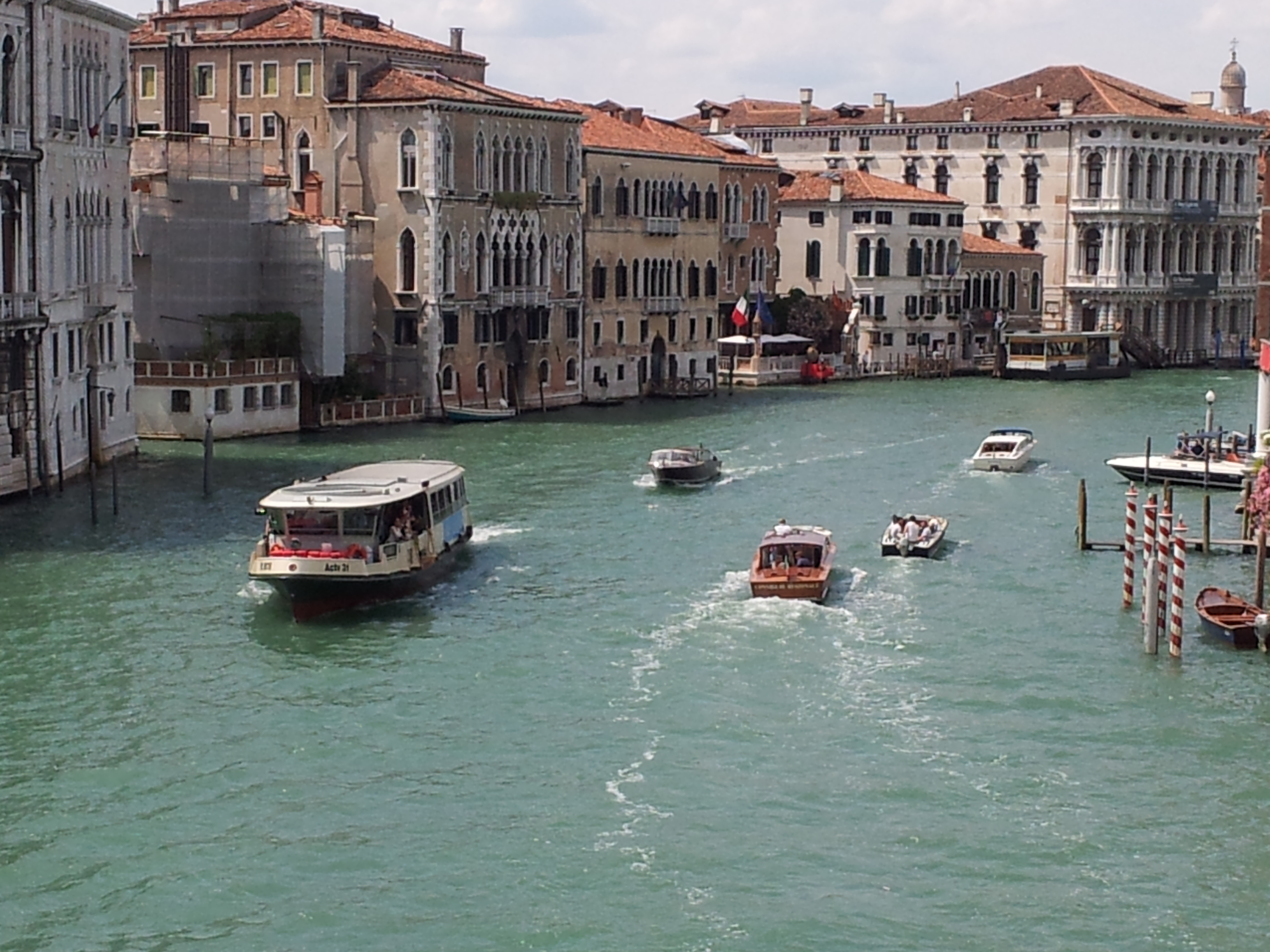
We saved our money and took the ACTV public waterbus, from the airport to the hotel, with one stop. It took a little over an hour and was equally as scenic.
Our room in the Hilton was on one of the upper levels, floor four, and had a view of the canal, the large passenger ships coming and going, as well as a remarkable view of Venice itself as far up the canal to St Marks Square in one direction, and the port for the passenger ships in the other.
We got to see three or four very large passenger ships come and go, along with a lot of other craft. I hadn’t realized how busy the waterways, and the Grand Canal, were.
Each evening after a day’s exploring we would end up in the Executive Lounge, and then one of the many restaurants, usually Il Molino for breakfast, and the Rialto Lobby Bar and Lounge for dinner. After that, it was a stroll down the waterfront taking in the night air, and perhaps to walk off the delicious dinner.
I’m on a riverboat, sailing slowly down the Nile, ahead of us the Pyramids, a sight, I’m told, to behold despite the ravages of time.
There are others, a curious bunch of people, drawn from all over the globe, and from different classes, in a time when that seemed to matter.
Of course, it’s 1935.
And it’s all in my head. Something I’d seen somewhere, or read perhaps, and now that I come to think of it, it was an Agatha Christie murder mystery.
Even now, nearly a hundred years later, it may have been possible to replicate it; only a world war, British Empire aspirations and later abandonment, and civil strife made it difficult, but not impossible.
And then, closing off travel anywhere, COVID-19 finished the job.
For someone who likes to travel the world, looking for locations and inspiration for my stories, that had made life far more unbearable than just having to remain locked up for fear of catching it. And, even though it is gone, we now seem to have was popping up everywhere, closing off things that we just took for granted would be there forever.
Not any more. Nationalism, greed, and in some cases, utter stupidity, are closing off countries that are no longer safe to visit. Even the United States was once thought to be the safest place on earth.
Gone are those treasured moments…
Like sitting at an outside cafe overlooking the main piazza in San Gimignano, having a pizza, an authentic pizza, and a bottle of Moretti beer.
Like wandering the narrow cobbled streets of Florence, staying in what was once a 12th-century monastery, having wild boar pasta, and just a short distance away, a gelato.
Like wandering around similarly narrow and cobbled laneways in Montmartre, stopping at a corner crepe restaurant, where the crepes are to die for.
Taking that away is like taking away a hand or a leg.
How long will it be before the world returns to normal, or will it?
In my conspiracy theory mind, it seems to me there is more going on than just viruses and greed; it has overtones of world domination, or worse, watching the destruction of the world economy, and capitalism for want of a better word, at the same pace that climate change is changing the planet.
Neither occurrence is new; it’s happened time and time again over many millennia, and it’s just that we don’t seem to learn from it.
With my attention elsewhere, I walked into a man who was hurrying in the opposite direction. He was a big man with a scar running down the left side of his face from eye socket to mouth, and who was also wearing a black shirt with a red tie.
That was all I remembered as my heart almost stopped.
He apologized as he stepped to one side, the same way I stepped, as I also muttered an apology.
I kept my eyes down. He was not the sort of man I wanted to recognize later in a lineup. I stepped to the other side and so did he. It was one of those situations. Finally getting out of sync, he kept going in his direction, and I towards the bus, which was now pulling away from the curb.
Getting my breath back, I just stood riveted to the spot watching it join the traffic. I looked back over my shoulder, but the man I’d run into had gone. I shrugged and looked at my watch. It would be a few minutes before the next bus arrived.
Wait, or walk? I could also go by subway, but it was a long walk to the station. What the hell, I needed the exercise.
At the first intersection, the ‘Walk’ sign had just flashed to ‘Don’t Walk’. I thought I’d save a few minutes by not waiting for the next green light. As I stepped onto the road, I heard the screeching of tires.
A yellow car stopped inches from me.
It was a high powered sports car, perhaps a Lamborghini. I knew what they looked like because Marcus Bartleby owned one, as did every other junior executive in the city with a rich father.
Everyone stopped to look at me, then the car. It was that sort of car. I could see the driver through the windscreen shaking his fist, and I could see he was yelling too, but I couldn’t hear him. I stepped back onto the sidewalk, and he drove on. The moment had passed and everyone went back to their business.
My heart rate hadn’t come down from the last encounter. Now it was approaching cardiac arrest, so I took a few minutes and several sets of lights to regain composure.
At the next intersection, I waited for the green light, and then a few seconds more, just to be sure. I was no longer in a hurry.
At the next, I heard what sounded like a gunshot. A few people looked around, worried expressions on their faces, but when it happened again, I saw it was an old car backfiring. I also saw another yellow car, much the same as the one before, stopped on the side of the road. I thought nothing of it, other than it was the second yellow car I’d seen.
At the next intersection, I realized I was subconsciously heading towards Harry’s new bar. It was somewhere on 6th Avenue, so I continued walking in what I thought was the right direction.
I don’t know why I looked behind me at the next intersection, but I did. There was another yellow car on the side of the road, not far from me. It, too, looked the same as the original Lamborghini, and I was starting to think it was not a coincidence.
Moments after crossing the road, I heard the roar of a sports car engine and saw the yellow car accelerate past me. As it passed by, I saw there were two people in it, and the blurry image of the passenger; a large man with a red tie.
Now my imagination was playing tricks.
It could not be the same man. He was going in a different direction.
In the few minutes I’d been standing on the pavement, it had started to snow; early for this time of year, and marking the start of what could be a long cold winter. I shuddered, and it was not necessarily because of the temperature.
I looked up and saw a neon light advertising a bar, coincidentally the one Harry had ‘found’ and, looking once in the direction of the departing yellow car, I decided to go in. I would have a few drinks and then leave by the back door if it had one.
Venice is definitely a city to explore. It has an incredible number of canals and walkways, and each time we would start our exploration at St Marks square when it’s not underwater
Everyone I have spoken to about exploring Venice has told me how easy it is to get lost. It has not happened to me, but with the infinite number of ways you can go, I guess it is possible.
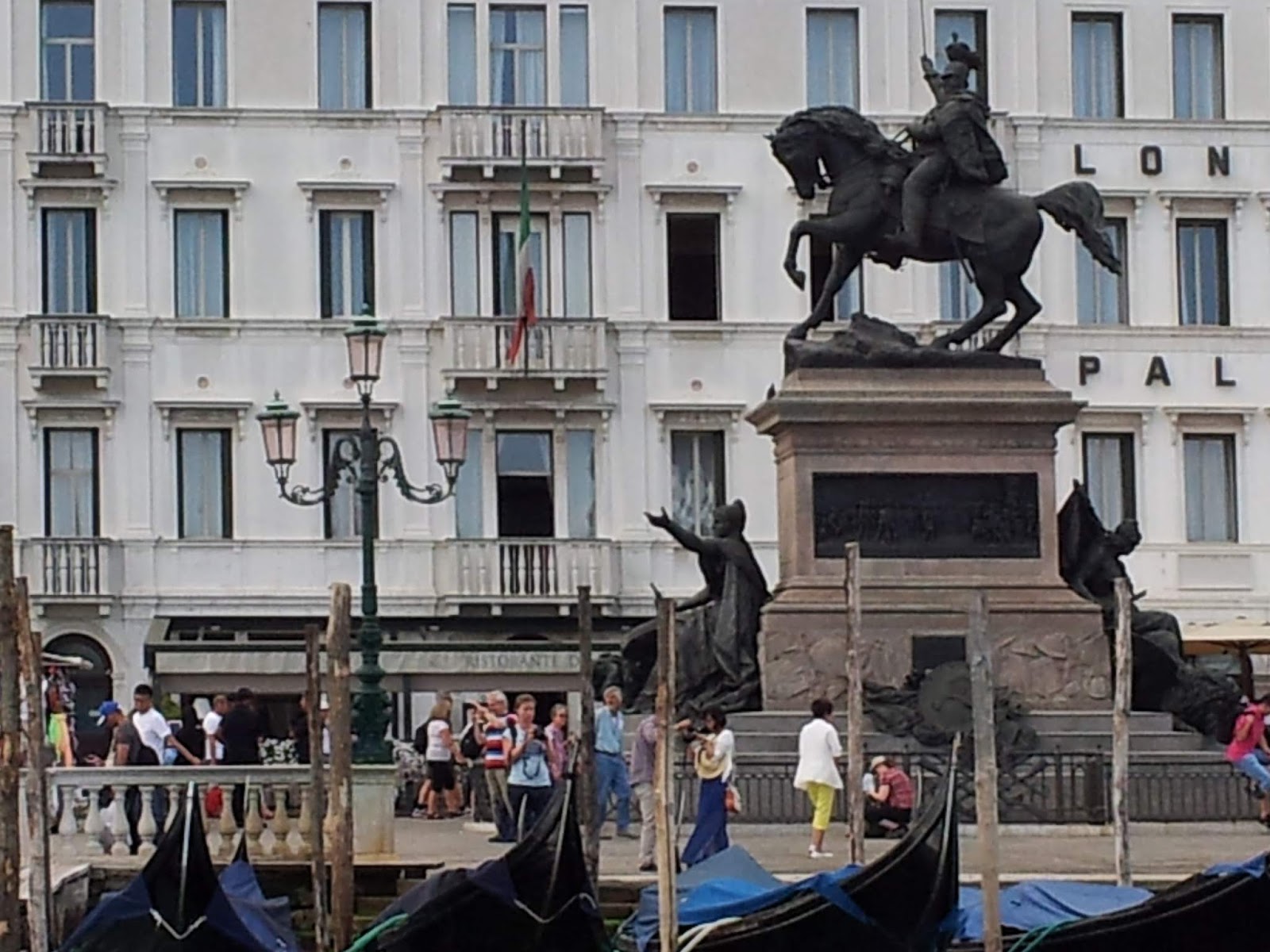
We started our exploration of Venice in St Marks square, where, on one side there was the Museo di Palazzo Ducale and, next door, the Basilica di San Marco. Early morning and/or at high tide, water can be seen bubbling up from under the square, partially flooding it. I have seen this happen several times. Each morning as we walked from the hotel (the time we stayed in the Savoia and Jolanda) we passed the Bridge of Sighs.
Around the other three sides of the square are archways and shops. We have bought both confectionary and souvenirs from some of these stores, albeit relatively expensive. Prices are cheaper in stores that are away from the square and we found some of these when we walked from St Marks square to the Railway station, through many walkways, and crossing many bridges, and passing through a number of small piazzas.
That day, after the trek, we caught the waterbus back to San Marco, and then went on the tour of the Museo di Palazzo Du which included the dungeons and the Bridge of Sighs from the inside. It took a few hours, longer than I’d anticipated because there was so much to see.
The next day, we caught the waterbus from San Marco to the Ponte di Rialto bridge. Just upstream from the wharf there was a very large passenger ship, and I noticed there were a number of passengers from the ship on the waterbus, one of whom spoke to us about visiting Venice. I didn’t realize we looked like professional tourists who knew where we were going.
After a pleasant conversation, and taking in the views up and down the Grand Canal, we disembarked and headed for the bridge, looking at the shops, mostly selling upmarket and expensive gifts, and eventually crossing to the other side where there was a lot of small market type stalls selling souvenirs as well as clothes, and most importantly, it being a hot day, cold Limonata. This was my first taste of Limonata and I was hooked.
Continuing on from there was a wide street at the end and a number of restaurants where we had lunch. We had a map of Venice and I was going to plot a course back to the hotel, taking what would be a large circular route that would come out at the Accademia Bridge, and further on to the Terminal Fusina Venezia where there was another church to explore, the Santa Maria del Rosario.
This is a photo of the Hilton Hotel from the other side of the canal.
It was useful knowledge for the second time we visited Venice because the waterbus from the Hilton hotel made its first stop, before San Marco, there. We also discovered on that second visit a number of restaurants on the way from the terminal and church to the Accademia Bridge.
This is looking back towards San Marco from the Accademia Bridge:
And this, looking towards the docks:
Items to note:
Restaurants off the beaten track were much cheaper and the food a lot different to that in the middle of the tourist areas.
There are a lot of churches, big and small, tucked away in interesting spots where there are small piazza’s. You can look in all of them, though some asked for a small fee.
Souvenirs, coffee, and confectionary are very expensive in St Marks square.
50 photographs, 50 stories, of which there is one of the 50 below.
They all start with –
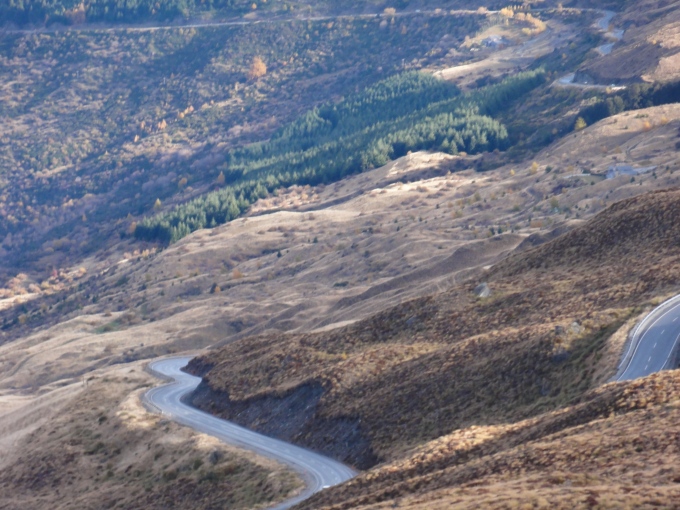
A picture paints … well, as many words as you like. For instance:
And the story:
…
It was once said that a desperate man has everything to lose.
The man I was chasing was desperate, but I, on the other hand, was more desperate to catch him.
He’d left a trail of dead people from one end of the island to the other.
The team had put in a lot of effort to locate him, and now his capture was imminent. We were following the car he was in, from a discreet distance, and, at the appropriate time, we would catch up, pull him over, and make the arrest.
There was nowhere for him to go.
The road led to a dead-end, and the only way off the mountain was back down the road we were now on. Which was why I was somewhat surprised when we discovered where he was.
Where was he going?
“Damn,” I heard Alan mutter. He was driving, being careful not to get too close, but not far enough away to lose sight of him.
“What?”
“I think he’s made us.”
“How?”
“Dumb bad luck, I’m guessing. Or he expected we’d follow him up the mountain. He’s just sped up.”
“How far away?”
“A half-mile. We should see him higher up when we turn the next corner.”
It took an eternity to get there, and when we did, Alan was right, only he was further on than we thought.”
“Step on it. Let’s catch him up before he gets to the top.”
Easy to say, not so easy to do. The road was treacherous, and in places, just gravel, and there were no guard rails to stop a three-thousand-foot fall down the mountainside.
Good thing then, I had the foresight to have three agents on the hill for just such a scenario.
Ten minutes later, we were in sight of the car, still moving quickly, but we were going slightly faster. We’d catch up just short of the summit car park.
Or so we thought.
Coming quickly around another corner, we almost slammed into the car we’d been chasing.
“What the hell…” Aland muttered.
I was out of the car and over to see if he was in it, but I knew that it was only a slender possibility. The car was empty, and no indication of where he had gone.
Certainly not up the road. It was relatively straightforward for the next mile, at which we would have reached the summit. Up the mountainside from here, or down.
I looked up. Nothing.
Alan yelled out, “He’s not going down, not that I can see, but if he did, there’s hardly a foothold and that’s a long fall.”
Then where did he go?
Then a man looking very much like our quarry came out from behind a rock embedded just a short distance up the hill.
“Sorry,” he said quite calmly. “Had to go if you know what I mean.”
I’d lost him.
It was as simple as that.
I had been led a merry chase up the hill, and all the time he was getting away in a different direction.
I’d fallen for the oldest trick in the book, letting my desperation blind me to the disguise that anyone else would see through in an instant.
It was a lonely sight, looking down that road, knowing that I had to go all that way down again, only this time, without having to throw caution to the wind.
Beyond the Comic Strip: A Beginner’s Guide to Creating Your Own Graphic Novel
For a long time, the term “graphic novel” was met with a shrug. People thought of them as “just comic books”—fleeting entertainment for kids. But today, the graphic novel stands as a respected, powerful medium of literature. From memoirs like Persepolis to genre-bending epics like Watchmen, graphic novels prove that when you combine visual language with the written word, you unlock a storytelling potential that prose alone just can’t touch.
If you’ve ever dreamed of telling a story through panels, splash pages, and speech bubbles, you’re in the right place. Let’s break down what graphic novels actually are and how you can start crafting your own.
What Exactly is a Graphic Novel?
At its core, a graphic novel is a book-length narrative told through sequential art.
Unlike a comic book, which is typically a serialised, thin pamphlet released monthly, a graphic novel is a complete, self-contained story (or a collected volume) bound in a book format. It uses the visual medium—panels, gutters, character design, and colour theory—to control the pacing of the reader’s experience in a way that text-only books cannot.
In a graphic novel, the art isn’t just an “illustration” of the story; the art is the story.
How to Create Your Own Graphic Novel: A Step-by-Step Guide
Creating a graphic novel is a marathon, not a sprint. It’s a labour of love that requires patience and a fair bit of planning. Here is your roadmap from concept to finished product.
1. Develop Your “Hook” and Script
Every great graphic novel starts with an idea. But before you pick up a pencil, you need a script.
The Synopsis: Summarise your story in a few paragraphs. What is the central conflict? Who is the protagonist?
The Script: Write it like a screenplay, but include descriptions of what is happening in each panel. Keep your dialogue tight—remember, you have limited space on the page!
2. Character and World Design
Before you draw the first page, spend time in your sketchbook.
Character Sheets: Draw your characters from different angles and with different expressions. If they aren’t consistent, the reader will get confused.
World-Building: What does your setting feel like? Create a “visual bible” for your world so the architectural style and atmosphere remain cohesive throughout the book.
3. Thumbnails: The Blueprint
This is the most crucial step. Thumbnails are tiny, rough sketches of every page in your book. They don’t need to look good; they just need to map out the flow.
Where does the reader’s eye go?
Are the panels too crowded?
Does the page turn reveal an exciting surprise?
Pro-tip: Don’t skip this! Fixing a mistake in a thumbnail takes seconds; fixing it in an inked final page takes hours.
4. Pencilling and Inking
Now it’s time to commit to the paper (or screen).
Pencilling: Draft the layout, body proportions, and backgrounds cleanly.
Inking: Use fine-tip pens or digital brushes to finalise the lines. This gives the drawings weight and definition, making them “pop” off the page.
5. Lettering: The Silent Storyteller
Bad lettering can ruin great art. Make sure your word balloons are placed in the order they should be read (top to bottom, left to right). Use clear, readable fonts, and ensure there is enough “breathing room” around the text so the page doesn’t look cluttered.
6. Coloring (or Shading)
If you aren’t doing the book in black and white, this is where you solidify the mood. Colour is a powerful tool—cool blues can signal sadness, while jarring reds can indicate danger. If you’re sticking to black and white, focus on value—using shadows and hatching to create depth and contrast.
Final Thoughts: Just Start
The biggest hurdle isn’t the technical skill—it’s the daunting nature of the project. A graphic novel is a mountain of work, but you climb it one panel at a time.
Don’t aim for perfection on your first attempt. Aim for completion. Whether you’re using traditional pencils and ink or an iPad with Procreate, the most important tool you have is your voice.
Revenge is a dish best served cold – or preferably so when everything goes right
Of course, it rarely does, as Alistair, Zoe’s handler, discovers to his peril. Enter a wildcard, John, and whatever Alistair’s plan for dealing with Zoe was dies with him.
It leaves Zoe in completely unfamiliar territory.
…
John’s idyllic romance with a woman who is utterly out of his comfort zone is on borrowed time. She is still trying to reconcile her ambivalence after being so indifferent for so long.
They agree to take a break, during which she disappears. John, thinking she has left without saying goodbye, refuses to accept the inevitable and calls on an old friend for help in finding her.
After the mayhem and being briefly reunited, she recognises an inevitable truth: there is a price to pay for taking out Alistair; she must leave and find them first, and he would be wise to keep a low profile.
But keeping a low profile just isn’t possible, and enlisting another friend, a private detective and his sister, a deft computer hacker, they track her to the border between Austria and Hungary.
What John doesn’t realise is that another enemy is tracking him to find her too. It could have been a grand tour of Europe. Instead, it becomes a race against time before enemies old and new converge for what will be an inevitable showdown.







 Thrills, Spills, and just a dash of Romance